
Entering Türkiye: a staged protocol for Iranian pharmaceutical companies, with the case of CinnaGen
Show affiliations
- Department of International Operations, Ramopharmin Pharmaceutical Co., Ankara, Türkiye
Journal of Pharmaceutical Enterprise · Volume 1 (2026) · Article e2026001 · J Pharm Enterp. 2026;1:e2026001
Abstract
Iranian pharmaceutical manufacturers looking to Türkiye meet a regulated market and a sanctions environment at once. The state sets prices, one public insurer pays for most medicine spending, and payments connected with Iran fall under United States and European Union sanctions law. Theories of entry mode and staged internationalization offer no procedure with decision gates for such an entrant.
This single-case study read, from public documents only, the Turkish trade-registry record of CinnaGen İlaç from 2014 to 2026, a company founded by the chief executive of an Iranian biopharmaceutical group. It was set against Türkiye's rules on licensing, inspection of foreign sites for good manufacturing practice, pricing, reimbursement and company law, and against other foreign manufacturers' entries.
A Singapore company held 90% of CinnaGen İlaç from 2018, a Turkish individual all its shares from 2024, and a private equity fund 55% by January 2026. In the notices read, set-off of shareholders' receivables paid 148,490,800 of the 179,950,000 Turkish lira by which capital grew from 2014 to 2020. The company was renamed three times and continues, with its plant. The article derives a protocol of ten stages, each closed by a gate that passes, holds or stops: purpose and fit; compliance and banking feasibility; market, price and reimbursement case; regulatory route; entry mode; legal vehicle, ownership and control; financing; build, license, price, list; export base; and review of scale, hold or exit. The lessons are to fix Türkiye's role first, obtain legal and bank clearance in writing before any other commitment, document ownership up to natural persons, fund through channels banks will process, and plan exit from the start.
The evidence is one case in public documents. The protocol was derived and has not yet been tested on an entry, and it reflects the rules in force in November 2026.
1. Introduction
Iranian pharmaceutical manufacturers work under sanctions that bind on banking, payments and imported inputs. Medicines are formally exempt, yet restrictions on money transfers and insurance have forced Iranian companies to pay cash in advance for imported medicines and raw materials, and credit for such imports has been extremely difficult to obtain [1]. The industry is exposed at exactly that point. Domestic manufacturers produced 96% of the country's generic medicines but relied on imported raw materials and active pharmaceutical ingredients, as Setayesh and Mackey report from earlier sources [2]. The same authors cite a currency that lost two-thirds of its value against the US dollar from 2010, inflation of 40–50% in 2013 and medicine price rises of 30–40% [2]. Supply was affected. In a sample of 26 medicines and medicine groups for non-communicable diseases, market availability fell significantly for 13 after the banking sanctions of 2011 and the sanctions on the Central Bank of Iran in 2012 [3]. Imported drugs, and drugs made from imported raw materials, were the more likely to be affected [3]. The industry has nonetheless built real capability. By 2012, newly established, science-based Iranian companies were manufacturing biopharmaceuticals, and about six non-originator biopharmaceuticals had been registered in Iran since 2003 through a national, case-by-case route [4]. In the same author's view, biosimilars developed outside the EU and the US had a very low chance of approval as biosimilars by the EMA or the FDA [4].
Firms from such home economies have reasons to go abroad beyond selling more. Luo and Tung describe an international springboard, a strategy by which a firm from an emerging economy catches up with established rivals relatively quickly by seeking strategic assets and opportunities abroad and by benefiting from favourable institutions in foreign countries [5]. In their account, such firms expand abroad to acquire resources that compensate for gaps in their capabilities and to ease institutional and market constraints at home [5]. Witt and Lewin, writing about advanced economies, treat outward investment as one form of escape, a partial or complete departure from a home business system whose institutions no longer fit a firm's needs [6]. Mathews argues that latecomer multinationals from the Asia-Pacific region internationalised to gain resources through links with external firms, and that partnerships and joint ventures were their usual way of reducing the risk of entry [7]. A constrained home market can also leave a capability that a firm can use abroad. Every foreign entrant bears a liability of foreignness, the extra cost of operating in a country as an outsider to it [8]. Multinationals from developing countries were more prevalent among the largest foreign affiliates in least developed countries with weaker regulatory quality [8]. They still favoured host countries with a stronger rule of law [8].
Sanctions shape how such firms can go abroad. Meyer and colleagues define sanctions as nonmilitary coercive measures imposed by a country or a group of countries against another country, organisation or individuals [9]. Secondary sanctions are penalties imposed on third parties for failing to comply with a sanctions regime, and firms in third countries weigh that risk when deciding whether to deal with a sanctioned economy [9]. The effect on trading partners can be measured. After new EU measures against Iran in January 2012, the monthly number of French firms exporting to Iran fell from 457 to 276, and firms that relied more heavily on trade finance were hit harder [10]. Iranian exporters, for their part, changed where they sold. After the export sanctions of March 2008, they redirected an estimated two-thirds of the export value lost in sanctioning countries to countries that imposed no sanctions [9,11]. Larger and more experienced exporters redirected more, and exporters already present in an alternative destination did so more easily [11]. The move had a price, since unit prices in the first shipment after redirection were 7.4% lower on average [11]. Sanctions also change the decisions of firms already established abroad. Of 22 Western multinationals with subsidiaries in Russia after February 2022, ten divested, four froze operations and eight stayed [12]. The pharmaceutical firm in that sample froze new clinical trials and new investment while keeping its operations [12].
Türkiye, Iran's neighbour, is a large and regulated destination for an Iranian manufacturer. It was the world's 19th-largest pharmaceutical market in 2024, at USD 11.5 billion, according to a sector report prepared by IQVIA for AIFD, the association of research-based pharmaceutical companies in Türkiye [13]. Medicines produced in Türkiye held 55.4% of the market by value and 92.8% by volume in 2025, in the figures of İEİS, the employers' association of Turkish pharmaceutical manufacturers [14]. The inspectorate of TİTCK, the Turkish Medicines and Medical Devices Agency, has been a participating authority of the Pharmaceutical Inspection Co-operation Scheme (PIC/S), the scheme through which national inspectorates of good manufacturing practice (GMP) co-operate, since January 2018 [15]. Iran's Food and Drug Administration has been listed with the same accession date [15]. Türkiye also favours local manufacture. İEİS dates the country's localisation policy, which favours medicines produced in Türkiye, to 2016 [14], and the European Union challenged that policy at the World Trade Organisation (WTO) in 2019 [16]. Pharmaceutical trade between the two countries already flows mainly one way. Türkiye reported pharmaceutical exports to Iran of USD 92.0 million in 2024 and imports from Iran of USD 1.4 million, in UN Comtrade data [17], and Iran was among the ten largest destinations of Turkish pharmaceutical exports that year [13].
Entry-mode theory explains how a firm chooses its route into such a market. An entry mode is the arrangement through which a firm serves a foreign market, from exporting and licensing to contract manufacturing (producing under contract for another company), joint ventures, acquisition and building its own plant [18,19]. Anderson and Gatignon framed the choice as a trade-off between control and the cost of committing resources, often under considerable risk and uncertainty [18]. A review of the empirical work found that no single mode performs best, while firms whose choices matched theoretical predictions performed better [19]. Hennart argues that the mode depends on how easily the local assets an entrant needs, such as distribution, permits and licences, can be traded, as well as on its own knowledge [20]. Where a permit cannot be bought on its own, acquiring or forming a joint venture with the firm that holds it may be the only access route [20]. Staged-internationalization theory explains entry as a sequence of growing commitments. In the Uppsala model, firms move from exporting through an agent to a sales subsidiary and then to production, because the market knowledge each step needs is gained mainly by operating in the market [21]. The Swedish pharmaceutical firm Pharmacia had sold through an agent or a licensee before setting up its own organisation in eight of the nine countries where it had one by 1972 [21]. The model's authors later stressed that commitment may also decline or stop when performance and prospects are not promising enough [22].
Pharmaceutical firms from emerging economies have entered foreign markets in stages and by acquisition. Indian manufacturers invested abroad mainly through joint ventures before 1990, through joint ventures and wholly owned subsidiaries in equal numbers in the 1990s, and mainly through acquisitions after 2000 [23]. Ranbaxy and Dr Reddy's favoured the acquisition of generic companies in Europe, which gave them product portfolios, sales networks and regulatory capacity [24]. Indian biosimilar makers combined alliances with multinationals, imported technology and plants abroad, and one of them sold biosimilars in emerging markets before seeking approval in the US and Europe [25]. Across 206 Indian pharmaceutical firms, access to foreign technology and foreign finance went with a higher share of foreign sales between 1995 and 2004 [26]. These literatures explain why a firm chooses a mode and in what order it commits [18,19,20,21,22]. They do not offer a staged procedure with decision gates for a manufacturer from a sanctioned home market entering a tightly regulated pharmaceutical market. The sanctions literature describes its own evidence on firm-level responses as rather thin and its managerial guidance as limited [9].
The case examined here is one such entry. In January 2017 CinnaGen, an Iran-based biopharmaceutical group, announced that it would build a plant in Türkiye through a Turkish company, CinnaGen İlaç [27,28]. In June 2019 the Turkish daily Daily Sabah reported, quoting the company's chief executive, that CinnaGen İlaç had opened a biopharmaceutical manufacturing plant with a research and development facility at Çerkezköy, in Tekirdağ province in north-western Türkiye [29]. The company presented the plant as serving both local and international markets [29]. In 2025 the company then named Yerlika Biopharma described itself as a Turkish contract manufacturer and developer of biological medicines, working from the Çerkezköy Organized Industrial Zone [30]. Section 3.3 traces the company's ownership and names from official Turkish company records.
This article reads the public record of that case, from 2014 to 2026, against Türkiye's rules on medicines regulation, pricing, reimbursement and company law, and against the routes by which other foreign manufacturers entered Türkiye. From that reading it derives a staged protocol for an Iranian pharmaceutical company that is considering Türkiye as a market, a production site or an export base. Each stage ends in a gate, a short set of pass/fail conditions that the company meets before it commits further resources. The protocol is built from public documents only.
2. Methods
2.1 Design
This study follows a single case through public documents. It reads the case against the rules a foreign manufacturer meets in Türkiye and against the routes by which other foreign manufacturers entered the same market, and it uses that reading to build a practical protocol. A case study, in Eisenhardt's definition, is a research strategy that focuses on understanding the dynamics present within single settings, and it can combine qualitative and quantitative evidence [31]. One case can carry such a purpose when it is selected for the information it holds, which Flyvbjerg calls information-oriented selection [32]. He argues that one can often generalise from a single case, depending on the case and how it is chosen, and that an atypical case often reveals more than an average one [32].
CinnaGen İlaç was selected on that ground. It is a Turkish manufacturing company set up by an Iranian biopharmaceutical group, with a public record continuous enough to follow from 2014 to 2026, in official company records, in Turkish law and in the company's own statements [27,30,33]. Such a case suits the building of practical knowledge and propositions. Eisenhardt names concepts, a conceptual framework and propositions as the outputs of building theory from cases, and she finds the approach most appropriate where little is known about a topic [31]. The claims of this study concern what must be in place, and in what order, for one kind of entry. Flyvbjerg leaves to large samples the question of how often a phenomenon occurs in a group and how it varies across cases [32].
2.2 Sources
The core source is the company's record in the trade registry, the public register in which Turkish companies record acts such as their founding, transfers of shares, changes of capital, appointments to the board and changes of name. Each registered act is published as a notice in the Türkiye Ticaret Sicili Gazetesi, the official gazette of the trade registry [33]. The company's record is held under İstanbul registry number 927931, which stays with the company through changes of name. It comprises 35 notices, from the founding notice of June 2014 to a notice of May 2026 [33]. Of these notices, 17 were read from the gazette's page images and transcribed, including every notice indexed as a share transfer, a capital increase or a change of name; the other 18 are known only by their date, issue and type in the gazette's index. The notices read do not show the capital step of 2017 to 2018, or how the shares passed to the sole shareholders recorded in 2020 and 2024. A registered act appears with its date, and the reasons for it lie outside the record. The notices name private individuals as shareholders and directors, and this article describes such persons by role and nationality [33].
Turkish law and regulation were read in the texts in force when they were collected. The regulation on the licensing of human medicinal products dates from 2021 and was read in its consolidated text, with amendments to December 2025 [34]. TİTCK's guideline on applications for the GMP inspection of manufacturing sites abroad was read in its tenth revision, of September 2025 [35]. Prices are governed by the presidential decision on the pricing of human medicinal products of March 2026 [36]. Reimbursement is governed by the drug reimbursement regulation of SGK, the Social Security Institution, which decides which medicines it pays for; that regulation was read in its text as published in August 2022 [37]. The foreign direct investment law of 2003 was read in its consolidated text [38], and the presidential decision on state aid for investment in the text dated May 2025 [39].
The compliance frame comes from US and EU sanctions law. The US Treasury's Office of Foreign Assets Control (OFAC) grants a general licence for the sale of medicine to Iran in its Iranian Transactions and Sanctions Regulations, read in the current text as last amended in July 2026 [40]. A general licence is a standing authorisation, published by the sanctioning authority, that permits a defined class of transactions without an individual licence [40]. The European Union's Council Regulation 267/2012 on restrictive measures against Iran was read in its consolidated text of 1 August 2026 [41]. Both texts were read for what they permit and require of the companies, banks and suppliers they bind [40,41].
Market and policy reports supply the facts of the host market. The 2025 sector report prepared by IQVIA for AIFD covers mainly the year 2024 [13], and İEİS's 2025 industry report covers 2015 to 2025 [14]. The Turkish Competition Authority (Rekabet Kurumu) published in August 2026 the preliminary report of its pharmaceutical sector inquiry, an investigation of competition across a whole industry [42]. The award of the arbitrators in the WTO dispute over the localisation policy (DS583), issued in July 2022, records their findings on that policy [43]. Pharmaceutical trade between Türkiye and Iran was taken from UN Comtrade data for 2024, as reported by Türkiye [17].
The comparator entries come from the companies' own statements. Amgen announced in April 2012 an agreement to acquire Mustafa Nevzat, a privately held Turkish pharmaceutical company [44]. ADQ, an Abu Dhabi investment and holding company, announced in June 2022 an agreement to acquire the Turkish Birgi Mefar Group [45]. In January 2023 Eczacıbaşı İlaç, a listed Turkish company, reported in a public disclosure that it had integrated Gensenta, a Turkish manufacturer it had bought from Amgen's Turkish company [46]. That disclosure records one foreign owner's exit from a Turkish company, by sale of its shares to a Turkish group [46]. In September 2026 Fareva announced its acquisition of a manufacturing site at Lüleburgaz, in Türkiye [47].
CinnaGen İlaç's own account of its plans comes from news reports of 2017 to 2019. The company's press release of January 2017 was relayed by the news service Matriks [27]. Interviews followed, one with the company's and the group's chief executives in the Turkish daily Dünya in November 2017 [48] and one with the company's chief executive in the trade publication PharmaBoardroom in December 2018 [49]. Daily Sabah reported the plant's opening in June 2019 [29]. Yerlika's present account of itself comes from its corporate web page [50] and from a 2025 interview with its chief executive in GaBI Journal [30].
The peer-reviewed literature supplies the theory of entry mode and staged internationalization [18,19,20,21,22] and the work on firms under sanctions [9]. All documents were collected in November 2026, and each is kept as captured, with its date of capture.
2.3 How the record was read
Each source was read at the strength of what it can show. The registry shows what was registered and on what date [33], and a legal text shows what the rule was on a given date [34,36]. Official reports state an authority's findings. The WTO award states the arbitrators' findings [43], and the Competition Authority's report states the preliminary assessments of the Authority's staff, ahead of any decision of its Board [42]. AIFD and İEİS speak for the companies whose market they describe, so their reports are read as statements of interested parties [13,14].
Company statements relayed by the press are reported as the company's claims and plans, in its name [27,29,48,49]. The 2025 interview with Yerlika's chief executive was funded by Yerlika, as the journal states, and is read in the same way [30]. The Amgen and ADQ releases announced agreements whose completion was subject to closing conditions, including regulatory approvals, and they are reported as agreements [44,45]. Where sources disagree, the article gives each figure with its source and does not choose between them. The press items of 2017 to 2019 state the investment and the export targets in different amounts, currencies and bases [29,48,49], and the article reports the range.
The registry chronology was built first. Each registered act was entered with its date, and every other source was then placed against that timeline [33]. Laws and sanctions texts were dated by their publication and amendments, so that each act of the company stands beside the rules in force at the time [34,40,41]. Eisenhardt notes that when a pattern from one data source is corroborated by evidence from another, the finding is stronger and better grounded [31].
The study used public documents only. The companies were not approached, no one was interviewed, and no confidential document was used. No other private individual is named; the two executives named in Section 3.3 appear in their public roles. Motives were not inferred from dates. The article reports when an act was registered and sets beside it the rules then in force. Meyer and colleagues observe that, under sanctions, people in firms and governments are unlikely to discuss their actions and motivations openly and may have strong incentives to disguise critical aspects of them [9].
2.4 How the protocol was built
The protocol was derived from theory, from Turkish rules and from the record, read together. The theory is the staged logic of internationalization and the choice of entry mode. In the Uppsala model, commitment to a foreign market grows in steps as the firm gains knowledge by operating there [21], and it may also decline or stop when performance and prospects are not promising enough [22]. Entry-mode theory frames each route into a market as a trade-off between control and the cost of committing resources [18], and Brouthers and Hennart group the modes into contracts and equity, with joint ventures and wholly owned subsidiaries both on the equity side [19].
Turkish rules impose an order of their own on a foreign manufacturer. A licence application must come from a person or trading company resident in Türkiye, and GMP evidence for every finished-product manufacturing step must be filed with it [34]. A manufacturing site abroad applies for TİTCK's GMP inspection through an importer resident in Türkiye [35]. Only a firm holding a manufacturing or import authorisation can apply for SGK to reimburse a medicine [37]. The foreign direct investment law, the pricing decision and the investment-incentive decision set the conditions for establishing the company, for its prices and for state support of a plant [36,38,39].
The CinnaGen record and the comparator entries show what happened at each of these points [33,44,45,46,47]. Eisenhardt treats the comparison of a framework built from cases with both similar and conflicting literature as a step that strengthens its internal validity and widens its generalizability [31].
The result is a sequence of stages, set out in Section 4. Each stage is written with its objective, the questions the company must answer, the evidence it should gather, what CinnaGen İlaç did at that point, and a gate. The gates are simple pass/fail conditions by design, with no weighting or scoring. A gate can also end in a decision to hold or to stop, in line with the Uppsala view that commitment may decline or stop [22].
3. Results
3.1 Türkiye as a destination: regulation, pricing, reimbursement, company law
Türkiye offers a foreign manufacturer a large market in which prices are set by the state and most spending is paid for by one public insurer [36,42]. İEİS put the pharmaceutical market at TL 430.8 billion and 2.65 billion boxes in 2025, across hospital and pharmacy channels, with reimbursed medicines at 93.2% of its value [14,51]. TL denotes the Turkish lira. The Competition Authority's preliminary report states that SGK pays for more than 85% of medicine spending by value and 95% by quantity [42]. Growth has come from prices more than from volume. In the AIFD/IQVIA report, price increases accounted for 90.6% of the growth in 2024 of the audited market, the pharmacy and hospital sales that IQVIA measures, while the number of boxes sold fell by 3.5% [13].
Local plants supply most boxes and somewhat more than half the value. Medicines produced in Türkiye made up 57% of the market by value and 90% by boxes in 2024 in the AIFD/IQVIA figures, which count as local whatever is produced in Türkiye without splitting it by the owner of the plant [13]. For 2025 the Competition Authority's report gives 59.59% by value and 89.98% by boxes, in data it takes from a domestic manufacturers' association [42]; the İEİS shares for the same year were given in Section 1. Imports are concentrated in originator and biotechnological products. In 2025, 68.8% of the value of originator medicines was imported, while 99.4% of generic boxes were produced in Türkiye, and biotechnological medicines made up 45.8% of the value of imports [14]. Biotechnological medicines held about 21.1% of the market by value, and 42 biosimilar products of 11 brands were manufactured in the country [14,51]. More than 80% of active ingredients are imported, in the AIFD/IQVIA account [13]. İEİS counted 111 manufacturing facilities and 15 active-ingredient facilities in December 2025, and about 850 companies [14]. Sales are concentrated. The 50 largest companies held 86% of value and 81% of volume in 2025 [14], and the 50 largest global companies held 48% of the Turkish market in 2024, against 88% of the US market [13].
Türkiye is also an export base. İEİS reports pharmaceutical exports of USD 2.51 billion and imports of USD 7.3 billion in 2025 [14]. In UN Comtrade, Türkiye reported exports of USD 2.27 billion in chapter 30 of the Harmonized System, the pharmaceutical chapter of the international goods classification, for 2024, and imports of USD 5.43 billion valued with freight and insurance [52]. Europe took 51.1% of exports in 2025 and Asia 38.8%, and the 20 largest destinations took 72% [14]. Iran was the fifth-largest destination in the İEİS table, at USD 97 million in 2024 and USD 82 million in 2025, or 3% of exports [14,51]. These figures come from the Turkish statistical office through İEİS and differ from the UN Comtrade value for 2024 given in Section 1 [14,17]. Iran does not appear among the 20 largest sources of Turkish pharmaceutical imports in 2025 [14]. In the association's view, export markets use Turkish prices as reference prices, so Turkish firms enter them at lower prices than they otherwise could [14]. The rules that follow are summarised, in the order a foreign manufacturer meets them, in Table 1.
| Step | Authority / instrument (with date) | Rule | Time limits or thresholds | Source |
|---|---|---|---|---|
| Company formation | Trade registry; Turkish Commercial Code, Law 6102 (2011) | Joint-stock company (A.Ş.) with one or more founders, so a foreign parent may found it alone; legal personality on registration in the trade registry. | Minimum capital TL 250,000 (TL 500,000 initial, registered-capital system), raised 24 Nov 2023; 25% of cash paid before registration; gazette announcement within 30 days. | [53] |
| Shareholding notification | Turkish Commercial Code, Law 6102 (2011), Article 198 | A holder whose direct or indirect stake crosses a threshold notifies the company and authorities; share rights stay frozen until registration and announcement. | Thresholds of 5, 10, 20, 25, 33, 50, 67 and 100% of capital; notification within 10 days. | [53] |
| Foreign investment | Foreign Direct Investment Law 4875 (2003) | Freedom to invest and national treatment unless agreements or special laws provide otherwise; free transfer abroad of profits, dividends and proceeds through banks. | Notification of statistical information, no permission or approval; no distinction by the investor's nationality. | [38] |
| Licensing (applicant and filing) | TİTCK; Regulation on the licensing of human medicinal products (2021, amended to Dec 2025) | Applicant is a person or trading company resident in Türkiye, with a qualified authorised person, for an imported product, named by the foreign licensor as sole representative; GMP evidence per step. | Filing all year; process starts only in February, May, August, November; completeness checks up to 30 days, 30 to complete, second check 30. | [13,34] |
| Licensing (clock and validity) | TİTCK; Regulation on the licensing of human medicinal products (2021, amended to Dec 2025) | Licence renewed once after five years, then valid indefinitely unless TİTCK orders one further five-year review; sales permit before first marketing. | 210 days from TİTCK's start notice (90 days with reliance), clock stopped for requests; renewal file 9 months before; suspension if no batch within 30 months. | [34] |
| GMP inspection of the foreign site | TİTCK; guideline on GMP inspection of sites abroad (in force 22 Sep 2025, for applications from 24 Sep 2025) | An importer established in Türkiye applies; a new site is inspected on site; file-based route only once a reference product of the same site has been found compliant on site; risk-based reviews extend certificates. | Required since 1 Mar 2010; certificate 3 years, up to 12 years (PIC/S country, 3 reviews) or 9 years (2 reviews); refusal bars reapplication for 6 months. | [35,54] |
| Pricing (reference price) | Ministry of Health, TİTCK; Presidential decision on pricing (11 Mar 2026, published 12 Mar 2026); communiqué of 29 Aug 2026 | Maximum price from the lowest ex-factory price, discounts excluded, in 5 to 10 EU reference countries (France, Spain, Italy, Portugal, Greece); repealed the 2017 decision. | First price applications concluded within 90 days (decision), ordinary ones within 45 days (communiqué); euro-value rises apply after 5 days, falls after 45. | [36,55] |
| Pricing (euro value) | Price Evaluation Commission; pricing decisions of February 2017, 23 Oct 2024, 18 Dec 2025 and 11 Mar 2026 | Euro value is the previous year's average euro selling rate of the Central Bank of the Republic of Türkiye times an adaptation coefficient, 70% under the 2017 decision and 65% under the 2026 decision. | TL 21.6721 (Oct 2024, kept for 2025); TL 25.3346 (Dec 2025); TL 26.8767 at 60% until 1 Apr 2026; TL 29.1164 at 65% from 1 Apr 2026. | [36,55,56,57,58] |
| Reimbursement (listing) | SGK; Drug Reimbursement Regulation (25 Aug 2022); Health Implementation Communiqué | Only listed trade names and barcodes are paid; applicant holds a manufacturing or import authorisation; evaluation commission reviews, Drug Reimbursement Commission decides, SGK President approves. | Last application days in March and August; decisions sent within 15 working days, evaluated within 10; re-application within two months without a new dossier. | [37,59] |
| Reimbursement (payment limits) | SGK; Health Implementation Communiqué (text valid from 1 Apr 2026) | SGK pays up to the cheapest equivalent's discounted unit price plus 6%, the cheapest counting only with 1% group share in one of the last five months. | No discount at or below TL 52.43; reference without generic 10/31/41%, reference with generics and generics 10/18/28%, bands to TL 100.37, to TL 151.24, from TL 151.25. | [42,59] |
| Localisation | TİTCK, SGK and Ministry of Health announcement (4 Mar 2016); WTO DS583 arbitration award (21 Jul 2022) | Products whose local-production commitments were not given, accepted or fulfilled lost SGK reimbursement; the award left it inconsistent with GATT Article III:4, unjustified under XX(b) or XX(d). | Aim of 60% of demand by value from domestic production; commitments within 18 months; compliance period expired 25 Apr 2023. | [16,43,60] |
| Investment incentives | Presidential decision on state aid for investments (29 May 2025) | Pharmaceutical manufacturing (NACE 21) is a high-technology product with no sector condition; each project needs an incentive certificate after assessment. | Minimum fixed investment TL 12 million (regions 1 and 2) or TL 6 million; TL 100 million Strategic Move; TL 500 million priority; applications until 31 Dec 2030. | [39] |
| Sanctions compliance (US licence) | OFAC; Iranian Transactions and Sanctions Regulations, section 560.530 (amended July 2026) | General licence for EAR99 medicine to Iran by covered persons, including non-US persons for items subject to the Export Administration Regulations; excludes listed drug classes, military, intelligence and law-enforcement buyers, blocked persons. | Shipment within 12 months of the contract; excluded items need a one-year specific licence; OFAC decides each year whether to revoke. | [40,61] |
| Sanctions compliance (EU transfers) | Council Regulation (EU) 267/2012 (consolidated text of 1 Aug 2026) | Transfers with banks domiciled in Iran prohibited except listed categories, including healthcare; no new accounts or correspondent relationships with them. | Healthcare transfers notified in advance from EUR 10,000; prior authorisation from EUR 100,000; bank records kept five years. | [41] |
| Sanctions compliance (banks' exposure) | US Treasury, OFAC; Golden Global Bank designation (4 Sep 2026); alert to foreign financial institutions (5 Oct 2026) | Foreign banks doing business with Iran's financial sector risk sanctions, including restricted US correspondent accounts; a Türkiye-based bank was designated. | Targeting at any time without advance notice; civil penalties on a strict-liability basis. | [62,63,64] |
A manufacturer that wants its own company in Türkiye meets the joint-stock company first, the anonim şirket (A.Ş.) of the Turkish Commercial Code of 2011 [53]. Such a company needs one or more founders who hold shares, and the natural and legal persons who subscribe shares and sign the articles of association are its founders [53]. A foreign parent company can therefore found one alone, as a single-shareholder A.Ş. [53]. Where the company is founded with one shareholder, or all its shares come to be held by one person, the sole shareholder's name, place of residence and citizenship are registered and announced. A fall to one shareholder is notified to the board within seven days, and the board has it registered within seven more [53]. The articles are written, with the founders' signatures notarised or given before the registry director, and they state among other things the trade name and seat, the business, the capital and the number of board members [53]. The company acquires legal personality on registration in the trade registry. Its articles are registered at the registry of its seat and announced in the Türkiye Ticaret Sicili Gazetesi within thirty days of formation [53]. A registered fact takes effect against third parties from the working day after its announcement in that gazette [53].
The Code prints a minimum capital of TL 50,000, and TL 100,000 of initial capital for a non-public company in the registered-capital system, under which the articles authorise the board to raise capital up to a ceiling [53]. A footnote to the consolidated text records that a presidential decision of 24 November 2023 raised these minima to TL 250,000 and TL 500,000, and that a correction to that decision was published on 26 November 2023 [53]. At least 25% of the nominal value of shares subscribed in cash is paid before registration, into a special bank account in the name of the company being formed, and the rest within 24 months [53]. Capital is increased by the general assembly or, in the registered-capital system, by the board, and an increase lapses if it is not registered within three months of the decision [53]. New capital can be subscribed in cash, contributed in kind or created from the company's own reserves [53]. The Code has no separate article on raising capital by setting off a shareholder's receivable against the company. It requires instead that the board's declaration on an increase state that any debt to be set off exists, is valid and can be set off [53]. Receivables contributed as capital are valued by experts appointed by the commercial court, and receivables not yet due cannot be capital [53]. Shareholders have a pre-emption right to new shares in proportion to their holdings, which the general assembly can restrict or remove only for justified reasons and with 60% of the capital voting in favour [53].
The board consists of one or more persons [53]. A legal person can sit on it, in which case one natural person designated by it is registered and announced alongside, and only that person attends and votes [53]. Article 359 of the Code sets no residency or nationality condition for board members and requires full legal capacity, while the residence and citizenship of board members are recorded in the registry [53]. Holdings are disclosed as well. Article 198 sets thresholds of 5, 10, 20, 25, 33, 50, 67 and 100% of a company's capital. An undertaking whose direct or indirect holding reaches one of them, or falls below it, notifies the company and the competent authorities within ten days, and the notification is registered and announced [53]. Until that is done, the voting and other rights attached to the shares concerned are frozen [53].
The foreign direct investment law of 2003 sets the investor's rights. Unless international agreements or special laws provide otherwise, foreign investors are free to invest in Türkiye and receive national treatment, that is, treatment equal to that of domestic investors [38]. Founding a new company or branch and acquiring shares both count as direct foreign investment [38]. Such investments cannot be expropriated or nationalised except in the public interest and against compensation [38]. Net profit, dividends, the proceeds of a sale or liquidation, payments under licence and management agreements, and loan principal and interest may be freely transferred abroad through banks or private finance institutions [38]. Disputes under investment contracts may go to national or international arbitration where the relevant legislation allows it and the parties agree [38]. Foreign staff receive work permits from the labour ministry [38]. The law replaced a system of permission and approval with one of notification, under which foreign investors report statistical information on their investments [38]. It draws no distinction by the investor's nationality [38].
The licence comes next. The regulation of 2021 on the licensing of human medicinal products, read with its amendments to December 2025, allows only natural persons or trading companies resident in Türkiye to apply to TİTCK for a licence, the marketing authorisation [34]. A company applicant must employ, as its authorised person, a graduate in pharmacy, medicine or chemistry entitled to practise in Türkiye [34]. For an imported product the applicant files the foreign licensor's document naming it the sole authorised representative for import, licensing and sale in Türkiye, and a product to be made under contract in Türkiye needs a contract-manufacturing agreement with a qualifying plant [34]. The dossier names the sites of every manufacturing step and carries GMP evidence for each step of the finished product [34]. That evidence can be a TİTCK document, a document of another competent authority that TİTCK accepts, or a GMP document from a country with which Türkiye has a mutual recognition agreement [34]. Official documents from abroad need an apostille or consular certification and are submitted in Turkish, with English accepted for the parts TİTCK allows [34]. In the AIFD/IQVIA account, the licensing process cannot be completed before a GMP certificate is issued [13].
Applications can be filed all year, but TİTCK starts the licensing process only in February, May, August and November [13,34]. A preliminary check of completeness takes up to 30 days, the applicant has 30 days to complete missing items, and a second check takes up to 30 days more [34]. The licensing process is then concluded within 210 days of TİTCK's separate notice that it has started, and the clock stops while TİTCK waits for information it has requested [34]. The period is 90 days for applications that rely on earlier assessments by authorities of comparable standards [34]. Elapsed times are longer than these legal periods. The Competition Authority states that licences take longer to complete than the law provides, without giving a figure [42]. A 2025 review, drawing on consultancy and industry reports, puts the average time from a licence application to listing for reimbursement at about three years [65]. A licence is renewed once after five years, on a file submitted nine months before, and is then valid indefinitely unless TİTCK orders one further five-year review [34]. It can be suspended if no commercial batch reaches the market within 30 months of licensing [34]. A sales permit is required before a product is first placed on the market, and again when its manufacturing site moves from abroad to Türkiye [34]. A reference product first licensed in the customs union of the European Union and Türkiye after 1 January 2005 has six years of data exclusivity from that first licence, limited by any patent term in Türkiye [34]. TİTCK granted 507 licences in 2025 [14,42].
A plant outside Türkiye must also pass TİTCK's GMP inspection, a requirement that has applied to imported products since 1 March 2010 [54]. The procedure is set by TİTCK's guideline on applications for the GMP inspection of manufacturing sites abroad, in force from 22 September 2025 and applied to applications made from 24 September 2025 [35,54]. The application is made by an importer established in Türkiye. The foreign manufacturer may send documents directly only after the importer has applied electronically, quoting the importer's file number, and responsibility for the file lies with the importer [35]. A site TİTCK has not inspected before goes to an on-site inspection, planned in an order of priority decided by TİTCK's priority assessment board [35]. A file-based inspection is open only where a reference product at the same site has already been inspected on site and found compliant, and a risk-based review serves to extend a certificate already issued [35]. The product must be seen in production during the inspection, and the site's documents must also be available in English [35]. Application fees must be paid in full for each dose and volume of each product, and the guideline states neither the amounts nor a time within which TİTCK decides [35].
An on-site certificate is valid for three years from the inspection [35]. Risk-based reviews can extend it to a total of 12 years, through three reviews, for a site in a country whose authority is a PIC/S member, and to 9 years, through two, for other sites [35]. When these are used up, the certificate can be extended once, by up to 12 months, on a current GMP certificate issued by a PIC/S member authority [35]. A file-based application also rests on PIC/S, since it requires the report of an inspection by a PIC/S member authority other than TİTCK within the last three years [35]. The guideline names no country; Section 1 gave the PIC/S listing of the Turkish and Iranian regulators [15,35]. One or more critical deficiencies found on site lead to refusal, and no new on-site application is accepted for six months [35]. A critical deficiency found at an inspection decided during a risk-based review leads to cancellation of the product certificates and a stop to imports [35]. For products licensed before 2010 whose foreign sites had never been inspected, TİTCK opened a one-off file-based route for applications made by 31 December 2025, on the latest inspection report of a PIC/S member authority [54]. The Competition Authority calls TİTCK's admission to PIC/S from 1 January 2018 important for proving the quality of medicines made in Türkiye [42].
Every medicine needs a state price before it can be sold. A product with no retail price cannot be sold in pharmacies, and one with no wholesale price cannot be sold by wholesalers or pharmacies [55]. The rules are now those of the presidential decision on the pricing of human medicinal products of 11 March 2026, published on 12 March 2026 and in force from the following day, which repealed the decision of 2017 [36]. The Ministry of Health sets maximum prices, and it names 5 to 10 member states of the European Union as reference countries, the countries whose prices are the basis of the Turkish price [36]. Its communiqué of 29 August 2026 names France, Spain, Italy, Portugal and Greece [55]. The real reference price is the lowest ex-factory price, discounts excluded, of the reference product licensed and marketed in those countries, and a lower price in a country where the batch is released or imported is used instead [36,55]. Where no such price exists, a price from another EU country, and failing that from any country, may be declared [36]. The euro price is converted into lira at the euro value, a fixed rate announced each year by the Price Evaluation Commission, on which the Ministry of Health, the Ministry of Treasury and Finance, the Presidency of Strategy and Budget and SGK sit [36]. The euro value is the previous year's average euro selling rate of the Central Bank of the Republic of Türkiye multiplied by an adaptation coefficient, now 65% [36]. An increase takes effect five days after it is announced and a decrease 45 days after [36,55].
The coefficient and the value have both changed often. The 2017 decision set the coefficient at 70% [56]. İEİS reports that it was cut to 60% in 2019 [14], and the AIFD/IQVIA report dates the 70% to the period until 2018 [13]. A presidential decision of 23 October 2024 raised the euro value by 23.5% to TL 21.6721 and kept it for 2025 without a new valuation [57]. A decision of 18 December 2025 raised it by 16.9% to TL 25.3346, to apply until it was set again in February 2026 [58]. The 2026 decision set it at TL 26.8767, with the coefficient applied at 60% until 1 April 2026, and at TL 29.1164, at 65%, from that date [36]. The industry associations measure the gap from the market rate. AIFD/IQVIA put the euro value at 58.7% of the current rate on 24 October 2024 [13], and İEİS at 50.6% after the December 2025 rise and 54.5% in May 2026 [14]. AIFD/IQVIA state that a value below the market rate creates problems of supply and raises costs for domestic producers as well as importers [13]. Before 2015 the value was frozen at TL 1.9595 from 2009, according to İEİS and to a 2016 review [14,66]. A 2026 review reads the gap between the official value and the market rate as the point where the mechanism fails to offset cost pressure when exchange rates are volatile [67].
Generics and older products are priced at fixed shares of the reference. Until a generic reaches the market, the original product may be priced up to its real reference price; from the first generic, the original and all generics are capped at 60% of the benchmark reference price held in the Ministry's database [36]. First generics marketed after the 2026 decision took effect, with a 60% price of at least TL 139.62 (TL 151.25 from 1 April 2026), may take 80% in their first year, 75% in the second and 70% in the third [36]. The second and third steps rise to 80% and 75% if generics manufactured in Türkiye reach 5% and then 10% of consumption [36,55]. Products of which any form first reached a market anywhere before 1 January 2000 are price-protected, and those priced above TL 92.65 are capped at 80% of the real reference price [36]. Biosimilars, blood products, orphan products, vaccines and several other classes are priced under separate Ministry rules [36]. A product made in Türkiye with no reference product can be priced on a cost card, a statement of its costs approved by a sworn financial adviser [36,55]. Applications go to TİTCK electronically. The decision requires first price applications to be concluded within 90 days, and the communiqué sets 45 days for ordinary price applications [36,55]. For an imported product, and for a locally made reference product whose licensor is abroad, the applicant files a price declaration document from the source countries, apostilled or certified by a Turkish consulate [55]. Reference prices are searched again every year, in fixed application periods [55].
Reference pricing dates from 2004, when it replaced a cost-plus model [68,69,70]. Before then, prices were regulated through profit margins based on declared production costs [70]. Studies covering 2007 to 2013 found that prices fell on generic entry because of these rules more than because of competition. Across 15 first generics listed in 2012, prices fell by 39% on average, with little further erosion as more generics entered [71]. In five groups of hypertension medicines, the fall in original prices after generic entry was attributed to direct price controls [72]. The authors of a 2023 review state that the fixed shares and the euro value lower companies' margins and lead to fewer or more hesitant requests to enter the market [70].
A price allows a sale, while payment by SGK requires a place on its reimbursement list. The Health Implementation Communiqué, SGK's rulebook for what general health insurance pays, states that medicines whose trade names and barcodes are not on the list are not paid for under any condition [59]. The procedure for entering the list is set by SGK's drug reimbursement regulation, read here in its text as published on 25 August 2022; it was amended in November 2024 [13,37]. Only a firm holding an authorisation to manufacture or to import the medicine may apply [37]. A Medical and Economic Evaluation Commission reviews the dossier, including pharmacoeconomic studies by cost-minimisation or cost-effectiveness. Its 13 voting members come from SGK, the Ministry of Health, the Ministry of Treasury and Finance, the Presidency of Strategy and Budget and two universities, and four industry associations sit as observers without a vote [37]. The Drug Reimbursement Commission, chaired by SGK, then decides, and the President of SGK approves [37]. The Commission works in two periods a year, with last application dates on the last working day of March and of August [37]. It sends its decisions within 15 working days of completing its work, the President of SGK evaluates them within 10 working days, and applicants not accepted are told the reasons within 10 working days of approval [37]. The regulation sets no total time from filing to decision, and a rejected firm may re-apply within two months without a new dossier [37]. Decisions are published as additions to and changes of the list, as in SGK's notice of 20 March 2026 on its 2025/2 period, which took effect five working days after publication [73].
Price-competitive products have faster routes. Each week the SGK secretariat lists a product whose unit price is at least 5% below the cheapest in its group, and the list takes effect on the second day after its Wednesday publication [37,42]. The first biosimilar of a reference product is given priority if its unit price is at least 30% below that of the listed reference product [37]. A newly listed medicine must show within five months that it is distributed on the market, or it is made passive, and it is removed from the list at the end of the tenth month [37]. Listed medicines carry a mandatory public institution discount on the wholesale price. In the communiqué as valid from 1 April 2026, no discount applies at or below TL 52.43, and a base discount of 10% or 11% applies above it [59]. A reference product with no generic carries 10%, 31% or 41% in the price bands up to TL 100.37, up to TL 151.24 and from TL 151.25, while reference products with generics, and generics, carry 10%, 18% or 28% [59]. Price-protected products carry 0%, 10% or 28%, and 40% in the top band if they have no reference [59]. A new molecule is exempt from the additional discounts for its first year on the list [59].
Internal reference pricing then caps what SGK pays within a group of equivalent products, those with the same active substance at the same dose in a similar form. SGK pays up to the cheapest product's discounted unit price plus 6%, and the cheapest product counts only if it held 1% of the group's market in at least one of the last five months; SGK does not pay the excess [42,59]. The Competition Authority states that, in a market where at least one medicine is reimbursed, not being reimbursed can be an entry barrier [42]. The payer may also favour local production. The communiqué allows SGK to create alternative payment models to encourage the production of products that are imported or not made in Türkiye, and the move of imported products to local production [59]. Alternative reimbursement agreements for high-cost innovative medicines have been made since 2016, with confidential terms [13].
The localisation policy tied reimbursement to local production. As the WTO panel and arbitrators described it, Türkiye required foreign producers to commit to producing certain medicines in Türkiye, and products whose commitments were not given, not accepted or not fulfilled were no longer reimbursed by SGK [43,60]. The stated aim, taken from the Tenth Development Plan for 2014 to 2018, was to meet 60% of domestic demand by value from domestic production [43,60]. The panel noted that about 40% was met in this way in 2018 and 2019 [60]. TİTCK, SGK and the Ministry of Health issued a public announcement on the localisation process on 4 March 2016 [43]. The requirement ran in five phases, set by the domestic share of each group of equivalent products. In January 2018 SGK announced that 45 products in the first phase would no longer be reimbursed from 8 February 2018 [60]. Commitments were typically to be implemented within 18 months, and once a commitment was accepted the company had a year to apply to change its marketing authorisation from import to local [60]. Türkiye told the panel that only the first two phases had been implemented [60]. The panel also examined a prioritisation measure, under which domestic products' applications for the reimbursement list, GMP inspection and marketing authorisation were reviewed before those of like imported products [16,43]. A study of İEİS data found that domestic sales grew faster than imported sales in 2014 to 2019, which its authors relate to a possible effect of the programme and to increased production capacity rather than a move to higher-value production [74].
The European Union requested consultations in the dispute, DS583, on 2 April 2019 [16]. The panel issued its report to the parties on 11 November 2021 [43]. Türkiye appealed on 25 April 2022 to arbitration under Article 25 of the WTO's dispute settlement rules, which the parties had agreed to use because the Appellate Body was not able to hear an appeal [16,43]. The award, issued on 21 July 2022, left standing the panel's finding that the localisation requirement was inconsistent with Article III:4 of the General Agreement on Tariffs and Trade 1994 (GATT), the national treatment obligation for imported products [16,43]. The arbitrators held that the requirement was not government procurement, since SGK does not acquire the medicines it pays for [43]. They upheld the finding that Türkiye had not justified it under Article XX(b) or XX(d), the general exceptions Türkiye invoked, the panel having found that Türkiye had not shown it to be a measure taken to protect human life or health [43,60]. The panel's finding that the prioritisation measure was also inconsistent with Article III:4 was not appealed and forms part of the award [16,43]. The arbitrators recommended that Türkiye bring its measures into conformity, and the parties agreed that the period for doing so would expire on 25 April 2023 [16,43]. Türkiye then informed the WTO of steps it had taken. These included a new drug reimbursement regulation in force from 25 August 2022, a recommendation that firms apply to re-activate their products in the reimbursement system, and a new alternative reimbursement regulation published on 12 May 2023 [16]. İEİS describes the localisation process as halted before it was complete. It also reports that the Medium-Term Programme for 2025 to 2027 states that the domestic production strategy will be reassessed with international obligations taken into account [14,51].
State aid for a plant is set by the presidential decision on state aid for investments of 29 May 2025. Applications under it are assessed until 31 December 2030, and its TL amounts are revalued each year [39]. The decision classes the manufacture of basic pharmaceutical products and preparations, code 21 of the NACE classification of economic activities, as a high-technology product, and its sector table sets no specific condition for that code [39]. The general minimum fixed investment is TL 12 million in the first and second of its six regions, graded by socio-economic development, and TL 6 million in the others [39]. A high-technology investment of at least TL 100 million can be considered under the Strategic Move Programme. That programme screens projects on five criteria, among them import dependence, value added of at least 30% and own funds of 20% of the investment, and sends those meeting three of them for a feasibility report [39]. High-technology investments of at least TL 500 million, or in products on a published priority list, are priority investments [39]. The instruments include exemption from customs duty and value-added tax on machinery, a reduction of income or corporate tax, interest support on investment loans, machinery support, land allocation and support for employers' social-security contributions, with rates and caps that differ by programme and region [39]. The tax reduction, for instance, has contribution rates of 50%, 40%, 30% and 20% across the programmes [39]. Each project needs an incentive certificate, issued after a sectoral, financial and technical assessment [39]. İEİS reports incentive certificates for fixed investment of TL 140.5 billion in pharmaceuticals between 2015 and 2023 [14], and the AIFD/IQVIA report notes that pharmaceutical manufacturing was made a priority investment area in 2015 [13].
Payments connected with Iran are governed by US and EU sanctions law, which binds the parties within its reach and exposes foreign banks to US measures [40,41,63]. The US general licence for medicine is section 560.530 of the Iranian Transactions and Sanctions Regulations, as amended in July 2026. It authorises a covered person to export or re-export medicine and medical devices to Iran, or to buyers in third countries purchasing for resale to Iran [40]. For items subject to the US Export Administration Regulations, a covered person includes a non-US person [40]. The licence extends to the related shipping, insurance, financing and payment, provided the goods are shipped within 12 months of the contract and payment terms stay within those the regulations authorise [40]. The items must be designated EAR99 under those export regulations, and the US Bureau of Industry and Security lists medicines that are not [40]. Analgesics other than non-steroidal anti-inflammatory drugs, cholinergics, anticholinergics, opioids, narcotics, benzodiazepines and bioactive peptides are excluded and need a one-year specific licence [40]. No sale to military, intelligence or law-enforcement buyers and no dealing with blocked persons is authorised [40]. The licence does not cover US technology or software used to manufacture medicine, such as technology to design or produce biotechnological items [40]. OFAC determines each year whether to revoke it [40]. In December 2016 OFAC published an answer to one of its frequently asked questions. It stated that a non-US person may export or re-export medicine to Iran under the general licences if the items are subject to the Export Administration Regulations and every condition of the licence is met [61].
Council Regulation 267/2012 binds the territory of the European Union, its nationals and companies wherever they are, and any business done wholly or partly in the Union [41]. In its consolidated text of 1 August 2026 it prohibits transfers of funds between banks within its scope and banks domiciled in Iran, except in listed categories that include healthcare and medical equipment [41]. Such transfers below EUR 100,000 need no prior authorisation but are notified in advance from EUR 10,000, and transfers from EUR 100,000 need prior authorisation; transfers below EUR 10,000 need neither [41]. Transfers for healthcare to or from other Iranian persons need no prior authorisation and are notified from EUR 10,000 [41]. Linked transfers count as one for these thresholds [41]. Banks within scope must keep continuous watch over such accounts, refuse payment instructions with incomplete information on the originator or beneficiary, keep records for five years and report suspicions [41]. They may not open new accounts or new correspondent relationships with banks domiciled in Iran [41]. The Central Bank of Iran, Bank Mellat and Bank Melli are among the entities whose funds are frozen [41]. National authorities may authorise sales of listed goods for medical or humanitarian purposes, and claims by Iranian parties under contracts affected by the measures cannot be satisfied [41]. Knowing and intentional participation in activities whose object or effect is to circumvent the measures is itself prohibited [41].
US action has reached a bank based in Türkiye. On 4 September 2026 OFAC designated Golden Global Bank and two İstanbul subsidiaries, adding them to its list of persons whose property under US jurisdiction is blocked [62,75]. Treasury stated that the bank had facilitated transactions for the Qods Force of Iran's Revolutionary Guard Corps and given Iran correspondent banking access, the accounts banks hold with one another to make payments abroad [62,63]. OFAC issued a general licence the same day authorising the wind-down of transactions with the persons blocked [75]. Treasury also stated that OFAC can prohibit, or impose strict conditions on, the US correspondent accounts of a foreign bank that knowingly conducts or facilitates a significant transaction for a designated person, and that its civil penalties apply on a strict-liability basis [62]. On 5 October 2026 OFAC alerted foreign financial institutions that continue to do business with Iran or its financial sector to the risk of sanctions under Operation Economic Outcast, announced by Treasury on 24 August 2026 [63,64]. It stated that those transacting with sanctioned Iranian banks could be targeted at any time without advance notice [63]. Such restrictions are published in the Federal Register or on an OFAC list of foreign financial institutions whose US correspondent accounts are restricted [64]. Türkiye's stated position differs. Answering a question about sanctions on Russia on 14 February 2024, the spokesperson of the Ministry of Foreign Affairs said that Türkiye implements only sanctions decided by the UN Security Council, and that unilateral sanctions concern the states and bodies that impose them [76]. In the same answer the spokesperson said that Turkish banks and companies borrow and lend abroad and that the Ministry informs them regularly about unilateral sanctions [76].
3.2 How foreign manufacturers entered Türkiye
Foreign manufacturers have entered the Turkish pharmaceutical industry mostly by buying companies and plants that were already operating there. Kahraman and Uğurluoğlu compiled 38 acquisitions in and around the sector between 2006 and 2014 from consultancy reports, a list that also includes some cosmetics, chemicals and distribution companies [77]. Foreign acquirers, mostly European, made 71% of these acquisitions, and 55% were for the whole of the company bought [77]. The authors found no merger in the period, since every transaction took the form of an acquisition [77]. Citing the 2015 report of İEİS, they add that 33 multinational companies had entered the Turkish market in the previous five years, and that 106 foreign-linked companies held 67% of the domestic market [77]. The entries are listed in Table 2.
| Year | Entrant | Target or site | Mode | Stake | Value as printed | Status | Source |
|---|---|---|---|---|---|---|---|
| 2007 | Zentiva | Eczacıbaşı Health Products and Eczacıbaşı Fine Chemical Products (75% of the Eczacıbaşı generics business) | Acquisition of a local manufacturer | 75%; seller kept 25% | Not stated in the seller's report; USD 610 million as listed by Kahraman and Uğurluoğlu | Completion (signed March 2007, concluded July 2007) | [77,78] |
| 2009 | Zentiva | Eczacıbaşı-Zentiva Health Products (further stake) | Acquisition of a local manufacturer | 25% | Not stated (no value disclosed in Kahraman and Uğurluoğlu) | Completion (as recorded by Kahraman and Uğurluoğlu) | [77] |
| 2012 | Amgen | Mustafa Nevzat, a privately held Turkish company | Acquisition of a local manufacturer | 95.6% agreed; more than 99% completed | USD 700 million valuation of the company (Amgen); USD 669 million for 95.6% as listed by Kahraman and Uğurluoğlu | Agreement 25 April 2012; completion 12 June 2012 | [44,77,79] |
| 2022 | ADQ (Abu Dhabi) | Birgi Mefar Group, sterile injectables | Acquisition of a local manufacturer | Not stated | Not stated | Agreement (13 June 2022); closing subject to regulatory approvals | [45] |
| 2007 | Sandoz | Roche's Gebze plants | Purchase of an existing plant | 100% of the plant, as listed by Kahraman and Uğurluoğlu | Not stated | Completion (reported April 2007 as bought; no purchase date given) | [77,80] |
| 2026 | Fareva | Company operating Sanofi's Lüleburgaz plant | Purchase of an existing plant | 70%; Sanofi keeps 30% (Linklaters); the Fareva release states no stake | Not stated | Agreement (January 2026); acquisition announced 15 September 2026, closing date not stated | [47,81] |
| 2025–2026 | SK Plasma (Korea) | Proturk plasma fractionation plant, Çubuk, Ankara, with the Turkish Red Crescent | Joint venture, new plant | 15% of the joint venture | EUR 500 million, as quoted from the Turkish President | Agreement (November 2025); groundbreaking reported 15 June 2026; plan: completion second half of 2028 | [82] |
| 2022 | Amgen (seller); Eczacıbaşı Group (buyer) | Gensenta, formerly Mustafa Nevzat | Exit by sale | 99.96% | USD 135 million (Daily Sabah); lira price equal to USD 135 million (KAP disclosure) | Exit: agreement reported 29 June 2022; completion announced 2 November 2022 | [46,83] |
The acquisition of a local manufacturer is the route most often on record. In 2007 Zentiva, which the seller's annual report describes as a leading branded generic company in Central and Eastern Europe, took 75% of the generics business of the Eczacıbaşı Group, a Turkish industrial group [78]. The agreement was signed in March 2007 and concluded in July 2007 [78]. It covered Eczacıbaşı Health Products, the company formed in 2003 from the group's manufacturing complex at Lüleburgaz, and Eczacıbaşı Fine Chemical Products, its active-ingredient company, and the seller kept 25% of each [78]. In June 2007 the group's marketing company transferred to the new company its marketing and distribution rights for all its generic products and several original medicines [78]. The report gives the complex an area of 60,000 square metres and a capacity of 400 million dosage-form units a year, and states that an FDA audit in April 2007 led to FDA approval of acyclovir capsule production there [78]. It prints no price. Kahraman and Uğurluoğlu list the 75% at USD 610 million, and record a further 25% of Eczacıbaşı-Zentiva Health Products bought by Zentiva in 2009, with no value disclosed [77]. In the seller's account, the new company would join a strong position in the Turkish market to Zentiva's international presence [78]. The transfer, the report adds, reduced the group's exposure to generics, freed resources for new areas of rapid growth and intensive research and development, and ended its manufacturing arm's direct involvement in pharmaceutical production [78].
Amgen, a US biotechnology company, came to its acquisition with a commercial presence already in place. It had set up an affiliate in Türkiye in 2010 and was marketing two products there [44]. On 25 April 2012 it announced an agreement to acquire 95.6% of Mustafa Nevzat, a privately held Turkish company, in an all-cash transaction that valued the company at USD 700 million [44]. Amgen described the target as the leading supplier of medicines to the Turkish hospital sector and a major supplier of injectables, with an export business and revenues of about USD 200 million in 2011 [44]. It stated that the transaction would significantly expand its presence in Türkiye and the surrounding region, which it called large, fast-growing priority markets [44]. Completion was subject to customary closing conditions, including regulatory approvals [44]. On 12 June 2012 Amgen announced that it had completed the acquisition of more than 99% of the shares, and presented the deal as a platform for growth in Türkiye and the surrounding region [79]. Kahraman and Uğurluoğlu list the transaction at USD 669 million for 95.6% [77].
An investment holding company from Abu Dhabi took the same route in 2022. On 13 June 2022 ADQ announced a definitive agreement to acquire the Birgi Mefar Group, which it described as one of Türkiye's leading producers of sterile injectables and a full-service contract developer and manufacturer [45]. In ADQ's description, the group makes vials and pre-filled syringes used for vaccines, specialises in lyophilisation and exports to more than 30 countries [45]. The release states neither the stake nor the price, and makes the transaction subject to customary closing conditions, including regulatory approvals [45]. ADQ placed the deal within its effort to build an integrated healthcare and life-sciences platform in the United Arab Emirates [45]. An ADQ executive quoted in the release called Türkiye an important market for ADQ's investments, and the release named access to a customer network that ranges from large multinationals to local and regional companies [45].
The most recent entry joins a contract manufacturer to a multinational's plant. In January 2026 the law firm Linklaters announced that it had advised Fareva, which it described as a world leader in industrial subcontracting for the pharmaceutical, cosmetics and household sectors, on a share purchase agreement with Sanofi [81]. Under that agreement Fareva would acquire 70% of the company operating Sanofi's manufacturing facility at Lüleburgaz, and Sanofi would keep a minority stake of 30% [81]. Completion was subject to customary regulatory approvals, among them clearance by the Competition Authority [81]. On 15 September 2026 Fareva announced the acquisition of the Lüleburgaz site, without naming the seller or stating a stake, a price or a closing date [47]. Fareva states that the site covers 338,000 square metres, of which 72,000 are industrial buildings, that it can produce up to 445 million packs a year on three shifts, and that nearly 750 employees are joining the group [47]. In the company's description, the site makes solid, liquid, semi-solid and sterile forms, penicillins and cephalosporins, for an international customer portfolio with markets in Europe, Asia, South America, Africa and Oceania [47]. Fareva gave greater capacity, flexibility and geographic reach, and efficient access to several international markets, as its reasons [47].
An earlier purchase of an existing plant from another multinational is on record in 2007. In April 2007 the Turkish daily Hürriyet reported that Sandoz, the generics company of Novartis, had bought the Gebze plants of the Swiss company Roche [80]. Kahraman and Uğurluoğlu list the purchase in 2007, as 100% of Roche's Gebze production facility, with no value disclosed [77]. The newspaper gives no price and no date of purchase [80]. Sandoz was already in the market, sixth in Türkiye by its chief executive's account [80]. He said that the company saw Türkiye as a production centre, that the Gebze plant would raise its production capacity in the country to 8 billion tablets, and that its exports from Türkiye would rise [80]. He also said that Sandoz was not looking for a local partner, but might consider buying a local company if a good opportunity arose [80].
The record also holds one exit by a foreign owner. On 29 June 2022 Daily Sabah reported that the Eczacıbaşı Group had agreed to buy 99.96% of Gensenta from Amgen for USD 135 million, subject to approval by the Competition Authority [83]. According to the same report, Gensenta was the former Mustafa Nevzat, bought by Amgen in 2012 and renamed in 2020 [83]. Eczacıbaşı İlaç published a disclosure on 6 January 2023 on the Public Disclosure Platform (Kamuyu Aydınlatma Platformu, KAP), where Turkish listed companies report material events [46]. It recorded there its purchase of the shares representing 99.96% of Gensenta's capital from Amgen İlaç Ticaret Limited Şirketi, Amgen's Turkish company, for a price in Turkish lira equal to USD 135 million [46]. The disclosure states that completion of the purchase had been announced on 2 November 2022 [46]. After the purchase, the buyer's marketing subsidiary took over domestic distribution, promotion, marketing and sale of the 88 finished products for which Gensenta holds the licence [46]. The consolidated workforce of the buyer and its subsidiaries went from 352 at 30 September 2022 to 1,099 on 6 January 2023 [46]. The Eczacıbaşı Group said that the acquisition added local production capabilities in pharmaceuticals, biosimilars and active ingredients, and export competency, to its portfolio [83]. Amgen called the transaction a strategic sale and stated that it would continue its activities in Türkiye [83]. The disclosures give no other reason for the sale [46,83].
One entry is a greenfield plant, one built new rather than bought, set up through a joint venture. SK Plasma, a Korean maker of plasma-derived medicines, signed a shareholders' agreement with the Turkish Red Crescent (Kızılay) to build a plasma fractionation plant and to set up a joint venture, Proturk [82]. Plasma fractionation separates blood plasma into medicines, here albumin, immunoglobulin and factor VIII [82]. The Korean daily Edaily reported on 15 June 2026 that ground had been broken at Çubuk, in Ankara, and dated the agreement to November of the previous year [82]. The plant is to have about 36,000 square metres of floor area and to process 600,000 litres of plasma a year, with completion targeted for the second half of 2028 and commercial production for 2030 [82]. SK Plasma holds 15% of the joint venture. It is to transfer its fractionation technology, support construction, quality control and the training of local staff, receive technology fees and take part in management on the basis of its stake [82]. Until commercial production begins, the company plans to fractionate plasma collected in Türkiye at its Andong plant in South Korea and to supply the finished products under a contract-manufacturing arrangement [82]. The Turkish President, as quoted in the report, put the investment at EUR 500 million [82]. In the report's account, the plant is expected to stabilise the supply of plasma-derived products, which had relied entirely on imports [82].
Acquisitions in the sector pass through merger control. The Competition Authority's preliminary report observes that the mergers and acquisitions brought before its Board in human medicines generally transfer brands, licence rights, control and business lines [42]. Board decisions on mergers and acquisitions in the pharmaceutical, health and medical-supply sector rose strongly from 2021 and peaked at 24 in 2023 [42]. The Authority's staff consider that a 2020 amendment to the communiqué on notifiable mergers played an important part in that rise. The amendment exempted technology undertakings, a class that includes firms in biotechnology, pharmacology and health technologies, from the Turkish turnover thresholds [42]. Three pharmaceutical transactions in 2022, four in 2023 and four in 2024 were examined under that exemption [42]. An amendment published on 11 February 2026 raised the thresholds that make a transaction notifiable, the individual-turnover threshold from TL 250 million to TL 1 billion, the Turkish-turnover threshold from TL 750 million to TL 3 billion and the worldwide-turnover threshold from TL 3 billion to TL 9 billion [42]. It also limited the exemption to technology undertakings established in Türkiye, and transactions involving biotechnology, pharmacology and health-technology firms are now subject to an individual-turnover threshold of TL 250 million, below the new general threshold [42]. The Gensenta and Lüleburgaz transactions were both announced as subject to the Authority's clearance [81,83].
Read against entry-mode theory, the entries spread across the trade-off between control and the cost of committing resources that Anderson and Gatignon describe [18]. Amgen ended with more than 99% of Mustafa Nevzat, Zentiva took 75% with the seller keeping 25%, Fareva agreed to take 70% with Sanofi keeping 30%, and SK Plasma holds 15% of Proturk [78,79,81,82]. In Anderson and Gatignon's framing, low-control modes minimise the resources committed, and with them the risk, often at the expense of returns [18]. Brouthers and Hennart treat how much of a venture to own and whether to buy or build it as separate decisions [19], and the entries differ on both. Hennart argued in 1989 that contracts protect the parties poorly when one of them has better information or when the environment changes in unpredictable ways, whereas equity aligns their incentives [84]. The Proturk arrangement joins the two forms, with technology fees beside a 15% stake and a part in management [82]. Amgen's own sequence, an affiliate selling two products from 2010 and a manufacturer acquired in 2012, follows the order of growing commitment that the authors of the Uppsala model observed, from a sales organisation to production [21,44].
The entries also show what was bought. Hennart argues that the mode of entry depends on how easily the entrant's knowledge and the local assets it needs can each be traded, and that acquisition is the efficient route when those assets are embedded in firms and the market for firms works [20]. Where a permit or licence cannot be traded on its own, acquiring or forming a joint venture with its holder may be the only way to obtain it [20]. The Turkish acquisitions bought bundles of this kind. Zentiva's purchase brought a plant, an active-ingredient company and the marketing and distribution rights for the seller's generics [78]. The Gensenta purchase brought 88 products for which the company held the licence [46], and Fareva describes the Lüleburgaz site as coming with its customer portfolio and nearly 750 staff [47]. The Competition Authority describes the sector's acquisitions in the same terms, as transfers of brands, licence rights, control and business lines [42]. Ranbaxy and Dr Reddy's acquired European companies on the same logic, for their portfolios, sales networks and regulatory capacity [24].
Commitments made in this way can also be reversed. The authors of the Uppsala model allow commitment to decline or cease, and they add that an acquisition is not necessarily a quick way to build a position in a foreign market [22]. Hennart illustrates with Borden's exit from Japan that a foreign footprint can contract as well as grow [20]. Brouthers and Hennart note that entry modes, once established, are difficult to change [19]. The Amgen record shows such a change made through a sale of shares. Ten years after it acquired Mustafa Nevzat, Amgen agreed to sell the company, by then named Gensenta, to a Turkish group, and stated that it would continue its activities in Türkiye [46,79,83].
3.3 The CinnaGen case, 2014–2026
The trade registry records CinnaGen İlaç as one company, under İstanbul registry number 927931, from its founding in June 2014 to a change of name in May 2026 [33]. The CinnaGen group's chief executive founded it alone. A company in Singapore came to hold 90% of it in November 2018, and the Turkish company's own chief executive held all of its shares in 2020 [33]. A Turkish individual was its sole shareholder from 2024, and from December 2025 that individual and a private equity investment fund held it together [33]. Its capital rose from TL 50,000 to TL 393,325,800, and it was renamed three times, as Asena Biopharma, Yerlika Biopharma and Yerlika İlaç [33]. The plant at Çerkezköy whose opening the press reported in June 2019 is described today by Yerlika as its own research and production facility, established in 2019 [29,50]. The record is drawn as a timeline in Figure 1, and capital and ownership by registration date are set out in Table 3.
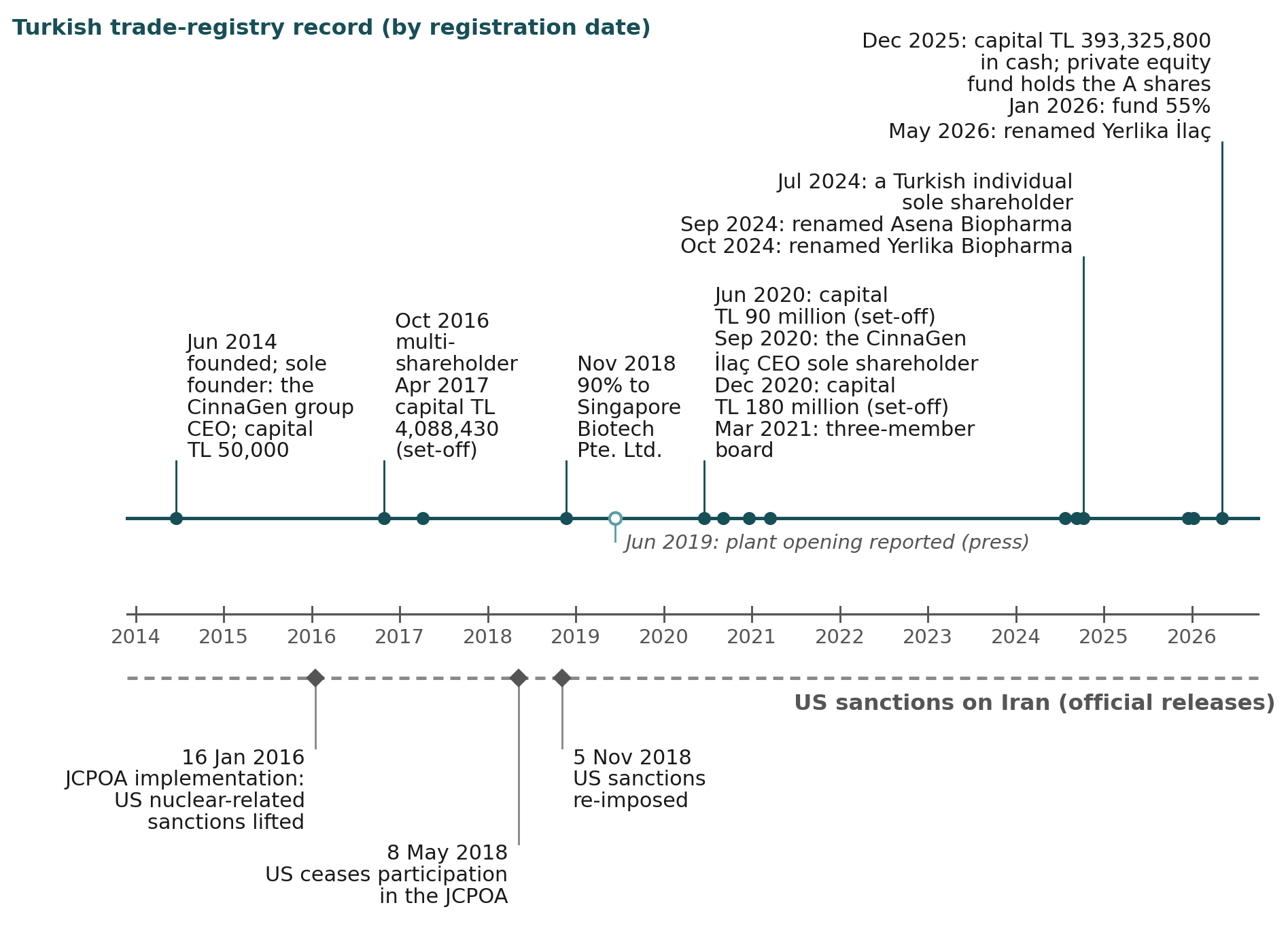
| Registered | Capital after (TL) | Increase and how paid | Shareholders after | Source |
|---|---|---|---|---|
| 17 June 2014 (founding) | TL 50,000 | Founding: 50 shares of TL 1,000; one quarter on registration, the rest within 24 months | The CinnaGen group CEO (founder), 100% | [33,53] |
| 28 October 2016 | TL 50,000 (no change) | None | Multi-shareholder from 20 October 2016; no shareholder or share transfer named | [33] |
| 5 April 2017 | TL 4,088,430 | TL 4,038,430, set off against the two shareholders' receivables | The CinnaGen group CEO (founder) and the CinnaGen İlaç CEO; split not shown | [33,53] |
| 22 November 2018 | TL 35,547,630 | Increase from TL 4,088,430 not shown in the notices read for this study; no price stated for the transfer | Singapore Biotech Pte. Ltd. 90% (31,992,867 shares, taken over 2 November 2018); the CinnaGen İlaç CEO 10% (3,554,763 shares) | [33,53] |
| 16 June 2020 | TL 90,000,000 | TL 54,452,370, set off against the receivables of Singapore Biotech Pte. Ltd. and the CinnaGen İlaç CEO | Singapore Biotech Pte. Ltd. and the CinnaGen İlaç CEO; percentages not shown | [33] |
| 3 September 2020 | TL 90,000,000 (no change; printed in notice of 15 September 2020) | None | The CinnaGen İlaç CEO, sole shareholder; transfer of Singapore Biotech's 90% not shown in the notices read for this study | [33] |
| 21 December 2020 | TL 180,000,000 | TL 90,000,000, set off against the CinnaGen İlaç CEO's receivable | The CinnaGen İlaç CEO (sole shareholder in the preceding notices) | [33] |
| 16 March 2021 | TL 180,000,000 (no change) | None | Single-shareholder status ended; no shareholder or share numbers named | [33] |
| 24 July 2024 | TL 180,000,000 (no change) | None | A Turkish individual, sole shareholder; transfer to this person not shown in the notices read for this study | [33] |
| 9 September 2024 | TL 180,000,000 (no change) | None (name changed to Asena Biopharma) | Not restated in the notice | [33] |
| 8 October 2024 | TL 180,000,000 (no change) | None (name changed to Yerlika Biopharma) | Not restated in the notice | [33] |
| 17 December 2025 | TL 393,325,800 | TL 213,325,800, paid in cash: 95,996,610 shares by the individual, 117,329,190 by the fund | A Ziraat Portföy private equity fund 216,329,190 shares (group A); a Turkish individual 176,996,610 shares (group B) | [33] |
| 6 January 2026 | TL 393,325,800 (no change) | None (notification of the change in ownership shares) | A Ziraat Portföy private equity fund 55% (from 0%); a Turkish individual 45% (from 100%) | [33,53] |
| 6 May 2026 | TL 393,325,800 (no change) | None (name changed to Yerlika İlaç) | Not restated in the notice | [33] |
Seventeen of the record's 35 notices were read in full from their page images [33]. The other 18, published between March 2015 and December 2023, are known only by their date, issue, page and type in the registry's index. They are listed there as amendments of the articles of association, notices on the board and on representation, and internal directives, the company's own rules on how its general assembly works and who may sign for it [33]. Nothing is drawn here from their content. Amounts below are as printed in the notices. From 2017 every share has a nominal value of TL 1, and no notice read for this study states a price paid for any share [33].
The company was registered on 17 June 2014 and announced in the gazette of 23 June 2014 as Cinnagen İlaç Sanayi ve Ticaret Anonim Şirketi (so spelled in the gazette), with its seat in Ataşehir, İstanbul [33]. Its one founder was Haleh Hamedifar, the chief executive of the CinnaGen group, shown in the notice as an Iranian national resident in Tehran [33]. The founder subscribed all 50 shares of TL 1,000 each, a capital of TL 50,000, with a quarter payable on registration and the rest within 24 months [33]. That was the minimum capital printed in the Turkish Commercial Code [53]. The founder alone formed the first board, for three years, as chair with sole signing authority [33]. The articles covered the manufacture, import, export and wholesale of medicines and active substances, and allowed the company to set up factories, to manufacture under contract and to obtain medicine licences [33].
On 20 October 2016 the board resolved that the company, until then a single-shareholder joint-stock company, would continue with more than one shareholder from that day [33]. The resolution was registered on 28 October 2016 and names no new shareholder [33]. The company's own later accounts date its founding to 2016. Ferhat Farşi, the chief executive of CinnaGen İlaç, told PharmaBoardroom in December 2018 that he had co-founded the Turkish affiliate in 2016 [49]. Daily Sabah reported the same in 2019, and Yerlika's web page gives November 2016 as its date of founding [29,50].
The first capital increase read for this study was decided by the general assembly on 3 April 2017 and registered on 5 April 2017 [33]. It raised the capital from TL 50,000, stated as fully paid, to TL 4,088,430 [33]. The increase of TL 4,038,430 was paid by set-off against the receivables that the two shareholders, the founder and Ferhat Farşi, held against the company, so that the company's debts to them became shares [33,53]. A certified accountant's report of 25 February 2017 established the receivables, and Ferhat Farşi chaired the meeting as deputy chair of the board [33].
The company's public plans date from the same months. In January 2017 a press release relayed by Matriks announced that CinnaGen had chosen Türkiye as its new production and research base for local and regional markets, with a plant to be founded that year in the Çerkezköy Organized Industrial Zone [27]. The release described the project as a greenfield investment with a Turkish partner, without naming the partner or giving any shares, and put Europe first among the export markets [27]. At the end of January 2017 Ekonomist, a Turkish business magazine, reported an investment of USD 30 million, operation from the third quarter of 2018 and a first product in 2019 [28]. It quoted Ferhat Farşi, described as a founding partner of CinnaGen İlaç, as saying that the company had obtained from the group the right to export to 20 countries [28]. The magazine added that the group's seven companies were all in Iran and that CinnaGen İlaç was the first of its companies in another country [28].
In November 2017 the two chief executives gave the project a larger total. In Dünya and in a column in Sabah, a Turkish daily, both of 27 November 2017, the plant was described as under construction, with test production planned for September 2018 [48,88]. The investment was put at USD 30 million of physical investment and USD 100 million in all once the transfer of technology and know-how was counted [48,88]. The chief executive of CinnaGen İlaç set an export target of USD 100 million for 2023 [48,88]. He told Sabah that the company had itself undertaken to the Ministry of Health to produce everything in Türkiye, the protein included [88]. He told Dünya that, for the time being, exports would be made from Iran on a re-export model, and that the project had been given priority-investment status [48]. The group's chief executive gave cultural closeness, the size of the population, and an investment climate and incentives that inspired confidence as the reasons why Türkiye was the group's first choice for investment abroad [48].
Ownership changed in November 2018. On 16 November 2018 the company notified the registry, under Article 198 of the Code, that the founder's whole holding of 31,992,867 shares, 90% of a capital of TL 35,547,630, had been taken over on 2 November 2018 by Singapore Biotech Pte. Ltd., a company based in Singapore [33,53]. Singapore Biotech had held none of the shares until then, and Ferhat Farşi kept his 3,554,763 shares, or 10% [33]. He signed the notification for the company. It was registered on 22 November 2018 and announced in the gazette of 28 November 2018, and it states no price [33]. No notice read for this study records the increase of the capital from TL 4,088,430 to the TL 35,547,630 stated in the notification, and none shows who owns or controls Singapore Biotech [33].
US sanctions on Iran are dated in 2018 by two official releases. On 8 May 2018 the US President ceased US participation in the Joint Comprehensive Plan of Action (JCPOA), and OFAC published a statement on that decision the same day [86]. The JCPOA is the agreement on Iran's nuclear programme under which the United States had lifted its nuclear-related sanctions on 16 January 2016 [85]. On 5 November 2018 the US Treasury stated that all US sanctions lifted or waived in connection with the JCPOA were re-imposed and in full effect from that day [87]. It stated on the same day that OFAC continued to maintain humanitarian authorisations and exceptions for the sale of food, medicine and medical devices to Iran [87].
In December 2018 the chief executive of CinnaGen İlaç told PharmaBoardroom that the plant at Çerkezköy would become operational in the first half of 2019 [49]. He said that two bioreactors of 2,000 litres each in the plant would be able to meet Türkiye's demand for monoclonal antibodies, and that the company would spend EUR 70 million to transfer the group's technology to Türkiye [49]. He also said that, while production had not yet started, the company had made an export agreement of USD 50 million covering, in his account, five countries [49]. In his account the Turkish company opened the door to exports to Europe, with three projects in preparation for submission to the EMA [49].
The opening of the plant was reported in June 2019. TGRT Haber, a Turkish news channel, reported on 11 June 2019 that the factory had opened that day, and Hürriyet and Daily Sabah reported the opening on 12 and 13 June [29,89,90]. In these reports the investment was USD 100 million, of which about USD 30 million was physical and USD 70 million technology transfer or know-how [29,89,90]. A 2019 profile published by Global Business Reports, written in the company's voice, put the same two parts at EUR 30 million in physical assets and EUR 70 million in research, development and technology transfer, and the company's staff in Türkiye at 54 [91]. The plant was described as including a research and development facility, and as the first in Türkiye to make medicines based on monoclonal antibodies, with rare and orphan drugs as its focus [29,90,91].
The export figures differ between sources and within them. The target was USD 100 million of exports in 2023 in the interviews of November 2017, in TGRT Haber, in Sabah in July 2019 and in the Global Business Reports profile [48,88,89,91,92]. It was USD 100 million a year to 20 countries in Daily Sabah and in the body of the Hürriyet report, and USD 150 million in the Hürriyet subheading [29,90]. The countries with signed agreements numbered twelve in Hürriyet and Daily Sabah, eleven in TGRT Haber and seven in Sabah [29,89,90,92]. A sale to Algeria was put at EUR 38 million in Dünya in 2017, and an Algerian agreement at USD 45 million over three years in TGRT Haber in 2019 [48,89]. In July 2019 the chief executive told Sabah that a second facility would be built, for filling vials, and that new molecules would be brought from the group's headquarters in Iran and produced in Türkiye [92]. In Sabah and in TGRT Haber he said that three or four more factories would follow if the company kept its momentum [89,92].
The capital was raised again in 2020, by set-off. The increase registered on 16 June 2020 took it from TL 35,547,630 to TL 90,000,000 [33]. The TL 54,452,370 was paid by set-off against the receivables of the two shareholders, Singapore Biotech Pte. Ltd. and Ferhat Farşi, as established in an accountant's report of 3 March 2020 [33]. The same notice registered Singapore Biotech (Holdings) Pte. Ltd., with the same registered address in Singapore, as chair of the board for one year, acting through a natural person resident in Singapore [33]. Ferhat Farşi, resident in İstanbul, became deputy chair, and each of the two was given sole signing authority [33]. The notices read for this study do not say how the two Singapore names relate to each other [33].
By the notice registered on 3 September 2020 the company was a single-shareholder joint-stock company, and its sole shareholder was Ferhat Farşi [33]. The roles of Singapore Biotech (Holdings) Pte. Ltd. as board member and chair ended, and he was elected chair [33]. A notice registered on 15 September 2020 printed the articles with the whole capital of TL 90,000,000 belonging to him [33]. On 21 December 2020 an increase to TL 180,000,000 was registered. Its TL 90,000,000 was paid by set-off against his receivable from the company, as established in an accountant's report of 7 December 2020 [33]. The notices read for this study do not show how the 90% held by Singapore Biotech Pte. Ltd. passed to him, or at what price [33]. The notice of 25 September 2020, which falls between these dates, is among those not read for this study [33].
Single-shareholder status ended by a notice registered on 16 March 2021 [33]. The same notice registered a board of three, each elected until 21 January 2024, made up of an Iranian national resident in Tehran, a Turkish national resident in İstanbul and Ferhat Farşi [33]. He is printed there as a Turkish national resident in İstanbul and was elected chair with sole signing authority [33]. The notice names no shareholders and no numbers of shares [33]. Between 2014 and 2020 the capital grew by TL 179,950,000. The notices read for this study record TL 148,490,800 of that as paid by set-off against shareholders' receivables, in 2017 and twice in 2020, and the remaining TL 31,459,200 is the step from TL 4,088,430 to TL 35,547,630 that no notice read for this study records [33].
A notice registered on 26 December 2023 appointed a Turkish national resident in İstanbul as a signatory with limited authority, under an internal directive published on 22 December 2023 that was not read for this study [33]. By the notice registered on 24 July 2024 the company again had a single shareholder, a Turkish national resident in İstanbul [33]. The notice gives this shareholder the same name as the Turkish board member elected in 2021, and no notice read for this study shows how the shares came to that person [33]. The general assembly of 5 September 2024 changed the name to Asena Biopharma İlaç Sanayi ve Ticaret Anonim Şirketi, registered on 9 September 2024 [33]. The general assembly of 3 October 2024 changed it to Yerlika Biopharma İlaç Sanayi ve Ticaret Anonim Şirketi, registered on 8 October 2024 [33].
The capital was raised in cash in December 2025. The notice registered on 17 December 2025 took it from TL 180,000,000 to TL 393,325,800 [33]. Of the increase of TL 213,325,800, 95,996,610 shares were subscribed and paid in cash by the individual shareholder [33]. The other 117,329,190 were subscribed and paid in cash by Ziraat Portföy Yönetimi A.Ş. Element Özel Girişim Sermayesi Yatırım Fonu, a private equity investment fund managed by the portfolio management company Ziraat Portföy Yönetimi A.Ş. [33]. The notice calls both of them existing shareholders. Its share table gives the fund 216,329,190 shares of group A and the individual 176,996,610 shares of group B [33]. The fund is thus shown with more shares than it subscribed in the increase, and no notice read for this study records how it came to hold the others [33]. In a notification under Article 198 registered on 6 January 2026, the board stated that the fund's share of the capital had risen from 0% to 55% and the individual's had fallen from 100% to 45% [33,53].
The articles registered in December 2025 divide control between the two groups of shares. The board has five members, three nominated by group A and two by group B, and a group that falls below 25% of the capital loses its right to nominate [33]. Important board decisions need at least one A member and one B member present and voting in favour, and the general assembly meets and decides with 75% of the total capital [33]. An internal directive requires the joint signatures of an A and a B signatory for listed transactions, among them any single transaction above USD 100,000 [33]. All five board members, elected until 10 December 2028, are printed as Turkish nationals, and the chair is the individual shareholder [33]. The general assembly of 1 May 2026 changed the name to Yerlika İlaç Sanayi ve Ticaret Anonim Şirketi, registered on 6 May 2026 [33]. The registered office stayed at the same address in Ataşehir, İstanbul, from 2017 to 2026 [33].
Yerlika's own pages describe the plant today, and what follows is the company's account. It states that it was founded in November 2016 to manufacture biotechnological medicines in Türkiye and to take part in international markets [50]. It offers its own products and contract manufacturing and contract development and manufacturing (CDMO) services for other firms, from its facility in the Çerkezköy Organized Industrial Zone [50]. It gives the facility an area of 4,215 square metres, single-use bioreactors of 10, 50 and 500 litres, and a filling capacity of 2.5 million units a year in vials, cartridges and syringes, for liquid and freeze-dried products [93]. In December 2018 the chief executive of CinnaGen İlaç had spoken of two bioreactors of 2,000 litres each [49]. Yerlika states that the facility holds a GMP certificate and that national and international authorities, which it does not name, audit its quality control regularly [93,94].
The company's timeline lists the establishment of the research and production facility in 2019, and TİTCK GMP certificates for two molecules in 2021 and for seven in 2023 [50]. It lists the licensing and launch of a recombinant factor VIIa biosimilar in 2022 [50]. For 2024 it lists its first contract production of cartridges, the start of a phase I study of an adalimumab biosimilar and licence applications for three further biosimilars [50]. In a 2025 interview in GaBI Journal, which Yerlika funded, its chief executive described the company as a contract manufacturer and developer that aims to reduce Türkiye's reliance on imported biologicals [30]. The interview's product table lists eptacog alfa, for haemophilia, as approved in Türkiye in 2021 and marketed since 2022, with technology transfer for local manufacturing under way [30]. The two sources date the product's approval differently, 2022 in the company's timeline and 2021 in the interview. It lists five further products with marketing authorisations expected between 2026 and 2029 [30]. The journal's editor added that follow-on biologicals approved in Türkiye might not have been authorised under the European Union's process for biosimilars [30].
The chief executive's message on the company's website states that the company was founded to bring to Türkiye the raw-material production technology of the largest biotechnological pharmaceutical company in the Middle East, which the message does not name [95]. The member directory of the Çerkezköy Chamber of Commerce and Industry lists a Çerkezköy branch of Yerlika İlaç Sanayi ve Ticaret A.Ş., with an address in Kapaklı, Tekirdağ, and medicine as its business [96]. The CinnaGen group's website, as captured on 25 November 2026, lists a head office in Tehran and a manufacturing site in Karaj, both in Iran, and names five companies of the group and no Turkish affiliate [97,98]. The group's history page does not mention Türkiye [99]. It states that CinnaGen received EU GMP certification in 2016, and in its latest entries that the EMA issued a positive opinion recommending approval of CinnaGen's teriparatide biosimilar [99].
The record shows a Turkish joint-stock company founded in 2014 by the chief executive of an Iranian biopharmaceutical group, with the chief executive of the Turkish company a shareholder by 2017 [33]. Its shareholders financed it from 2017 to 2020 mainly by converting their receivables into capital [33]. Singapore Biotech Pte. Ltd. held 90% of it from November 2018, Singapore Biotech (Holdings) Pte. Ltd. chaired its board in 2020, and the Turkish company's chief executive held all its shares from September 2020 until the notice of March 2021 [33]. A plant at Çerkezköy was announced in 2017 and reported opened in June 2019, with investment and export figures that the company gave differently from one source to the next [27,29,48,90]. A Turkish individual owned the company from 2024, and from December 2025 it was owned jointly by that individual and a private equity investment fund, the fund holding 55% [33]. In those years the company raised capital in cash, adopted shared control between two groups of shares and took the names Asena Biopharma, Yerlika Biopharma and Yerlika İlaç [33]. The company and its plant continue, and the company describes itself today as a Turkish contract manufacturer and developer of biological medicines [30,33,50].
4. A protocol for Iranian pharmaceutical companies entering Türkiye
The protocol set out here is for an Iranian pharmaceutical company that is considering Türkiye as a market, a production site or an export base, or as each of these in turn. It orders the decisions such a company takes before it commits resources, and names the evidence each decision needs [18,21]. It was built, as Section 2.4 describes, from the staged logic of internationalization and entry-mode choice, from the order that Turkish rules impose on a foreign manufacturer, and from the CinnaGen İlaç record read beside the comparator entries [22,33,34]. Every rule and figure it relies on was given, with its source, in Sections 1 to 3, and each is cited again where a stage uses it.
The stages run from 0 to 9. Each states its objective, the questions the company must answer, the evidence it should gather and what CinnaGen İlaç did at that point in its own entry. That last part reports dated acts and attributed statements only, and says so where the record is silent [33]. Each stage closes with a gate, a short list of conditions written so that a board can mark each one as met or not met. A gate passes when every condition is met. It holds when a condition is not yet met but can be, and the company then waits without committing further resources. It stops when a condition cannot be met, and the entry, or the part of it that depends on that condition, ends there. The three outcomes follow the Uppsala view that commitment grows in steps and may also decline or stop when performance and prospects are not promising enough [21,22]. The stages and their gates are drawn in Figure 2 and summarised in Table 4.
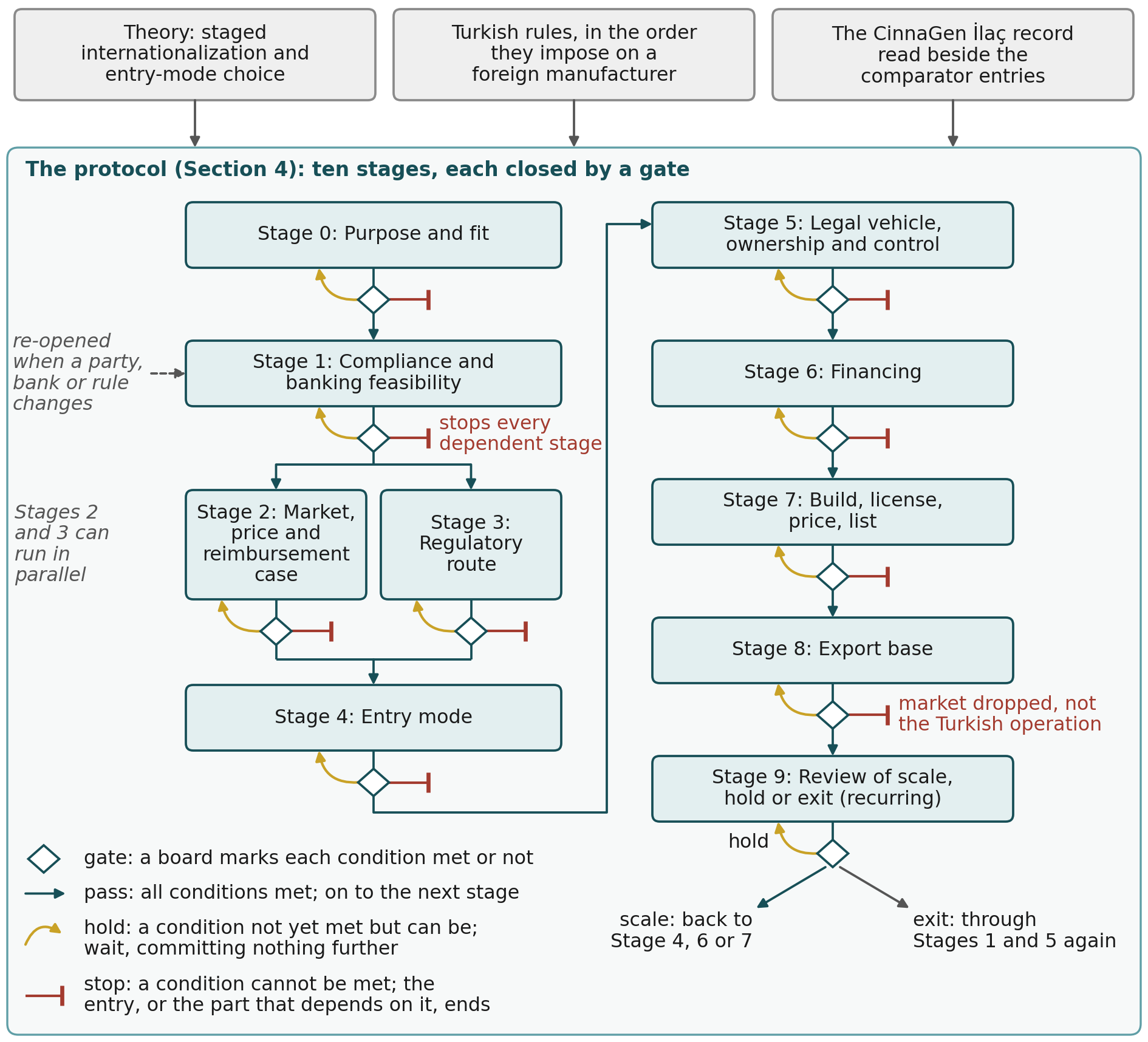
| Stage | Objective | Gate: passes when | Hold or stop | What CinnaGen İlaç did |
|---|---|---|---|---|
| 0. Purpose and fit | A written statement of Türkiye's role: market, production site, export base, or these in sequence. | Role and order of steps stated in writing; each product placed in its Turkish product class; capability brought and sought named; board has approved role and product list. | Holds while the role is agreed and the product list is not; stops if no product fits the role. | Registered June 2014; January 2017 release announced Türkiye as production and research base for local and regional markets, Europe first among export markets [27,33] |
| 1. Compliance and banking feasibility | Every flow of goods, technology and money lawful under each binding sanctions regime, and processed by banks with full knowledge. | Legal opinion (US, EU, Turkish law) finds every flow permitted or licensed, none circumventing a measure; products classified against the general licence; US technology authorised; all counterparties screened; banks fully informed, confirming in writing. | Holds while an opinion, licence or bank answer is pending; stops, with dependent stages, if any condition fails. | Sanctions assessment and banking not shown in the record; founded 2014, multi-shareholder 2016, plant opening reported June 2019 [29,33] |
| 2. Market, price and reimbursement case | A product-by-product case that holds at the price Türkiye allows and the amount SGK pays. | Per product: maximum price computed from the five reference countries, euro value dated; SGK payment computed; case holds without a euro-value rise; reimbursement timing follows SGK dates; local-production instrument named, existence stated. | Holds pending cost-card price or payment-model decision; stops a product failing at the reimbursed amount, the entry if none passes. | No price or reimbursement decision recorded; November 2017, its CEO said it had undertaken to the Ministry of Health to produce everything in Türkiye [88] |
| 3. Regulatory route | A licensing and inspection route for each product, with a dated plan the rules allow. | Resident licence holder with qualified authorised person named; for foreign-made products, a Turkish importer agrees to seek TİTCK GMP inspection; GMP evidence for every step; plan treats legal periods as minimums; exclusivity and patents checked. | Holds while GMP inspection is pending, and for six months after refusal; stops without resident holder or inspectable site. | June 2014 articles allowed licences, factories and contract manufacturing; pre-opening licence applications not shown in the record; Yerlika lists three further biosimilar applications in 2024 [33,50] |
| 4. Entry mode | An entry mode that fits the Stage 0 role and survives Stages 1 to 3. | Modes compared on control, resources, local assets and reversal cost; local assets listed with tradability; chosen mode serves the role and uses only cleared flows; competition clearance checked; partner contracts cover know-how and changed conditions. | Holds while a partner or target is sought; a failing mode is dropped; stops only if no mode passes. | Own plant: January 2017 release described a greenfield investment with an unnamed Turkish partner; plant reported under construction November 2017, opened June 2019 [27,29,48] |
| 5. Legal vehicle, ownership and control | A Turkish company whose ownership and control are documented, disclosable and able to change in an orderly way. | Ownership chain to ultimate natural persons documented for the banks; Article 198 notifications planned for every threshold; board, chair and signatories named, with group rights where shared; change-of-control rules agreed; owners and directors screened. | Holds until the documents exist; stops if an owner or controller cannot be disclosed to the company's banks. | Founded 17 June 2014 by the CinnaGen group CEO alone; 2 November 2018 Singapore Biotech Pte. Ltd. took the founder's 90%; its owner not shown [33] |
| 6. Financing | A financing plan naming the source, form and channel of each amount, from founding capital to the plant. | Each tranche's source, amount, form and date named; cross-border amounts use cleared, informed bank channels; set-off receivables documented, origin showable; state aid certified, or plan holds without it; response to delayed or refused transfers stated. | Holds while certificate or bank answer is pending; stops if a needed transfer has no channel cleared at Stage 1. | Increases of TL 4,038,430 (April 2017), TL 54,452,370 (June 2020) and TL 90,000,000 (December 2020) paid by set-off; TL 213,325,800 in cash, December 2025 [33] |
| 7. Build, license, price, list | A product on the market: made at a certified site, licensed, priced and, where needed, listed for reimbursement. | Per product: site holds accepted GMP evidence per step; licence, sales permit, approved price before launch; first commercial batch within 30 months; SGK application filed where needed, distribution shown within five months; local-production commitments documented. | Holds a product until every condition is met; commitment beyond the first products waits for the Stage 9 review. | Opening reported 11–13 June 2019; Yerlika lists TİTCK GMP certificates for two molecules in 2021, seven in 2023; factor VIIa biosimilar licensed and launched 2022 [29,50,89,90] |
| 8. Export base | What exports from Türkiye would add, market by market, to exports from the home country. | Per market: regulator's evidence named, whether a Turkish licence and TİTCK inspection meet it; export price allows for Turkish reference pricing; Iranian-party flows pass Stage 1; volumes rest on signed contracts or are labelled targets. | Holds a market until its regulatory route is known; a failing market is dropped without stopping the Turkish operation. | 2017: export right to 20 countries reported; CEO said exports would, for now, be made from Iran; exports and EU approval not shown [28,48] |
| 9. Review of scale, hold or exit | A standing, periodic decision to scale, hold or reduce commitment, with an orderly exit if chosen or forced. | Board sets triggers in advance, tied to earlier gates or product cases; reviews at fixed intervals and on Stage 1 change; licences and listings held by Turkish company; share-sale rules and approvals identified; hold defined. | Scaling returns to the changed stage, usually 4, 6 or 7; exit reruns Stages 1 and 5. | Turkish individual sole shareholder by July 2024; renamed Asena Biopharma, Yerlika Biopharma (2024), Yerlika İlaç (May 2026); private equity fund 55% by January 2026 [33] |
Stage 0. Purpose and fit
The objective is a written statement of the role Türkiye is to play. That role can be a market for products made in Iran, a production site for the Turkish market, an export base for third markets, or these in sequence. The Uppsala sequence, from exporting through an agent to a sales subsidiary and then to production, is one such order [21]. The questions are which products the company would bring, how each fits the Turkish market, and what capability the company brings that the market lacks. Firms from emerging economies have also gone abroad to acquire resources that compensate for gaps in their capabilities, the strategy Luo and Tung call a springboard [5]. A company that seeks such gains in Türkiye names them as part of the role.
The market data of Section 3.1 frame the fit by product class. Imports are concentrated in originator and biotechnological products. In 2025, 68.8% of the value of originator medicines was imported, 99.4% of generic boxes were produced in Türkiye, and biotechnological medicines made up 45.8% of the value of imports [14]. Biotechnological medicines held about 21.1% of the market by value, and 42 biosimilar products of 11 brands were made in the country [14,51]. More than 80% of active ingredients are imported, in the AIFD/IQVIA account [13]. Price increases accounted for 90.6% of the growth of the audited market in 2024, while the number of boxes sold fell by 3.5% [13]. Sales are concentrated, with the 50 largest companies holding 86% of value in 2025 [14]. A maker of generics thus meets a market whose boxes are already made locally, and a maker of biologics meets one that still imports much of what it spends [14]. On the home side, science-based Iranian companies were making biopharmaceuticals by 2012, and about six non-originator biopharmaceuticals had been registered in Iran since 2003 [4].
CinnaGen's stated purpose dates from January 2017. A press release relayed by Matriks announced that the group had chosen Türkiye as its new production and research base for local and regional markets, and put Europe first among the export markets [27]. Ekonomist reported that the Turkish company had obtained from the group the right to export to 20 countries, and that it was the group's first company outside Iran [28]. In November 2017 the group's chief executive gave cultural closeness, the size of the population, and an investment climate and incentives that inspired confidence as the reasons why Türkiye was the group's first choice for investment abroad [48]. In 2019 the plant was presented as the first in Türkiye to make medicines based on monoclonal antibodies, with rare and orphan drugs as its focus [29,90,91]. The company itself had been registered in June 2014, two and a half years before the first of these statements [33]. The gate of Stage 0 passes when the following conditions are met:
- The role of Türkiye, as a market, a production site, an export base or a sequence of these, is stated in writing, with the order of the steps.
- Each product proposed is placed in its Turkish product class (originator, generic or biosimilar; imported or made locally), with that class's place in the market as given in Section 3.1 [13,14].
- The capability the company brings for each product, and any capability it seeks to gain in Türkiye, is named.
- The board has approved the role and the product list as the basis for the stages that follow.
The gate holds while the role is agreed and the product list is not. It stops if no product fits the role chosen, and the company may then return to the choice of role, since commitment in the Uppsala view may stop as well as grow [22].
Stage 1. Compliance and banking feasibility
The objective is to establish, before any other commitment, that every flow of goods, technology and money the entry needs is lawful under each sanctions regime that binds a party to it. A second objective is that banks will process the payments with full knowledge of them. The stage comes first because payments connected with Iran are governed by US and EU sanctions law, which binds the parties within its reach and exposes foreign banks to US measures [40,41,63]. Firms in third countries weigh the risk of secondary sanctions when deciding whether to deal with a sanctioned economy [9]. French exporters that relied more heavily on trade finance were hit harder by the EU measures against Iran of January 2012 [10], and Iranian companies have had to pay cash in advance for imported medicines and raw materials [1]. The questions are which laws bind each party and each bank in the chain, which flows each law permits and on what conditions, and which counterparties are excluded.
The evidence is the text of each rule as in force on the date of the assessment, read by counsel in a legal opinion, a written statement of whether each planned act is lawful. The US general licence in section 560.530 of the Iranian Transactions and Sanctions Regulations, as amended in July 2026, covers medicine designated EAR99, shipped within 12 months of the contract, with the related financing and payment [40]. It excludes listed drug classes, which need a one-year specific licence, as well as military, intelligence and law-enforcement buyers and blocked persons [40]. It does not cover US technology or software used to manufacture medicine, and OFAC determines each year whether to revoke it [40]. Council Regulation 267/2012, in its text of 1 August 2026, binds EU persons and business done in the Union [41]. It allows healthcare transfers with banks domiciled in Iran, notified in advance from EUR 10,000 and authorised in advance from EUR 100,000, and it counts linked transfers as one [41]. It also prohibits knowing and intentional participation in activities whose object or effect is to circumvent its measures [41].
The exposure of banks is evidence in its own right. OFAC designated a Türkiye-based bank on 4 September 2026, and on 5 October 2026 it alerted foreign financial institutions that those transacting with sanctioned Iranian banks could be targeted at any time without advance notice [62,63]. Restrictions on the US correspondent accounts of foreign banks are published in the Federal Register or on an OFAC list [64]. Türkiye's Ministry of Foreign Affairs stated on 14 February 2024 that Türkiye implements only sanctions decided by the UN Security Council. The same answer said that Turkish banks and companies borrow and lend abroad and that the Ministry informs them regularly about unilateral sanctions [76]. Türkiye's stated position therefore leaves the question of what a given bank will process to be answered bank by bank [76].
The record does not show how CinnaGen İlaç assessed sanctions or arranged its banking. It shows that the entry spanned changes in the US rules. The United States lifted its nuclear-related sanctions on 16 January 2016, ceased participation in the JCPOA on 8 May 2018 and re-imposed the sanctions on 5 November 2018 [85,86,87]. On that last date the Treasury stated that OFAC continued to maintain humanitarian authorisations for the sale of medicine to Iran [87]. The company was founded in 2014 and became multi-shareholder in 2016, and the opening of its plant was reported in June 2019 [29,33]. The registry states no reason for any of its acts [33]. The gate of Stage 1 passes when the following conditions are met:
- A written legal opinion from counsel qualified in US and EU sanctions law and in Turkish law covers every planned flow of goods, technology and money and every party to it. It finds each flow permitted or covered by a licence held, and finds that no element of the plan has the object or effect of circumventing a measure [40,41].
- Each product to be sold to Iran is classified against the conditions of the general licence, including EAR99 status, the excluded classes and the 12-month shipment condition, or a specific licence is held for it. No buyer is a military, intelligence or law-enforcement purchaser [40].
- Any US technology or software to be used in manufacture is identified, and the legal opinion states how its use is authorised [40].
- Every counterparty, including shareholders, board members, customers, suppliers, distributors and banks, has passed counterparty screening, a check against the US and EU lists of blocked, designated and frozen persons and the published restrictions on foreign banks, repeated before each new contract or payment [41,63,64].
- Each bank that will process the company's payments has been given full disclosure of the parties, the goods and the purpose of the payments, and has confirmed in writing that it will process them. Each payment meets the notification and authorisation thresholds that apply to it [41].
If any condition fails, the gate stops, and with it every stage that depends on the failed flow. It holds while an opinion, a licence application or a bank's answer is pending. The gate is opened again whenever a party, a bank or a rule changes, since OFAC decides each year whether to revoke the general licence and has stated that it can act without advance notice [40,63].
Stage 2. Market, price and reimbursement case
The objective is a case, product by product, that holds at the price Türkiye allows and at the amount SGK pays. Prices are set by the state, and SGK pays for more than 85% of medicine spending by value [36,42]. The questions are what maximum price each product would receive, whether and when SGK would list it, what SGK would pay within its group, and how these amounts move with the euro value. The authors of a 2023 review state that the fixed shares and the euro value lower companies' margins and lead to fewer or more hesitant requests to enter the market [70].
The price evidence is the lowest ex-factory price, discounts excluded, of the reference product in France, Spain, Italy, Portugal and Greece, the reference countries named in the communiqué of 29 August 2026 [36,55]. That price is converted at the euro value, TL 29.1164 at a coefficient of 65% from 1 April 2026 [36]. The value was set by decisions of October 2024 and December 2025 before the 2026 decision [57,58], and the industry associations put it at 50.6% to 58.7% of the market rate on the dates they measured [13,14]. From the first generic, the original and all generics are capped at 60% of the benchmark reference price, with higher shares for first generics in their first three years [36]. Biosimilars, orphan products and several other classes are priced under separate Ministry rules, and a product made in Türkiye with no reference product can be priced on a cost card [36,55].
The reimbursement evidence is the product's group of equivalent products and its discount band. SGK pays up to the cheapest equivalent's discounted unit price plus 6%, counting the cheapest only if it held 1% of the group in one of the last five months [42,59]. In the band from TL 151.25, the public institution discount is 41% for a reference product with no generic and 28% for generics, in the communiqué as valid from 1 April 2026 [59]. Applications to the Drug Reimbursement Commission close on the last working day of March and of August, and only a firm holding a manufacturing or import authorisation may apply [37]. A first biosimilar priced at least 30% below the listed reference product is given priority, and a product at least 5% below the cheapest in its group can be listed in the weekly list [37]. A 2025 review, drawing on consultancy and industry reports, puts the average time from licence application to reimbursement at about three years [65]. The Competition Authority states that not being reimbursed can be an entry barrier where at least one medicine in the market is reimbursed [42].
Local production can bear on payment. SGK may create alternative payment models to encourage local production and the move of imported products to it [59]. The localisation requirement once removed reimbursement from products whose local-production commitments were not given, accepted or fulfilled, and in 2022 it was found inconsistent with GATT Article III:4 [43]. İEİS describes the localisation process as halted before it was complete, and reports that the Medium-Term Programme for 2025 to 2027 states that the domestic production strategy will be reassessed [14,51].
The record holds no price or reimbursement decision for any product of CinnaGen İlaç. In November 2017 the chief executive of CinnaGen İlaç told Sabah that the company had undertaken to the Ministry of Health to produce everything in Türkiye, the protein included [88]. The gate of Stage 2 passes, product by product, when the following conditions are met:
- A maximum price has been computed under the decision of 11 March 2026 from the five reference countries, with the euro value used and its date stated [36,55].
- The group of equivalent products, the price band and the public institution discount are identified, and the amount SGK would pay is computed [59].
- The case holds at the amount SGK would pay, and it does not depend on a rise in the euro value.
- The time to reimbursement in the plan follows the SGK application dates and is no shorter than the evidence of Section 3.1 supports [37,65].
- Any part of the case that rests on local production names the instrument that would reward it, such as an alternative payment model, and states whether that instrument exists on the date of the case [59].
The gate holds for a product whose case depends on a decision not yet taken, such as a cost-card price or an alternative payment model [55,59]. It stops for a product whose case fails at the reimbursed amount, and it stops the entry if no product passes.
Stage 3. Regulatory route
The objective is a licensing and inspection route for each product, with a dated plan that the rules allow. A licence can be applied for only by a natural person or trading company resident in Türkiye, which employs as its authorised person a graduate in pharmacy, medicine or chemistry entitled to practise there [34]. The questions are who will hold each licence, where each manufacturing step will take place, how GMP will be shown for each step, and how long the route will take.
For a product made in Iran, the Turkish applicant files the foreign licensor's document naming it the sole authorised representative, and GMP evidence for each step of the finished product [34]. TİTCK's GMP inspection of the Iranian site is applied for by an importer established in Türkiye, which carries responsibility for the file [35]. A site TİTCK has not inspected goes to an on-site inspection. The product must be seen in production, and the site's documents must also be available in English [35]. The certificate is valid for three years and can be extended to 12 years through risk-based reviews for a site in a country whose authority is a PIC/S member [35]. TİTCK's inspectorate and Iran's Food and Drug Administration are both listed by PIC/S with an accession date of January 2018 [15]. A critical deficiency leads to refusal and bars a new on-site application for six months [35]. In the AIFD/IQVIA account, licensing cannot be completed before a GMP certificate is issued [13]. The guideline states neither the fees nor the time within which TİTCK decides [35].
The licensing clock is set by the regulation. TİTCK starts the process only in February, May, August and November, after a completeness check of up to 30 days, 30 days to complete the file and a second check of up to 30 days [34]. It then concludes within 210 days of its start notice, or 90 days for applications that rely on earlier assessments by authorities of comparable standards, with the clock stopped while it waits for information it has requested [34]. The Competition Authority states that licences take longer than the law provides [42]. A reference product first licensed in the customs union of the European Union and Türkiye after 1 January 2005 has six years of data exclusivity from that licence, limited by any patent term in Türkiye [34].
The articles registered in June 2014 allowed CinnaGen İlaç to obtain medicine licences, to set up factories and to manufacture under contract [33]. The record does not show which licences the company applied for before its plant opened, or whether any product was first imported from Iran [33]. Yerlika's timeline lists licence applications for three further biosimilars in 2024 [50], and the 2025 interview lists five further products with marketing authorisations expected between 2026 and 2029 [30]. The gate of Stage 3 passes when the following conditions are met:
- A licence holder resident in Türkiye, with an authorised person who meets the regulation's conditions, is named for each product, whether it is the company's own Turkish subsidiary or a partner [34].
- For each product made outside Türkiye, an importer established in Türkiye has agreed to apply for TİTCK's GMP inspection, and the site can show the product in production, with its documents in English [35].
- GMP evidence of a kind the regulation accepts is on file, or planned, for every manufacturing step of the finished product [34].
- The dated plan treats TİTCK's start months and legal periods as the shortest possible times, and allows for clock stops and longer elapsed times [34,42].
- Data exclusivity and any patent term in Türkiye have been checked for each reference product on which the company's product relies [34].
The gate holds while a GMP inspection is pending, and for six months after a refusal [35]. It stops for a product that has no resident licence holder or whose site cannot meet the inspection conditions.
Stage 4. Entry mode
The objective is a choice of entry mode that fits the role set at Stage 0 and survives Stages 1 to 3. The options run from export through a Turkish importer and licence holder, through licensing or contract manufacturing at a Turkish plant, to a joint venture, an acquisition or the company's own plant [18,19]. The questions are how much control each option gives, what resources it commits, which local assets it secures and how hard it is to reverse.
Anderson and Gatignon frame the choice as a trade-off between control and the cost of committing resources, and low-control modes minimise the resources committed, often at the expense of returns [18]. A review of the empirical work found that no single mode performs best, while firms whose choices matched theoretical predictions performed better [19]. Hennart argues that the mode depends on how easily the local assets an entrant needs, such as distribution, permits and licences, can be traded [20]. Where a permit cannot be bought on its own, acquiring its holder or forming a joint venture with it may be the only route [20]. Contracts protect the parties poorly when one of them has better information or when the environment changes in unpredictable ways [84]. Once established, entry modes are difficult to change [19], and an acquisition is not necessarily a quick way to build a position in a foreign market [22].
The Turkish record leans to acquisition. Foreign acquirers made 71% of the 38 acquisitions in and around the sector that Kahraman and Uğurluoğlu compiled for 2006 to 2014 [77]. The purchases by Zentiva, Eczacıbaşı and Fareva brought plants, licences, marketing rights, customers and staff [46,47,78]. Amgen sold two products through its own affiliate from 2010 before it acquired a manufacturer in 2012 [44]. SK Plasma took 15% of a joint venture that is building a new plant, with technology fees and a part in management [82]. İEİS counted 111 manufacturing facilities in December 2025, among which a contract site or a target would be found [14]. Acquisitions in the sector pass through the Competition Authority. Since February 2026, transactions involving biotechnology, pharmacology and health-technology firms have been subject to an individual-turnover threshold of TL 250 million [42].
CinnaGen İlaç took the route of its own plant. The January 2017 release described a greenfield investment with a Turkish partner, without naming the partner or giving any shares [27]. The notices read for this study show the founder and the chief executive of CinnaGen İlaç as the company's two shareholders in April 2017 [33]. The plant was reported under construction in November 2017 and opened in June 2019 [29,48]. Yerlika now offers contract manufacturing and development services for other firms from the same facility [50]. The gate of Stage 4 passes when the following conditions are met:
- The modes open to the company have been compared on control, resources committed, the local assets each secures and the cost of reversing it [18,19,20].
- The local assets the entry needs, such as licences, a certified plant, distribution and staff, are listed, each with whether it can be bought or contracted for on its own [20].
- The chosen mode serves the role set at Stage 0 and uses only flows cleared at Stage 1.
- Where the mode is an acquisition or a joint venture, the need for Competition Authority clearance has been checked against the thresholds in force [42].
- Where the mode rests on a contract with a Turkish partner, the contract covers the know-how it transfers and what happens if the environment changes [84].
The gate holds while a partner or a target is sought. A mode that fails a condition is dropped and the comparison continues among the others, since no single mode performs best in the empirical work [19]. The gate stops the entry only if no mode passes.
Stage 5. Legal vehicle, ownership and control
The objective is a Turkish company whose ownership and control are documented, can be disclosed and can change in an orderly way. The vehicle in the record is the joint-stock company (A.Ş.), which a foreign parent can found alone [53]. The questions are who will own the company and through which entities, who will sit on its board and sign for it, and how ownership and control may change later.
The minimum capital is TL 250,000, or TL 500,000 of initial capital in the registered-capital system, after the presidential decision of 24 November 2023 [53]. At least 25% of cash capital is paid before registration into a bank account in the name of the company being formed, so a bank relationship cleared at Stage 1 is needed before the company exists [53]. The board may include legal persons, each acting through one registered natural person, and the Code sets no residency or nationality condition for board members [53]. A holder whose direct or indirect stake reaches or falls below 5, 10, 20, 25, 33, 50, 67 or 100% notifies the company and the authorities within ten days, and the rights attached to those shares are frozen until the notification is registered and announced [53]. Shareholders have a pre-emption right to new shares, which the general assembly can restrict only for justified reasons and with 60% of the capital in favour [53]. The foreign direct investment law gives foreign investors national treatment, asks only for notification of statistical information and allows profits, dividends and sale proceeds to be transferred abroad through banks [38].
CinnaGen İlaç was founded on 17 June 2014 by the CinnaGen group's chief executive alone, with the capital of TL 50,000 then printed in the Code as the minimum [33,53]. It continued with more than one shareholder from 20 October 2016, and in April 2017 the founder and the chief executive of CinnaGen İlaç were its two shareholders [33]. On 2 November 2018 Singapore Biotech Pte. Ltd. took over the founder's 90%, as notified under Article 198, and no notice read for this study shows who owns or controls that company [33]. In 2020 Singapore Biotech (Holdings) Pte. Ltd. chaired the board through a natural person, and from September 2020 the chief executive of CinnaGen İlaç held all the shares [33]. A Turkish individual was sole shareholder from July 2024 [33]. From December 2025 that individual and a private equity investment fund held the company, the fund with 55% by the notification of January 2026 [33]. The articles of December 2025 give each of two groups of shares board seats and require a member of each group to approve important board decisions [33]. Each change is visible in the registry by its date, and none by its reason [33]. The gate of Stage 5 passes when the following conditions are met:
- The ownership chain, from the Turkish company up to the natural persons who ultimately own and control each shareholder, is documented and ready to be given to the company's banks. The registry records shareholders, but the CinnaGen İlaç notices read for this study do not show who owns a corporate shareholder [33].
- An Article 198 notification is planned for every threshold that a planned or possible change of holding would cross, within the ten days the Code allows [53].
- The board, its chair and those with signing authority are named, and where ownership is shared the articles set out the nomination rights and the decisions that need the approval of each group [33,53].
- The shareholders have agreed in writing how control may change, by transfer of shares or by an increase of capital, and how pre-emption rights will be treated [53].
- Every shareholder and board member has passed the counterparty screening of Stage 1.
The gate holds until the documents exist. It stops if an owner or a controller cannot be disclosed to the company's banks, since every shareholder must pass the screening of Stage 1 against the published lists of blocked and frozen persons [41,62].
Stage 6. Financing
The objective is a financing plan that names the source, form and channel of each amount the company needs, from founding capital to the plant. The questions are how capital will be paid in, which amounts must cross borders and through which banks, and which state aid the project can obtain. The Code allows new capital in cash, in kind or from the company's own reserves [53]. An increase may also be paid by setting off a shareholder's receivable, in which case the board's declaration states that the debt exists, is valid and can be set off [53]. An increase lapses if it is not registered within three months of the decision [53]. Any amount that comes from abroad depends on a channel cleared at Stage 1, and the foreign direct investment law provides for transfers through banks [38,41].
State aid is set by the decision of 29 May 2025, which classes pharmaceutical manufacturing, NACE code 21, as high technology [39]. The minimum fixed investment is TL 12 million in regions 1 and 2 and TL 6 million in the others, and the TL amounts are revalued each year [39]. High-technology projects of at least TL 100 million can be considered under the Strategic Move Programme, whose criteria include own funds of 20% of the investment, and those of at least TL 500 million are priority investments [39]. Each project needs an incentive certificate, issued after a sectoral, financial and technical assessment, and applications are assessed until 31 December 2030 [39].
CinnaGen İlaç's shareholders financed it mainly by set-off from 2017 to 2020 [33]. Increases of TL 4,038,430 in April 2017, TL 54,452,370 in June 2020 and TL 90,000,000 in December 2020 were each paid by converting shareholders' receivables, established by accountants' reports, into shares [33]. Together they come to TL 148,490,800 of the TL 179,950,000 by which the capital grew from 2014 to 2020, and no notice read for this study records the remaining step [33]. The notices do not show how the receivables arose [33]. In December 2025 the capital was raised by TL 213,325,800 in cash, subscribed by the individual shareholder and the private equity fund [33]. The company's statements of 2017 to 2019 put the investment at USD 100 million in all, about USD 30 million of it physical and the rest technology transfer, and a 2019 profile in the company's voice put the two parts at EUR 30 million and EUR 70 million [29,48,91]. The chief executive of CinnaGen İlaç said in November 2017 that the project had been given priority-investment status, and no document of that status is in the record read for this study [48]. The gate of Stage 6 passes when the following conditions are met:
- Each tranche of capital and debt is named with its source, its amount, its form (cash, set-off or contribution in kind) and its date.
- Every amount that crosses a border has a bank channel cleared at Stage 1, and the bank has the disclosure Stage 1 requires [41].
- Where an increase is to be paid by set-off, the receivable exists, is documented and has an origin that can be shown to the company's banks [53].
- Any state aid the plan counts on is backed by an incentive certificate, or the plan holds without it [39].
- The plan states what the company does if a transfer is delayed or refused.
The gate holds while a certificate or a bank's answer is pending. It stops if the plan needs a transfer that no channel cleared at Stage 1 can carry, such as a transfer with a bank domiciled in Iran outside the categories the EU regulation allows [41].
Stage 7. Build, license, price, list
The objective is a product on the market, made at a certified site, licensed, priced and, where the case needs it, listed for reimbursement. The questions are whether to build a plant or use a contract site, in what order to seek certificates, licences, prices and listing, and what commitments on local production to make. A plant in Türkiye needs GMP evidence for each step it performs, which can be a TİTCK document [34]. A sales permit is required before a product is first marketed, and again when its manufacturing site moves from abroad to Türkiye [34]. A licence can be suspended if no commercial batch reaches the market within 30 months [34].
A product with no retail price cannot be sold in pharmacies, and first price applications are to be concluded within 90 days [36,55]. A newly listed medicine must show within five months that it is distributed, or it is made passive, and it is removed from the list at the end of the tenth month [37]. Under the localisation requirement, commitments were typically to be implemented within 18 months, and a company whose commitment was accepted had a year to change its marketing authorisation from import to local [60].
CinnaGen İlaç's building plans are on record in the company's words. In January 2017 it announced a plant to be founded that year at Çerkezköy, and Ekonomist reported operation from the third quarter of 2018 and a first product in 2019 [27,28]. In November 2017 test production was planned for September 2018 [48]. In December 2018 the chief executive said that the plant would become operational in the first half of 2019, with two bioreactors of 2,000 litres each [49]. The opening was reported from 11 to 13 June 2019 [29,89,90]. Yerlika gives the facility today single-use bioreactors of 10, 50 and 500 litres and a filling capacity of 2.5 million units a year [93]. Its timeline lists TİTCK GMP certificates for two molecules in 2021 and for seven in 2023, and the licensing and launch of a recombinant factor VIIa biosimilar in 2022 [50]. The 2025 interview lists eptacog alfa as approved in Türkiye in 2021 and marketed since 2022 [30]. The record does not show that product's price or its listing for reimbursement. The gate of Stage 7 passes, product by product, when the following conditions are met:
- The site, own or contracted, holds GMP evidence of a kind TİTCK accepts for every step it performs [34].
- The product has its licence, its sales permit and an approved price before launch, and a new sales permit is planned if its site moves to Türkiye [34,55].
- The first commercial batch is scheduled within 30 months of licensing [34].
- Where the Stage 2 case needs listing, the SGK application is filed, and distribution can be shown within five months of listing [37].
- Every commitment on local production made to a Turkish authority is written down, dated and matched to a production plan.
The gate holds a product until all its conditions are met. Commitment beyond the first products waits for the review of Stage 9, in line with the Uppsala view that the knowledge each further step needs is gained mainly by operating in the market [21].
Stage 8. Export base
The objective is to establish what exports from Türkiye would add, market by market, to exports from the home country. Türkiye exported pharmaceuticals worth USD 2.51 billion in 2025, 51.1% of them to Europe and 38.8% to Asia, and Iran was the fifth-largest destination in the İEİS table [14,51]. The questions are which markets accept Turkish licences and inspections as evidence, at what prices the company can enter them, and which flows involve Iranian parties.
Production in Türkiye brings a TİTCK licence and inspection by a PIC/S participating authority, which the Competition Authority calls important for proving the quality of medicines made in Türkiye [15,42]. PIC/S lists Iran's Food and Drug Administration with the same accession date as TİTCK's inspectorate, January 2018 [15]. Turkish prices can weigh on exports. In the İEİS view, export markets use Turkish prices as reference prices, so Turkish firms enter them at lower prices than they otherwise could [14]. Approval in Türkiye is also distinct from approval in the European Union. The editor of the 2025 interview noted that follow-on biologicals approved in Türkiye might not have been authorised under the European Union's process for biosimilars [30]. Cheraghali judged in 2012 that biosimilars developed outside the EU and the US had a very low chance of approval as biosimilars by the EMA or the FDA [4]. Foreign entrants have described Turkish plants as serving exports. Amgen described Mustafa Nevzat as having an export business, ADQ described Birgi Mefar as exporting to more than 30 countries, and Fareva gave efficient access to several international markets as a reason for its purchase [44,45,47].
CinnaGen İlaç's export plans are on record as plans. In 2017 Ekonomist reported its right to export to 20 countries, and its chief executive told Dünya that, for the time being, exports would be made from Iran on a re-export model [28,48]. The export target was USD 100 million, for 2023 or for each year, in most reports, and USD 150 million in the Hürriyet subheading [29,48,89,90]. The countries with signed agreements numbered between seven and twelve, depending on the report [29,89,90,92]. In December 2018 the chief executive spoke of three projects in preparation for submission to the EMA [49]. The record does not show the exports made or any EU approval obtained. Yerlika states that it was founded to take part in international markets [50]. The gate of Stage 8 passes, market by market, when the following conditions are met:
- The target market is named, with the evidence its regulator requires and whether a Turkish licence and a TİTCK inspection meet it.
- The export price case allows for the market's use of the Turkish price as a reference, where it does so [14].
- Every export or import flow that involves an Iranian party has passed the Stage 1 gate [40,41].
- Export volumes in the plan rest on signed contracts, or are labelled as targets.
The gate holds a market until its regulatory route is known. A market that fails is dropped without stopping the Turkish operation, a decline of commitment in one market of the kind the Uppsala authors allow for [22].
Stage 9. Review of scale, hold or exit
The objective is a standing decision, taken at set intervals, to scale, hold or reduce the commitment in Türkiye, and an exit that can be made in an orderly way if it is chosen or forced. The questions are what results would justify more commitment, what would justify a pause, and what an exit would require. The authors of the Uppsala model allow commitment to decline or cease when performance and prospects are not promising enough [22]. Hennart's account of Borden's exit from Japan shows a foreign footprint contracting as well as growing [20].
Firms already established abroad change course under sanctions. Of 22 Western multinationals with subsidiaries in Russia after February 2022, ten divested, four froze operations and eight stayed [12]. The pharmaceutical firm in that sample froze new clinical trials and new investment while keeping its operations [12]. In Türkiye, Amgen agreed in June 2022 to sell Gensenta, the former Mustafa Nevzat, to the Eczacıbaşı Group for USD 135 million, ten years after buying it, subject to the Competition Authority's approval [79,83]. After the purchase, the buyer's marketing subsidiary took over the sale of the 88 finished products for which Gensenta holds the licence [46]. Amgen stated that it would continue its activities in Türkiye [83]. Under the Code a change of owners is made by a transfer of shares or by new capital, and a holding that crosses a threshold is notified within ten days [53].
CinnaGen İlaç's owners and name changed from 2024, and its plant continued. A Turkish individual was sole shareholder by July 2024, and no notice read for this study shows how the shares came to that person or at what price [33]. The company was renamed Asena Biopharma in September 2024, Yerlika Biopharma in October 2024 and Yerlika İlaç in May 2026, under the same registry number [33]. The private equity fund held 55% by the notification of January 2026 [33]. Yerlika describes itself today as a Turkish contract manufacturer and developer of biological medicines working from Çerkezköy [30,50]. The CinnaGen group's website, as captured on 25 November 2026, names five companies of the group and no Turkish affiliate [97,98]. The gate of Stage 9 passes at each review when the following conditions are met:
- The board has set in advance its triggers, the results or events that call for a decision to scale, hold or reduce commitment. Each is tied to the outcome of an earlier gate or to a product case of Stage 2.
- The review is held at intervals the board has fixed, and also whenever a Stage 1 condition changes [63].
- Licences, certificates and reimbursement listings are held by the Turkish company, so that they stay with it if its shares change hands, as Gensenta's licences did [46].
- The articles and any shareholders' agreement set out how shares may be sold, including pre-emption rights, and the Article 198 notifications and any Competition Authority clearance a sale would need are identified [42,53].
- A hold is defined by what continues and what stops, for instance operations continuing while new investment is frozen, as in the pharmaceutical case Sawant and colleagues report [12].
A decision to scale sends the company back to the stage that the larger commitment changes, usually Stage 4, 6 or 7. A decision to exit runs through Stages 1 and 5 again, since a sale moves money and changes the owners [41,53].
The gates are linked. A stop at Stage 1 stops every stage that depends on the failed flow. Stage 1 is opened again whenever a party, a bank or a rule changes, since OFAC decides each year whether to revoke the general licence and has told banks that they can be targeted without advance notice [40,63]. Stages 2 and 3 can run in parallel, because pricing, reimbursement and licensing are separate procedures, although only a firm holding a manufacturing or import authorisation can apply to SGK [34,37]. Stages 4, 5 and 6 build on those results and on each other, since the mode decides the vehicle and the vehicle decides how capital is paid in [53]. Stage 7 begins when they have passed, Stage 8 follows it market by market, and Stage 9 recurs for as long as the company is in Türkiye [22]. The CinnaGen İlaç record shows the stages overlapping in practice. The company was registered in 2014 and its plant was announced in 2017. Most of the capital it held by 2021 was paid in by set-off in 2020, after the opening of the plant was reported [27,29,33].
5. Discussion
5.1 What the protocol adds
The protocol turns two general literatures into a sequence of decisions for one kind of entrant. Entry-mode theory explains why a firm chooses a mode, and staged internationalization explains in what order it commits [18,19,20,21,22]. The sanctions literature describes its own managerial guidance as limited [9]. Section 4 sets out an order of decisions for a manufacturer from a sanctioned home market, each closed by a gate whose conditions a board can mark as met or not met. Compliance and banking come first, at Stage 1. Every later stage moves goods, technology or money that US and EU sanctions law governs, and foreign banks are exposed to US measures [40,41,63]. A stop at Stage 1 therefore stops every stage that depends on the flow concerned. The stage is opened again whenever a party, a bank or a rule changes, since OFAC decides each year whether to revoke its general licence for medicine and has told banks that they can be targeted without advance notice [40,63].
The protocol also follows the order that Turkish rules impose. A licence can be applied for only by a person or trading company resident in Türkiye, and the GMP inspection of a site abroad is applied for by an importer established there [34,35]. Only a firm holding a manufacturing or import authorisation can apply to SGK [37]. A resident party is thus needed before a product can be licensed, inspected or listed, and Stages 3 and 7 are written around that party. The price is set from the lowest ex-factory price in five EU reference countries, converted at a euro value that has been set by three decisions since October 2024 [36,55,57,58]. Stage 2 accordingly asks that each product's case hold at the amount SGK pays and at the euro value in force, with no reliance on a future rise [36,59].
Ownership, control and financing are decided explicitly, at Stages 5 and 6, and documented in a form the company's banks can use. The Turkish Commercial Code requires a holder whose direct or indirect stake crosses one of eight thresholds to notify within ten days. It freezes the rights attached to the shares until the notification is registered and announced [53]. The registry records shareholders, while the CinnaGen İlaç notices read for this study do not show who owns a corporate shareholder [33]. The protocol therefore asks the company itself to document the chain up to the natural persons who own and control it. It also treats the form in which capital is paid as a decision in its own right. The record shows capital paid mainly by set-off from 2017 to 2020, each receivable established by an accountant's report [33]. Stage 6 asks that the origin of any receivable to be set off be documented and shown to the banks [53].
Review and exit are planned from the start, at Stage 9, because the comparator record shows a foreign owner leaving by a sale of shares, and the CinnaGen İlaç record shows owners changing. Amgen acquired Mustafa Nevzat in 2012 and agreed in 2022 to sell it, by then named Gensenta, to a Turkish group [79,83]. The licences for its 88 finished products stayed with the company [46]. The shareholders of CinnaGen İlaç changed several times between 2016 and 2025, its name changed three times under one registry number, and the company and its plant continue [33,50]. The protocol has the board fix its triggers, its review intervals and its share-sale rules before it commits, and define what a hold continues and what it stops [12,22,53].
5.2 The protocol and the theory
The protocol keeps the staging of the Uppsala model and changes what moves a firm from one step to the next. In the original model, commitment grows as the firm gains market knowledge by operating in the market [21]. The revised model allows commitment to decline or stop when performance and prospects are not promising enough [22]. In the protocol each step waits on a gate with written conditions, and the hold and the stop make that decline a decision taken at a known point. Much of what the early stages need can also be known before operating. The rules on licensing, inspection, pricing and reimbursement are published texts [34,35,36,37]. Kostova and Zaheer argue that the regulatory domain is the easiest to read because it is formalised in laws, rules and regulations [100]. The entries differ in how closely they follow the Uppsala order. Amgen's affiliate sold two products from 2010 before Amgen acquired a manufacturer in 2012, a move from a sales organisation to production [21,44]. The CinnaGen İlaç record shows a company registered in 2014 and a plant announced in 2017. It does not show whether any product was sold in Türkiye before the plant opened [27,33].
The revised model also names a liability of outsidership, the disadvantage of a firm with no position in the business network of the market it enters, which its authors set beside the liability of foreignness [22]. Turkish rules make a measure of insidership a legal condition. The licence holder must be resident in Türkiye, and the GMP inspection of a foreign site begins with an importer established there, which carries responsibility for the file [34,35]. Stages 3 and 4 therefore ask early who that resident party will be. Johanson and Vahlne add that mutual trust and commitment rest on a common history of joint business experience more than on formal agreements [22].
Entry-mode theory frames the choice as a trade-off between control and the resources committed [18]. Brouthers and Hennart treat how much to own and whether to buy or build as separate decisions [19]. Stage 4 keeps both questions and adds the cost of reversing a mode, since modes once established are difficult to change [19]. Hennart's bundling argument fits the comparators closely. He holds that the mode depends on how easily the entrant's knowledge and the local assets it needs can each be traded [20]. The acquisitions recorded in Section 3.2, including the Turkish Eczacıbaşı Group's purchase of Gensenta, bought plants, licences, marketing rights, customer portfolios and staff together [46,47,78]. CinnaGen İlaç departs from that pattern. It built its own plant, announced as a greenfield investment, and in the company's account received its first TİTCK GMP certificates in 2021 and, in its timeline, licensed and launched its first product in 2022 [27,29,50]. Hennart argued in 1989 that contracts protect the parties poorly when one of them has better information or when conditions change unpredictably [84]. The argument bears on any transfer of know-how between a group and its Turkish company, such as the transfer of technology CinnaGen İlaç announced [49]. Dunning distinguishes market-seeking, resource-seeking, efficiency-seeking and strategic-asset-seeking entry, each pointing to different features of the host location [101]. The written role of Stage 0 does similar work, since it fixes what the entry is for before a mode is chosen.
Zaheer defines the liability of foreignness as all the additional costs that a firm operating abroad incurs and a local firm does not [102]. Among its sources he lists the home-country environment, with the example of US restrictions on high-technology sales to certain countries [102]. For an Iranian manufacturer in Türkiye, this source carries the sanctions exposure of the home country. The host's own law treats the investor equally, since the foreign direct investment law grants national treatment and draws no distinction by the investor's nationality [38]. The added cost falls instead on banking, payments and technology, through US and EU rules that bind the parties and banks around the company [40,41,62]. The protocol places that cost at Stage 1, before any resources are committed.
Kostova and Zaheer treat legitimacy, a subsidiary's acceptance by the institutional environment of its host country, as a problem separate from market entry. They argue that legitimacy issues can become salient at any point in a company's history [100]. The recurring review of Stage 9, and the re-opening of Stage 1 on any change of party, bank or rule, rest on the same view that the conditions of entry persist after it. Xu and Shenkar define institutional distance as the extent of similarity or dissimilarity between the regulatory, cognitive and normative institutions of two countries [103]. They propose that a large regulatory distance favours lower-control forms such as a minority joint venture, and that a local equity partner can mobilise local legitimacy [103]. Eden and Miller argue that institutional distance drives the liability of foreignness and inclines a firm to an intermediate share of ownership [104]. They note that their propositions reflect the ownership strategies of multinationals from industrialised countries [104]. The protocol does not score distance. It meets the regulatory part through the written rules of Stages 1 to 3, and it leaves the share of ownership to the comparison of modes at Stage 4 [103,104].
The emerging-market views explain why a firm from a constrained home goes abroad. Luo and Tung's springboard centres on acquiring strategic assets and capabilities abroad to compensate for gaps at home [5]. Witt and Lewin, writing about advanced economies, describe outward investment as an escape from a home business system that no longer fits a firm's needs [6]. Mathews argues that latecomers gain resources through links with external firms, usually partnerships and joint ventures, and that such links can speed up the learning the Uppsala model describes [7]. The CinnaGen İlaç statements describe a flow in the other direction, from the home group to the host. The company announced the transfer of the group's technology to Türkiye, put at EUR 70 million in December 2018, and presented Türkiye as a production and research base for local and regional markets [27,49]. The group's chief executive gave cultural closeness, the size of the population, and the investment climate and incentives as the reasons for the choice [48]. These stated reasons concern the host location. The January 2017 release mentioned a Turkish partner without naming it, and the notices read for this study show the founder and the chief executive of CinnaGen İlaç as the two shareholders in April 2017 [27,33]. Cuervo-Cazurra and Genc's evidence concerns host countries among the least developed, a group to which Türkiye does not belong [8]. Stage 0 accommodates these views, since it asks the board to name both the capability the company brings and any capability it seeks [5].
The emerging-market pharmaceutical literature records entries in stages and by acquisition, as Section 1 showed for Indian manufacturers [23,24]. Athreye and Godley link the rise of Indian acquisitions abroad after 2000 partly to relaxed home rules on outflows of foreign exchange [23]. One Indian biosimilar maker sold in emerging markets before seeking approval in the US and Europe [25]. Stage 8 carries that market-by-market sequence, testing each export market against the evidence its own regulator requires. The Turkish case adds a host-side condition. The editor of the 2025 interview noted that follow-on biologicals approved in Türkiye might not have been authorised under the European Union's process for biosimilars [30]. Across 206 Indian firms, foreign technology and foreign finance went with a higher share of foreign sales [26]. For an Iranian entrant, foreign finance depends on bank channels cleared at Stage 1, and Stage 6 makes that channel a condition of its gate [41].
The sanctions literature describes the environment that Stage 1 tests. Meyer and colleagues report a wide range of firm responses to sanctions, and they conclude that a firm's reaction depends on the legal text of the sanctions and on the social support for them [9]. As Section 1 reported, the number of French firms exporting to Iran fell after the EU measures of January 2012, most among firms that relied on trade finance [10]. The protocol accordingly treats the decisions of banks, suppliers and partners as evidence to be obtained in writing. Dang and colleagues studied Vietnamese firms under the threat of US trade measures. Documentation and certification were among the responses they found, and they report that the documents firms provided were the only information that mattered to the US agencies [105]. In Russian firm data, Gaur and colleagues found that sanctions had no persistent negative effect on the turnover or employment of the firms targeted [106]. Their evidence concerns the targeted firms themselves. The protocol concerns the parties around an entrant from a sanctioned country, whose decisions determine which flows can be made.
Sawant and colleagues found that Western multinationals that stayed in Russia reconfigured their subsidiaries, and they describe a freeze as a pause in the subsidiary's resource development [12]. Stage 9 uses that distinction to define a hold. Witt and colleagues observe that international business theory developed mostly in an era when growing interdependence could be taken for granted [107]. The protocol starts from a setting in which a rule can change during an entry, as the US rules on Iran did in 2016 and 2018 [85,87]. Haidar's estimate that Iranian exporters redirected two-thirds of the export value lost after 2008 describes aggregate trade [11]. The protocol treats every flow that involves an Iranian party as a Stage 1 question, whatever its destination [40,41].
5.3 Lessons for Iranian manufacturers
Decide the role of Türkiye before choosing the vehicle. This lesson comes from Stage 0. A market for products made in Iran, a production site and an export base call for different products and different evidence, and the Turkish market sorts products by class [14]. In 2025, 99.4% of generic boxes were produced in Türkiye, while 68.8% of the value of originator medicines was imported and biotechnological medicines made up 45.8% of the value of imports [14]. CinnaGen İlaç was registered in June 2014, and its role was stated publicly in January 2017, as a production and research base for local and regional markets with Europe first among export markets [27,33]. Later statements gave export targets that differed from one source to the next [29,48,90]. A role and a product list approved by the board in writing give each later stage a fixed reference. The export part of the role can then be tested market by market at Stage 8, with volumes labelled as targets until contracts exist.
Clear compliance and banking before any other commitment, and keep them under review. This lesson comes from Stage 1. The rules on payments connected with Iran changed during the CinnaGen İlaç entry. The United States lifted its nuclear-related sanctions in January 2016 and re-imposed them in November 2018, between the company's founding in 2014 and the reported opening of its plant in 2019 [29,33,85,87]. The rules have continued to change. In September 2026 OFAC designated a bank based in Türkiye, and in October 2026 it warned foreign banks that those dealing with sanctioned Iranian banks could be targeted at any time without advance notice [62,63]. Türkiye's stated position, that it implements only sanctions decided by the UN Security Council, leaves the question of what a given bank will process to be answered bank by bank [76]. The company obtains a written legal opinion on every flow, uses licensed channels for every payment and gives every bank full disclosure before it commits further. The opinion is renewed whenever a party, a bank or a rule changes, since OFAC decides each year whether to revoke its general licence for medicine [40].
Build the price and reimbursement case at the amount SGK pays and at the euro value in force. This lesson comes from Stage 2. SGK pays for more than 85% of medicine spending by value [42]. Within a group of equivalent products it pays up to the cheapest product's discounted unit price plus 6% [59]. The euro value that converts reference prices into lira was set by decisions of October 2024, December 2025 and March 2026, and stands at TL 29.1164 from 1 April 2026 [36,57,58]. The industry associations put it at 50.6% to 58.7% of the market rate on the dates they measured, and before 2015 it had been frozen at TL 1.9595 since 2009 [13,14,66]. A case that holds only if the euro value rises rests on a decision the company does not take. Each product's maximum price, discount band and SGK payment are computed under the rules in force, and the product stays in the plan only if its case holds at those amounts. The CinnaGen İlaç record holds no price or reimbursement decision, so this lesson rests on the Turkish rules [36,37].
Plan the GMP route through a Turkish importer and PIC/S evidence, and date it from the legal periods as minimums. This lesson comes from Stage 3. A site outside Türkiye reaches TİTCK's GMP inspection only through an importer established in Türkiye, which carries responsibility for the file [35]. A site not inspected before is inspected on site, with the product seen in production, and a refusal bars a new on-site application for six months [35]. Risk-based reviews can extend a certificate to 12 years for a site in a country whose authority is a PIC/S member, against 9 years for other sites [35]. PIC/S lists Iran's Food and Drug Administration with the same accession date as TİTCK's inspectorate [15]. The Competition Authority states that licences take longer than the law provides, and a 2025 review puts the average time from licence application to reimbursement at about three years [34,42,65]. In Yerlika's own timeline, the first TİTCK GMP certificates came in 2021 and the first licensed product was launched in 2022, after the opening of the plant was reported in June 2019 [29,50]. The importer and the PIC/S evidence for each foreign-made product are named early, and the plan counts TİTCK's start months and legal periods as the shortest possible times.
Choose the entry mode against the local assets that cannot be bought separately. This lesson comes from Stage 4. Foreign acquirers made 71% of the 38 acquisitions in and around the sector that Kahraman and Uğurluoğlu compiled for 2006 to 2014 [77]. The purchases brought bundles of assets. Zentiva's brought a plant, an active-ingredient company and marketing rights, the Eczacıbaşı Group's purchase of Gensenta brought 88 licensed products, and Fareva's a customer portfolio and nearly 750 staff [46,47,78]. Where a licence or permit cannot be traded on its own, acquiring its holder or forming a joint venture with it may be the only way to obtain it [20]. CinnaGen İlaç built its own plant, and Yerlika now offers contract manufacturing and development services for other firms from that facility [29,50]. The company lists the local assets its entry needs, marks which can be bought or contracted for on their own, and compares the modes on that list, on control and on the cost of reversal. An acquisition or a joint venture also needs a check against the Competition Authority's thresholds. Since February 2026, transactions involving biotechnology, pharmacology and health-technology firms have been subject to an individual-turnover threshold of TL 250 million [42].
Document ownership and control as the company's banks will need them, and plan every Article 198 notification. This lesson comes from Stage 5. A holder whose stake reaches or falls below 5, 10, 20, 25, 33, 50, 67 or 100% notifies within ten days, and the rights attached to the shares are frozen until the notification is registered and announced [53]. The CinnaGen İlaç record shows the instrument in use. Notifications under Article 198 recorded the founder's 90% taken over by Singapore Biotech Pte. Ltd. in November 2018 and the private equity fund's 55% in January 2026 [33]. No notice read for this study shows who owns or controls Singapore Biotech [33]. The articles of December 2025 show a division of control written down in full, with board seats for each of two groups of shares, decisions that need a member of each, and joint signatures for any single transaction above USD 100,000 [33]. The company documents the chain of ownership up to the natural persons who own and control each shareholder, in a form its banks can screen, and plans in advance the notification each change of holding would need.
Fund the company through channels a bank will process, and record how each amount of capital is paid. This lesson comes from Stage 6. The Code allows capital to be paid in cash, in kind or from reserves, and an increase paid by set-off needs the board's declaration that the debt exists, is valid and can be set off [53]. At founding, at least 25% of cash capital is paid before registration into a bank account in the company's name, so a bank relationship is needed before the company exists [53]. The capital of CinnaGen İlaç grew by TL 179,950,000 from 2014 to 2020. The notices read for this study record TL 148,490,800 of that as paid by set-off against shareholders' receivables, each established by an accountant's report [33]. In December 2025 the capital was raised by TL 213,325,800 in cash [33]. Any amount from abroad depends on a bank channel cleared at Stage 1. The EU regulation requires healthcare transfers with banks domiciled in Iran to be notified from EUR 10,000 and authorised from EUR 100,000 [41]. Each tranche is named in advance with its source, amount, form, date and channel, and each receivable that becomes capital keeps a record of its origin that the company's banks can read.
Write down the rules for review, change of control and exit at the start. This lesson comes from Stage 9. Amgen acquired Mustafa Nevzat in 2012 and, ten years later, agreed to sell it as Gensenta to the Eczacıbaşı Group for USD 135 million, subject to the Competition Authority's approval [79,83]. The licences for its 88 finished products stayed with the company, and Amgen stated that it would continue its activities in Türkiye [46,83]. The shareholders of CinnaGen İlaç changed several times between 2016 and 2025. The company took three new names in 2024 and 2026 under the same registry number, and the company and its plant continue [33,50]. Its articles of December 2025 tie each group's right to nominate board members to a holding of 25%, and require 75% of the capital for the general assembly to meet and decide [33]. The board fixes at the start the triggers for a review, the intervals at which it is held, the rules for selling shares, including pre-emption rights, and the meaning of a hold, such as operations continuing while new investment is frozen [12,53]. Licences, certificates and listings are held by the Turkish company, so that they stay with it if its shares change hands, as Gensenta's did [46].
5.4 Implications for policy
For Turkish policy, the evidence bears on localisation and on the predictability of prices. The localisation policy tied SGK reimbursement to commitments to produce in Türkiye, with the aim of meeting 60% of domestic demand by value from domestic production [43,60]. The panel noted that about 40% was met in 2018 and 2019 [60]. The 2022 award left the requirement inconsistent with GATT Article III:4, and İEİS reports that the domestic production strategy is to be reassessed with international obligations taken into account [14,43,51]. SGK's communiqué still allows alternative payment models to encourage local production and the move of imported products to it [59]. Petricevic and Teece argue that host-state industrial policy and conditions of market access shape the strategies of foreign firms [108]. In the protocol, such an instrument enters a foreign manufacturer's Stage 2 case once it exists in a dated text [59]. The price side shows the same dependence. The euro value was raised by decisions of October 2024 and December 2025 and set again in March 2026, and its coefficient was 70% under the 2017 decision and is 65% under the 2026 decision [36,56,57,58]. The authors of a 2023 review state that the fixed shares and the euro value lead to fewer or more hesitant requests to enter the market [70]. The more of the euro value's path a company can compute in advance, the less of its Stage 2 case rests on a decision not yet taken.
For Iranian policymakers, the evidence bears on the regulatory standing of Iranian sites. Risk-based reviews extend a TİTCK certificate to 12 years for a site in a country whose authority is a PIC/S member, and to 9 years for others [35]. PIC/S lists Iran's Food and Drug Administration with an accession date of January 2018 [15]. That standing thus bears on the term of the certificates on which Iranian-made products reach the Turkish market. Home rules on payments abroad can also shape entry. As Section 5.2 noted for India, home rules on outflows of foreign exchange bore on acquisitions abroad [23].
5.5 Limitations
This study rests on a single case read from public documents. Flyvbjerg argues that one can often generalise from a single case, depending on the case and how it is chosen, and he leaves to large samples the question of how often a phenomenon occurs and how it varies [32]. The protocol is offered in that sense, as a sequence of decisions shown to arise in one entry and read against the Turkish rules and other foreign entries. Eisenhardt names the risks of theory built from cases, among them theory that is modest and idiosyncratic or overly complex [31]. The protocol was derived from the record, the rules and the comparators, and it has not been applied to an entry and observed. The study holds no evidence on how entries that meet its gates perform.
The registry record was read in part. Of its 35 notices, 17 were read in full, and the other 18 are known by their date, issue and type [33]. The notices read do not record the capital step from TL 4,088,430 to TL 35,547,630, the passage of Singapore Biotech's 90% to the chief executive of CinnaGen İlaç, or the transfer of the shares to the Turkish individual [33]. The companies were not approached and no one was interviewed, so the record holds acts and statements without the reasons for them. Meyer and colleagues observe that, under sanctions, people in firms are unlikely to discuss their actions and motivations openly [9]. The company's statements of 2017 to 2019 are claims, and they give the investment and the export targets in different amounts [29,48,49]. The 2025 interview with Yerlika's chief executive was funded by Yerlika [30].
The market data come from AIFD and İEİS, which speak for the companies whose market they describe [13,14]. The estimate of about three years from licence application to reimbursement draws on consultancy and industry reports [65]. The record holds no outcome data. Profitability, volumes sold and exports achieved are not in it [30,33,50]. The rules were read as in force when the documents were collected, in November 2026, and several of them change often. The euro value has been set by three decisions since October 2024 [36,57,58]. OFAC decides each year whether to revoke its general licence for medicine, and it warned in October 2026 that it could act without advance notice [40,63]. The Competition Authority's report is preliminary, ahead of any decision of its Board [42]. A company using the protocol reads each rule again on the date of its own assessment, as Stage 1 requires [40,41].
Further research could apply the protocol to other entries into Türkiye, such as the acquisitions and the joint venture of Section 3.2, and ask whether their records show the same points of decision [77,82]. It could carry the protocol to other host countries, whose own rules on licensing, pricing and company law would change the content and order of Stages 2, 3 and 5. Eisenhardt treats the comparison of a framework built from cases with both similar and conflicting literature as a step that widens its generalizability [31]. Interviews with managers, bankers and regulators would add the reasons that documents do not hold, within the limits Meyer and colleagues describe for research under sanctions [9]. Kostova and Zaheer's view that legitimacy issues can arise at any point in a company's history also suggests following entrants beyond their first products [100].
6. Conclusion
An Iranian pharmaceutical manufacturer that looks to Türkiye as a market, a production site or an export base meets a regulated market and a sanctions environment at once. Türkiye's medicines inspectorate takes part in PIC/S, its prices are set by the state, and one public insurer pays for most medicine spending [15,36,42]. Payments connected with Iran are governed by US and EU sanctions law, which binds the parties within its reach and exposes foreign banks to US measures [40,41,63]. The literatures on entry mode and staged internationalization explain why a firm chooses a mode and in what order it commits [18,19,21,22]. They leave open the staged procedure, with decision gates, that such an entrant needs, and the sanctions literature describes its own managerial guidance as limited [9].
This article read the public record of CinnaGen İlaç, from 2014 to 2026, against Türkiye's rules on licensing, pricing, reimbursement and company law and against the routes by which other foreign manufacturers entered the same market. From that reading it derived a protocol of ten stages, numbered 0 to 9, each closed by a gate of pass/fail conditions that a board can mark as met or not met. The company first states the role of Türkiye and clears compliance and banking. It then builds the market, price and reimbursement case, sets the regulatory route, and chooses the entry mode, the legal vehicle with its ownership and control, and the financing. The last stages build, license, price and list the first products, test Türkiye as an export base market by market, and review at set intervals whether to scale, hold or exit. Compliance and banking come first because every later stage moves goods, technology or money that sanctions law governs [40,41]. The later stages follow the order that Turkish rules impose, since a resident party is needed before a product can be licensed, inspected or listed [34,35,37]. Ownership, control and financing are decided explicitly and documented in a form the company's banks can use. Review and exit are planned from the start, before resources are committed.
For an Iranian manufacturer and its board, the protocol turns the entry into a series of written decisions taken in a known order. The role of Türkiye and the product list are fixed before the vehicle is chosen. The legal opinion and the banks' written answers come before any other commitment, and they are renewed whenever a party, a bank or a rule changes. Each product's case is computed at the amount SGK pays and at the euro value in force. The licensing plan names the resident licence holder and the Turkish importer, and it treats legal periods as the shortest possible times. The mode is chosen against the local assets that cannot be bought on their own. The chain of ownership is documented up to natural persons, every capital payment goes through a channel a bank will process, and the rules for review, change of control and exit are written down at the start. The CinnaGen İlaç record shows such conditions changing within one entry. US nuclear-related sanctions on Iran were lifted in 2016 and re-imposed in 2018, between the company's founding and the reported opening of its plant. Its shareholders changed several times between 2016 and 2025, and it took three new names in 2024 and 2026. The company and the plant continue [29,33,50,85,87].
The protocol is a structured way for a board to decide whether and how to enter, drawn from one case read in public documents and from the rules in force in November 2026. It was derived from the record, the rules and the comparator entries, and it has yet to be applied to an entry and observed. A company using it reads each rule again on the date of its own assessment. The next step is to test the protocol on other entries into Türkiye and to carry it to other host countries, whose own rules would change the content and order of its stages.
Declarations
Funding
This study was funded by KHESHT Investment Group.
Competing interests
The author works in the Department of International Operations of Ramopharmin Pharmaceutical Co., an Iranian pharmaceutical manufacturer owned by KHESHT Investment Group. Ramopharmin Pharmaceutical Co. founded and supports this journal (see About). The author has no relationship with CinnaGen, CinnaGen İlaç or Yerlika, and those companies were not approached for this study.
Ethical considerations
The study used public documents only: laws, regulations and decisions, official notices and reports, trade-registry notices, company statements, press reports and published research. It involved no human participants, no interviews and no patient or personal health data. Private individuals named in the registry notices are described by role and nationality only.
Data availability
All sources are publicly available and are cited in the reference list. The trade-registry notices can be viewed through the Türkiye Ticaret Sicili Gazetesi's notice search under İstanbul registry number 927931. Each web source was captured in November 2026, and the date of capture is kept with it.
Use of artificial intelligence
The author used an artificial-intelligence assistant (Claude, Anthropic) to collect and organise the sources, check numbers against them, prepare the figures and tables and draft text under the author's direction. The author reviewed the content and takes full responsibility for it.
Author contributions
Emre Altin is the sole author and is responsible for the whole of the work.
References
- 1. Cheraghali AM. Impacts of international sanctions on Iranian pharmaceutical market. DARU J Pharm Sci. 2013;21:64.
- 2. Setayesh S, Mackey TK. Addressing the impact of economic sanctions on Iranian drug shortages in the joint comprehensive plan of action: promoting access to medicines and health diplomacy. Global Health. 2016;12:31.
- 3. Kheirandish M, Varahrami V, Kebriaeezade A, Cheraghali AM. Impact of economic sanctions on access to noncommunicable diseases medicines in the Islamic Republic of Iran. East Mediterr Health J. 2018;24:42-51.
- 4. Cheraghali AM. Biosimilars; a unique opportunity for Iran national health sector and national pharmaceutical industry. DARU J Pharm Sci. 2012;20:35.
- 5. Luo Y, Tung RL. A general theory of springboard MNEs. J Int Bus Stud. 2018;49:129-52.
- 6. Witt MA, Lewin AY. Outward foreign direct investment as escape response to home country institutional constraints. J Int Bus Stud. 2007;38:579-94.
- 7. Mathews JA. Dragon multinationals: New players in 21st century globalization. Asia Pac J Manag. 2006;23:5-27.
- 8. Cuervo-Cazurra A, Genc M. Transforming disadvantages into advantages: developing-country MNEs in the least developed countries. J Int Bus Stud. 2008;39:957-79.
- 9. Meyer KE, Fang T, Panibratov AY, Peng MW, Gaur A. International business under sanctions. J World Bus. 2023;58:101426.
- 10. Crozet M, Hinz J, Stammann A, Wanner J. Worth the pain? Firms’ exporting behaviour to countries under sanctions. Eur Econ Rev. 2021;134:103683.
- 11. Haidar JI. Sanctions and export deflection: evidence from Iran. Econ Policy. 2017;32:319-55.
- 12. Sawant RJ, Ameyaw AK, Treviño LJ, Li Y. Multinational enterprises’ strategic responses to geopolitical tensions and sanctions. J Int Bus Stud 2026.
- 13. Araştırmacı İlaç Firmaları Derneği (AIFD). Türkiye İlaç Sektörü Raporu 2025 [Türkiye Pharmaceutical Sector Report 2025]. Araştırmacı İlaç Firmaları Derneği (AIFD); 2025 Dec 10 [cited 2026 Nov 25].
- 14. İlaç Endüstrisi İşverenler Sendikası (İEİS). Turkish Pharmaceutical Industry 2025. İlaç Endüstrisi İşverenler Sendikası (İEİS); 2026 [cited 2026 Nov 25].
- 15. Pharmaceutical Inspection Co-operation Scheme (PIC/S). PIC/S Members (Participating Authorities). Pharmaceutical Inspection Co-operation Scheme (PIC/S) [cited 2026 Nov 25].
- 16. World Trade Organization. DS583: Turkey — Certain Measures Concerning the Production, Importation and Marketing of Pharmaceutical Products. World Trade Organization; 2023 May 19 [cited 2026 Nov 25].
- 17. United Nations Statistics Division. UN Comtrade (public preview API): Türkiye reporter, partner Iran, HS 30 (pharmaceutical products), 2024, exports and imports. UN Comtrade; 2024 Dec 31 [cited 2026 Nov 25].
- 18. Anderson E, Gatignon H. Modes of Foreign Entry: A Transaction Cost Analysis and Propositions. J Int Bus Stud. 1986;17:1-26.
- 19. Brouthers KD, Hennart JF. Boundaries of the Firm: Insights From International Entry Mode Research. J Manage. 2007;33:395-425.
- 20. Hennart JF. Down with MNE-centric theories! Market entry and expansion as the bundling of MNE and local assets. J Int Bus Stud. 2009;40:1432-54.
- 21. Johanson J, Vahlne JE. The Internationalization Process of the Firm—A Model of Knowledge Development and Increasing Foreign Market Commitments. J Int Bus Stud. 1977;8:23-32.
- 22. Johanson J, Vahlne JE. The Uppsala internationalization process model revisited: From liability of foreignness to liability of outsidership. J Int Bus Stud. 2009;40:1411-31.
- 23. Athreye S, Godley A. Internationalization and technological leapfrogging in the pharmaceutical industry. Ind Corp Change. 2009;18:295-323.
- 24. Kedron P, Bagchi-Sen S. Foreign direct investment in Europe by multinational pharmaceutical companies from India. J Econ Geogr. 2012;12:809-39.
- 25. Kale D. From small molecule generics to biosimilars: Technological upgrading and patterns of distinctive learning processes in the Indian pharmaceutical industry. Technol Forecast Soc Change. 2019;145:370-83.
- 26. Chittoor R, Sarkar M, Ray S, Aulakh PS. Third-World Copycats to Emerging Multinationals: Institutional Changes and Organizational Transformation in the Indian Pharmaceutical Industry. Organ Sci. 2009;20:187-205.
- 27. CinnaGen İlaç. CinnaGen, yeni üretim ve ihracat üssü için Türkiye'yi seçti- Basın Açıklaması [CinnaGen chose Türkiye as its new production and export base - press release]. Matriks Haber; 2017 Jan 17 [cited 2026 Nov 25].
- 28. Ekonomist. İranlı CinnaGen Türkiye'den 20 ülkeye açılacak [Iranian CinnaGen will reach 20 countries from Türkiye]. Ekonomist; 2017 Jan 31 [cited 2026 Nov 25].
- 29. Daily Sabah. Global medicine giant CinnaGen opens $100M biotech plant in Çerkezköy. Daily Sabah; 2019 Jun 13 [cited 2026 Nov 25].
- 30. GaBI Journal Editor. Turkey’s biotech manufacturing ambitions: Yerlika Biopharma’s strategic role. GaBI Journal; 2025 Apr 15 [cited 2026 Nov 25].
- 31. Eisenhardt KM. Building Theories from Case Study Research. Acad Manage Rev. 1989;14:532-50.
- 32. Flyvbjerg B. Five Misunderstandings About Case-Study Research. Qual Inq. 2006;12:219-45.
- 33. Türkiye Ticaret Sicili Gazetesi. Türkiye Ticaret Sicili Gazetesi ilanları, İstanbul Ticaret Sicili Müdürlüğü, Sicil No 927931 (Cinnagen İlaç → Asena → Yerlika Biopharma → Yerlika İlaç San. ve Tic. A.Ş.) [Turkish Trade Registry Gazette notices, İstanbul registry no. 927931 (CinnaGen İlaç to Yerlika), 2014–2026]. TOBB; 2014–2026 [cited 2026 Nov 25].
- 34. Sağlık Bakanlığı. Beşeri Tıbbi Ürünler Ruhsatlandırma Yönetmeliği [Regulation on Licensing of Human Medicinal Products]. Mevzuat Bilgi Sistemi; 2021 Dec 11 [cited 2026 Nov 25].
- 35. Türkiye İlaç ve Tıbbi Cihaz Kurumu (TİTCK). Yurt Dışı Üretim Tesislerinin GMP Denetimleri İçin Yapılacak Müracaatlara Dair Kılavuz (İDD-KLVZ-21) [Guideline on Applications for GMP Inspections of Overseas Manufacturing Facilities (İDD-KLVZ-21)]. Türkiye İlaç ve Tıbbi Cihaz Kurumu (TİTCK); 2025 Sep 22 [cited 2026 Nov 25].
- 36. Cumhurbaşkanlığı. Beşeri Tıbbi Ürünlerin Fiyatlandırılmasına Dair Karar (Karar Sayısı: 11031) [Decision on Pricing of Human Medicinal Products (Presidential Decision 11031)]. Resmî Gazete; 2026 Mar 12 [cited 2026 Nov 25].
- 37. Sosyal Güvenlik Kurumu. Sosyal Güvenlik Kurumu İlaç Geri Ödeme Yönetmeliği [SGK Drug Reimbursement Regulation]. Resmî Gazete; 2022 Aug 25 [cited 2026 Nov 25].
- 38. Türkiye Büyük Millet Meclisi. Doğrudan Yabancı Yatırımlar Kanunu (Kanun No. 4875) [Foreign Direct Investment Law No. 4875]. Mevzuat Bilgi Sistemi; 2003 Jun 17 [cited 2026 Nov 25].
- 39. Cumhurbaşkanlığı. Yatırımlarda Devlet Yardımları Hakkında Karar (Karar Sayısı: 9903) [Decision on State Aid for Investments (Presidential Decision 9903)]. Resmî Gazete; 2025 May 30 [cited 2026 Nov 25].
- 40. Office of Foreign Assets Control. 31 CFR § 560.530 Commercial sales, exportation, and reexportation of agricultural commodities, medicine, medical devices, and certain related software and services. Electronic Code of Federal Regulations (eCFR); 2026 Jul 27 [cited 2026 Nov 25].
- 41. Council of the European Union. Council Regulation (EU) No 267/2012 of 23 March 2012 concerning restrictive measures against Iran and repealing Regulation (EU) No 961/2010 (consolidated text). EUR-Lex; 2012 Mar 23 [cited 2026 Nov 25].
- 42. Rekabet Kurumu. İlaç Sektör İncelemesi Ön Raporu [Pharmaceutical Sector Inquiry Preliminary Report]. Rekabet Kurumu; 2026 Aug 1 [cited 2026 Nov 25].
- 43. World Trade Organization. Turkey – Certain Measures Concerning the Production, Importation and Marketing of Pharmaceutical Products: Award of the Arbitrators (WT/DS583/ARB25). World Trade Organization; 2022 Jul 25 [cited 2026 Nov 25].
- 44. Amgen. Amgen to Acquire Mustafa Nevzat, a Leading Privately Held Turkish Pharmaceutical Company. Amgen; 2012 Apr 25 [cited 2026 Nov 25].
- 45. ADQ. ADQ to acquire leading Turkish pharmaceuticals company Birgi Mefar Group to further strengthen its healthcare & life sciences portfolio. Abu Dhabi Media Office; 2022 Jun 13 [cited 2026 Nov 25].
- 46. Eczacıbaşı İlaç Pazarlama. KAP bildirimi (Eczacıbaşı İlaç): Gensenta hisselerinin devri [KAP disclosure (Eczacıbaşı İlaç): transfer of Gensenta shares from Amgen]. Kamuyu Aydınlatma Platformu (KAP); 2023 Jan 6 [cited 2026 Nov 25].
- 47. FAREVA. FAREVA strengthens its pharmaceutical footprint with the acquisition of the Lüleburgaz site in Türkiye. FAREVA; 2026 Sep 15 [cited 2026 Nov 25].
- 48. Ekinci İ. Çerkezköy'den, kilosu 3 milyon dolara biyoteknolojik ilaç ihracatı yapacak [From Çerkezköy, will export biotech drugs at USD 3 million per kg]. Dünya Gazetesi; 2017 Nov 27 [cited 2026 Nov 25].
- 49. PharmaBoardroom. Ferhat Farsi – CEO and Founding Partner, CinnaGen Ilac Turkey. PharmaBoardroom; 2018 Dec 20 [cited 2026 Nov 25].
- 50. Yerlika İlaç. Hakkımızda - Yerlika İlaç [About us - Yerlika İlaç]. Yerlika İlaç; 2026 Jun 10 [cited 2026 Nov 25].
- 51. İlaç Endüstrisi İşverenler Sendikası (İEİS). Türkiye İlaç Sektörü Raporu 2025 [Türkiye Pharmaceutical Sector Report 2025 (Turkish edition)]. İlaç Endüstrisi İşverenler Sendikası (İEİS); 2026 [cited 2026 Nov 25].
- 52. United Nations Statistics Division. UN Comtrade (public preview API): Türkiye reporter, partner World, HS 30 (pharmaceutical products), 2024, exports and imports. UN Comtrade; 2024 Dec 31 [cited 2026 Nov 25].
- 53. Türkiye Büyük Millet Meclisi. 6102 sayılı Türk Ticaret Kanunu [Turkish Commercial Code, Law No. 6102 (consolidated text)]. Mevzuat Bilgi Sistemi; 2011 Feb 14 [cited 2026 Nov 25].
- 54. Türkiye İlaç ve Tıbbi Cihaz Kurumu (TİTCK). Yurt Dışı Üretim Tesislerinin GMP Denetimleri İçin Yapılacak Müracaatlara Dair Kılavuz (duyuru) [TİTCK announcement: guideline on applications for GMP inspections of overseas manufacturing facilities (updated)]. Türkiye İlaç ve Tıbbi Cihaz Kurumu (TİTCK); 2025 Sep 23 [cited 2026 Nov 25].
- 55. Sağlık Bakanlığı. Beşeri Tıbbi Ürünlerin Fiyatlandırılması Hakkında Tebliğ [Communiqué on Pricing of Human Medicinal Products (implementing Decision 11031)]. Resmî Gazete; 2026 Aug 29 [cited 2026 Nov 25].
- 56. Bakanlar Kurulu. Beşeri Tıbbi Ürünlerin Fiyatlandırılmasına Dair Karar (2017/9901) [Decision on Pricing of Human Medicinal Products (Council of Ministers 2017/9901, original text)]. Resmî Gazete; 2017 Feb 24 [cited 2026 Nov 25].
- 57. Cumhurbaşkanlığı. Beşeri Tıbbi Ürünlerin Fiyatlandırılmasına Dair Kararda Değişiklik Yapılması Hakkında Karar (Karar Sayısı: 9063) [Amendment to the Pricing Decision (Presidential Decision 9063) — euro value applied throughout 2025]. Resmî Gazete; 2024 Oct 24 [cited 2026 Nov 25].
- 58. Cumhurbaşkanlığı. Beşeri Tıbbi Ürünlerin Fiyatlandırılmasına Dair Kararda Değişiklik Yapılmasına Dair Karar (Karar Sayısı: 10702) [Amendment to the Pricing Decision (Presidential Decision 10702) — new periodic euro value 25.3346 TL]. Resmî Gazete; 2025 Dec 19 [cited 2026 Nov 25].
- 59. Sosyal Güvenlik Kurumu. Sosyal Güvenlik Kurumu Sağlık Uygulama Tebliği (SUT) [SGK Health Implementation Communiqué (SUT), consolidated]. Mevzuat Bilgi Sistemi [cited 2026 Nov 25].
- 60. World Trade Organization. Turkey – Certain Measures Concerning the Production, Importation and Marketing of Pharmaceutical Products: Notification of an Appeal by Turkey under Article 25 of the DSU (WT/DS583/12). World Trade Organization; 2022 Apr 28 [cited 2026 Nov 25].
- 61. Office of Foreign Assets Control. 363. Is the exportation or reexportation by non-U.S. persons of agricultural commodities, medicine, or medical devices that are subject to the Export Administration Regulations (EAR) to Iran authorized U.S. Department of the Treasury; 2016 Dec 22 [cited 2026 Nov 25].
- 62. U.S. Department of the Treasury. Treasury Severs Iranian Regime's Financial Lifelines in Türkiye. U.S. Department of the Treasury; 2026 Sep 4 [cited 2026 Nov 25].
- 63. Office of Foreign Assets Control. OFAC ALERT: Notice to Foreign Financial Institutions Conducting Business with Iran. U.S. Department of the Treasury; 2026 Oct 5 [cited 2026 Nov 25].
- 64. Office of Foreign Assets Control. 156. How will U.S. and foreign financial institutions know that the Treasury Department has made such a finding pursuant to the Iranian Financial Sanctions Regulations U.S. Department of the Treasury; 2026 Oct 5 [cited 2026 Nov 25].
- 65. Seyhun Ö. Pharmaceutical Market Access in Türkiye: Processes, Challenges, and Opportunities. J Health Syst Policies. 2025;7:41-57.
- 66. Atikeler EK, Özçelikay G. Comparison of pharmaceutical pricing and reimbursement systems in Turkey and certain EU countries. SpringerPlus. 2016;5:1876.
- 67. Sarı A, İlbars H. İlaç Fiyatlandırma Sistemi ve Geri Ödeme Mevzuatının Türkiye İlaç Sektörü ve Serbest Eczanelere Etkisi: Güncel Bir Derleme. Eurasian J Health Technol Assess. 2026;10:49-60.
- 68. Atun R, Aydın S, Chakraborty S, Sümer S, Aran M, Gürol I, et al. Universal health coverage in Turkey: enhancement of equity. Lancet. 2013;382:65-99.
- 69. Yılmaz ES, Koçkaya G, Yenilmez FB, Saylan M, Tatar M, Akbulat A, et al. Impact of Health Policy Changes on Trends in the Pharmaceutical Market in Turkey. Value Health Reg Issues. 2016;10:48-52.
- 70. Erdağ E, Yumrukaya L, Yeğenoğlu S. Pharmaceutical Pricing Methods and a Reflection from World to Türkiye: Traditional Review. J Lit Pharm Sci. 2023;12:201-9.
- 71. Gürsoy K. How is current pharmaceuticals pricing policy on generics performing in Turkey regarding price erosion Sosyal Güvence. 2017;6:62-78.
- 72. Kumru S, Top M. Pricing and reimbursement of generic pharmaceuticals in Turkey: Evaluation of hypertension drugs from 2007 to 2013. Health Policy Technol. 2018;7:182-93.
- 73. Sosyal Güvenlik Kurumu. 2025/2. Dönem İlaç Geri Ödeme Komisyonu Kararlarına İstinaden Bedeli Ödenecek İlaçlar Listesinde Yapılan Düzenlemeler Hakkında Duyuru [SGK announcement: EK-4/A reimbursement list changes after the 2025/2 Drug Reimbursement Commission]. Sosyal Güvenlik Kurumu; 2026 Mar 20 [cited 2026 Nov 25].
- 74. Vural EH, Yilmaz ES, Vural IM, Aydin S, Bektemur G. Early Results of Transformation of Pharmaceutical Industry in Turkey: Scope of Localization. Gazi Med J. 2022;33:325-8.
- 75. Office of Foreign Assets Control. Iran-related Designations; Issuance of Iran-related General License. U.S. Department of the Treasury; 2026 Sep 4 [cited 2026 Nov 25].
- 76. T.C. Dışişleri Bakanlığı. Dışişleri Bakanlığı Sözcüsü Öncü Keçeli'nin Basını Bilgilendirme Toplantısı, 14 Şubat 2024 [Foreign Ministry Spokesperson Öncü Keçeli's press briefing, 14 February 2024 (contains the statement that Türkiye implements only UN Security Council sanctions)]. T.C. Dışişleri Bakanlığı; 2024 Feb 14 [cited 2026 Nov 25].
- 77. Kahraman G, Uğurluoğlu Ö. Türkiye ilaç sektöründe stratejik ortaklıklar, birleşme ve satın almalar: 2006-2014 döneminin incelenmesi. Yönetim ve Ekonomi Araştırmaları Dergisi. 2016;14:198-221.
- 78. Eczacıbaşı Group. Eczacıbaşı Group 2007 Annual Report. Eczacıbaşı Group; 2008 Jun 6 [cited 2026 Nov 25].
- 79. Amgen. Amgen Completes Acquisition of Mustafa Nevzat Pharmaceuticals. Amgen; 2012 Jun 12 [cited 2026 Nov 25].
- 80. Hürriyet. Sandoz: Fırsat çıkarsa yerel şirket alabiliriz [Sandoz: if an opportunity arises we can buy a local company]. Hürriyet; 2007 Apr 22 [cited 2026 Nov 25].
- 81. Linklaters. Linklaters advises Fareva on its acquisition of majority stake in Sanofi’s Lüleburgaz manufacturing facility. Linklaters; 2026 Jan [cited 2026 Nov 25].
- 82. Kim JW. SK Plasma Breaks Ground on 600,000-Liter Production Facility in Turkey. Edaily; 2026 Jun 15 [cited 2026 Nov 25].
- 83. Daily Sabah. Turkish pharma giant Eczacıbaşı to acquire US-owned drug manufacturer. Daily Sabah; 2022 Jun 29 [cited 2026 Nov 25].
- 84. Hennart JF. Can the “New Forms of Investment” Substitute for the “Old Forms?” A Transaction Costs Perspective. J Int Bus Stud. 1989;20:211-34.
- 85. U.S. Department of the Treasury. Statement by Treasury Secretary Jacob J. Lew on Reaching Implementation Day under the Joint Comprehensive Plan of Action Regarding Iran's Nuclear Program. U.S. Department of the Treasury; 2016 Jan 16 [cited 2026 Nov 25].
- 86. Office of Foreign Assets Control. Information on the President's decision with respect to the JCPOA. U.S. Department of the Treasury; 2018 May 8 [cited 2026 Nov 25].
- 87. U.S. Department of the Treasury. U.S. Government Fully Re-Imposes Sanctions on the Iranian Regime As Part of Unprecedented U.S. Economic Pressure Campaign. U.S. Department of the Treasury; 2018 Nov 5 [cited 2026 Nov 25].
- 88. Oğuz Ş. Kilosu milyon $’lık ilaçlar Türkiye’den ihraç edilecek [Drugs worth millions of dollars per kg will be exported from Türkiye]. Sabah; 2017 Nov 27 [cited 2026 Nov 25].
- 89. TGRT Haber. Türkiye biyoteknoloji üssü oluyor [Türkiye becomes a biotechnology hub]. TGRT Haber; 2019 Jun 11 [cited 2026 Nov 25].
- 90. Eser E. İlaç gibi yatırım [Investment like a drug]. Hürriyet; 2019 Jun 12 [cited 2026 Nov 25].
- 91. Global Business Reports. CinnaGen - Turkey Pharmaceuticals 2019 - Company Profiles. Global Business Reports; 2019 [cited 2026 Nov 25].
- 92. Sabah. Cinnagen ikinci fabrikaya başlıyor [Cinnagen starts on a second factory]. Sabah; 2019 Jul 7 [cited 2026 Nov 25].
- 93. Yerlika İlaç. Üretim Tesisi - Yerlika İlaç [Production facility - Yerlika İlaç]. Yerlika İlaç; 2026 Jun 12 [cited 2026 Nov 25].
- 94. Yerlika İlaç. Kalite Kontrol Laboratuvarları - Yerlika İlaç [Quality control laboratories - Yerlika İlaç]. Yerlika İlaç; 2026 Jun 10 [cited 2026 Nov 25].
- 95. Yerlika İlaç. CEO Mesajı - Yerlika İlaç [CEO message - Yerlika İlaç]. Yerlika İlaç; 2025 Jun 13 [cited 2026 Nov 25].
- 96. Çerkezköy Ticaret ve Sanayi Odası. YERLİKA İLAÇ SANAYİ VE TİCARET ANONİM ŞİRKETİ ÇERKEZKÖY ŞUBESİ - Firma Rehberi [Yerlika İlaç Sanayi ve Ticaret A.Ş., Çerkezköy branch: chamber member directory record]. Çerkezköy Ticaret ve Sanayi Odası [cited 2026 Nov 25].
- 97. CinnaGen. CinnaGen - home page. CinnaGen [cited 2026 Nov 25].
- 98. CinnaGen. Our Production Capacity | CinnaGen. CinnaGen [cited 2026 Nov 25].
- 99. CinnaGen. Our History | CinnaGen. CinnaGen [cited 2026 Nov 25].
- 100. Kostova T, Zaheer S. Organizational Legitimacy under Conditions of Complexity: The Case of the Multinational Enterprise. Acad Manage Rev. 1999;24:64-81.
- 101. Dunning JH. The eclectic paradigm as an envelope for economic and business theories of MNE activity. Int Bus Rev. 2000;9:163-90.
- 102. Zaheer S. Overcoming the liability of foreignness. Acad Manage J. 1995;38:341-63.
- 103. Xu D, Shenkar O. Institutional Distance and the Multinational Enterprise. Acad Manage Rev. 2002;27:608-18.
- 104. Eden L, Miller SR. Distance matters: liability of foreignness, institutional distance and ownership strategy. Adv Int Manag. 2004;16:187-221.
- 105. Dang QT, Rammal HG, Ghauri PN, Jasovska P, Velasquez S. ‘Caught in the middle’: Effects on and reactions of Vietnamese timber exporters in the context of US-China economic sanctions. J World Bus. 2024;59:101583.
- 106. Gaur A, Settles A, Väätänen J. Do Economic Sanctions Work? Evidence from the Russia‐Ukraine Conflict. J Manag Stud. 2023;60:1391-414.
- 107. Witt MA, Lewin AY, Li PP, Gaur A. Decoupling in international business: Evidence, drivers, impact, and implications for IB research. J World Bus. 2023;58:101399.
- 108. Petricevic O, Teece DJ. The structural reshaping of globalization: Implications for strategic sectors, profiting from innovation, and the multinational enterprise. J Int Bus Stud. 2019;50:1487-512.
Rights and permissions
Open Access. This article is licensed under a Creative Commons Attribution 4.0 International License (CC BY 4.0), which permits use, sharing, adaptation, distribution and reproduction in any medium or format, as long as appropriate credit is given to the original authors and the source, a link to the licence is provided, and any changes are indicated.
About this article
Cite this article
Altin, E. (2026). Entering Türkiye: a staged protocol for Iranian pharmaceutical companies, with the case of CinnaGen. Journal of Pharmaceutical Enterprise, 1, e2026001. https://pharmenterprise.org/articles/turkiye-entry-protocol/
- Received
- 27 November 2026
- Accepted
- 27 November 2026
- Published
- 27 November 2026
- DOI
- to be assigned
- Article number
- e2026001
- Review
- Read and reviewed by the journal's editorial team; not externally peer-reviewed.
- Licence
- CC BY 4.0
For AI & data
This paper is published with its Markdown, structured data, figure data and citation files for people and AI agents (how to use them).
- Markdown (full paper)
- Structured JSON
- Table 1 (CSV)
- Table 2 (CSV)
- Table 3 (CSV)
- Table 4 (CSV)
- BibTeX
- RIS
- CSL-JSON
- Everything (ZIP)
Keywords
- Türkiye
- Iran
- pharmaceutical industry
- foreign market entry
- sanctions
- case study
ترجمه فارسی توسط هوش مصنوعی انجام شده است و حاوی اشتباهات ساختاری است.
پروتکل ورود به بازار دارویی ترکیه برای شرکتهای داروسازی ایرانی: مطالعه موردی سیناژن
- Department of International Operations, Ramopharmin Pharmaceutical Co., Ankara, Türkiye
Corresponding author: Emre Altin, Department of International Operations, Ramopharmin Pharmaceutical Co., Ankara, Türkiye. E-mail: emrealtin@ramopharmin.org
این نسخه ترجمه فارسی مقاله انگلیسی است؛ در صورت هرگونه اختلاف میان دو متن، متن انگلیسی ملاک خواهد بود.
چکیده
تولیدکنندگان دارویی ایرانی که ترکیه را در نظر دارند، همزمان با بازاری تنظیمشده و محیطی تحریمی روبهرو میشوند. در ترکیه قیمت دارو را دولت تعیین میکند و بیشتر هزینه دارو را یک بیمهگر عمومی میپردازد؛ پرداختهای مرتبط با ایران نیز تابع قوانین تحریم آمریکا و اتحادیه اروپاست. نظریه شیوه ورود (entry-mode theory) و نظریه بینالمللیشدن مرحلهای (staged internationalization) برای چنین تازهواردی هیچ رویهای با دروازههای تصمیم ارائه نمیکنند.
در این مطالعه تکموردی، سوابق ثبت تجارت ترکیه درباره شرکت سیناژن ایلاچ (CinnaGen İlaç) از ۲۰۱۴ تا ۲۰۲۶، تنها بر پایه اسناد عمومی، بررسی شد. سیناژن ایلاچ را مدیرعامل یک گروه ایرانی تولیدکننده داروهای بیولوژیک تأسیس کرد. این سوابق با قواعد ترکیه در زمینه صدور پروانه، بازرسی محلهای تولید خارج از کشور از نظر اصول بهینه ساخت، قیمتگذاری، بازپرداخت و حقوق شرکتها، و نیز با ورود دیگر تولیدکنندگان خارجی به ترکیه مقایسه شد.
از ۲۰۱۸ یک شرکت سنگاپوری مالک ۹۰٪ سهام سیناژن ایلاچ بود، از ۲۰۲۴ یک شخص حقیقی ترکیهای همه سهام آن را در اختیار داشت و تا ژانویه ۲۰۲۶ سهم یک صندوق سرمایهگذاری خصوصی در آن به ۵۵٪ رسیده بود. سرمایه سیناژن ایلاچ از ۲۰۱۴ تا ۲۰۲۰ به میزان ۱۷۹٬۹۵۰٬۰۰۰ لیر ترکیه افزایش یافت و بنا بر آگهیهایی که بررسی شد، ۱۴۸٬۴۹۰٬۸۰۰ لیر از این مبلغ از راه تهاتر با مطالبات سهامداران پرداخت شد. سیناژن ایلاچ سه بار تغییر نام داده و همراه با کارخانهاش همچنان برقرار است. مقاله از این مورد پروتکلی دهمرحلهای به دست میدهد که هر مرحله آن با یک دروازه تصمیم بسته میشود و نتیجه هر دروازه عبور، توقف موقت یا توقف کامل است. مراحل عبارتاند از: هدف و تناسب؛ رعایت الزامات و امکانپذیری بانکی؛ توجیه بازار، قیمت و بازپرداخت؛ مسیر ثبت و مقررات؛ شیوه ورود؛ ساختار حقوقی، مالکیت و کنترل؛ تأمین مالی؛ ساخت، پروانه، قیمتگذاری و ورود به فهرست؛ پایگاه صادراتی؛ و بازبینی برای گسترش، توقف موقت یا خروج. بنا بر درسهای این مطالعه، نقش ترکیه باید پیش از هر چیز تعیین شود، تأیید حقوقی و بانکی پیش از هر تعهد دیگری کتباً گرفته شود، زنجیره مالکیت تا اشخاص حقیقی مستند شود، تأمین مالی از مجرایی انجام شود که بانک حاضر به پردازش پرداختهای آن باشد، و خروج از همان آغاز برنامهریزی شود.
شواهد این پژوهش به یک مورد و به اسناد عمومی محدود است. پروتکل بهدستآمده هنوز در هیچ ورودی آزموده نشده است و قواعدی را بازتاب میدهد که در نوامبر ۲۰۲۶ اعتبار داشتند.
واژگان کلیدی: ترکیه؛ ایران؛ صنعت داروسازی؛ ورود به بازار خارجی؛ تحریم؛ مطالعه موردی
۱. مقدمه
تولیدکنندگان دارو در ایران زیر تحریمهایی کار میکنند که بانکداری، پرداختها و واردات نهادهها را محدود میکند. دارو رسماً از تحریم معاف است، اما محدودیت در انتقال پول و بیمه، شرکتهای ایرانی را ناچار کرده است که بهای داروها و مواد اولیه وارداتی را نقدی و پیشاپیش بپردازند، و گرفتن اعتبار برای این واردات بسیار دشوار بوده است [۱]. صنعت دارو درست از همین نقطه آسیبپذیر است. Setayesh و Mackey به نقل از منابع پیشین گزارش میکنند که تولیدکنندگان داخلی ۹۶٪ داروهای ژنریک کشور را میساختند، اما به مواد اولیه و مواد مؤثره دارویی وارداتی وابسته بودند [۲]. به گفته همین نویسندگان، پول ملی از سال ۲۰۱۰ دو سوم ارزش خود را در برابر دلار آمریکا از دست داد، تورم در سال ۲۰۱۳ به ۴۰ تا ۵۰٪ رسید و قیمت دارو ۳۰ تا ۴۰٪ افزایش یافت [۲]. عرضه دارو نیز آسیب دید. در نمونهای از ۲۶ دارو و گروه دارویی بیماریهای غیرواگیر، پس از تحریمهای بانکی سال ۲۰۱۱ و تحریم بانک مرکزی ایران در سال ۲۰۱۲، فراهمی ۱۳ قلم از آنها در بازار بهطور معناداری کاهش یافت [۳]. داروهای وارداتی و داروهایی که از مواد اولیه وارداتی ساخته میشدند بیشتر احتمال داشت آسیب ببینند [۳]. با این حال، صنعت داروی ایران توانمندی واقعی به دست آورده است. تا سال ۲۰۱۲، شرکتهای ایرانی تازهتأسیس و دانشبنیان داروهای بیولوژیک تولید میکردند، و از سال ۲۰۰۳ حدود شش داروی بیولوژیک غیراصل (non-originator) در ایران از راه یک فرایند ملی و موردبهمورد ثبت شده بود [۴]. به نظر همین نویسنده، داروهای بیوسیمیلاری که بیرون از اتحادیه اروپا و آمریکا توسعه یافته بودند بخت بسیار کمی داشتند که آژانس داروی اروپا (EMA) یا سازمان غذا و داروی آمریکا (FDA) آنها را بهعنوان بیوسیمیلار تأیید کند [۴].
شرکتهای چنین کشورهایی برای رفتن به خارج دلایلی جز فروش بیشتر هم دارند. Luo و Tung سکوی پرش (springboard) بینالمللی را راهبردی میدانند که با آن، شرکتی از یک اقتصاد نوظهور با جستوجوی داراییهای راهبردی (strategic assets) و فرصتها در خارج و بهرهگیری از نهادهای مساعد کشورهای دیگر، نسبتاً سریع به رقیبان جاافتاده میرسد [۵]. به گفته آنان، این شرکتها در خارج گسترش مییابند تا منابعی برای جبران کمبود توانمندیهای خود به دست آورند و از فشار محدودیتهای نهادی و بازاری در کشور خود بکاهند [۵]. Witt و Lewin در بررسی اقتصادهای پیشرفته، سرمایهگذاری برونمرزی (outward investment) را یکی از شکلهای گریز (escape) میدانند، یعنی خروج جزئی یا کامل شرکت از نظام کسبوکار کشور مادر (home business system)، وقتی نهادهای این نظام دیگر با نیازهای شرکت سازگار نیستند [۶]. Mathews استدلال میکند که چندملیتیهای دیرآمده (latecomer multinationals) منطقه آسیا و اقیانوسیه بینالمللی شدند تا از راه پیوند با شرکتهای دیگر منابع به دست آورند، و مشارکت و سرمایهگذاری مشترک (joint venture) راه معمول آنان برای کاستن از خطر ورود بود [۷]. بازار محدود کشور مادر نیز ممکن است توانمندیای بر جا بگذارد که شرکت بتواند در خارج به کار گیرد. هر تازهوارد خارجی هزینه خارجیبودن (liability of foreignness) را میپردازد، یعنی هزینه اضافه فعالیت در کشوری که در آن غریبه است [۸]. چندملیتیهای کشورهای در حال توسعه در کشورهای کمتر توسعهیافتهای که کیفیت مقررات (regulatory quality) ضعیفتری داشتند، بیشتر در میان بزرگترین واحدهای وابسته خارجی (foreign affiliates) دیده میشدند [۸]. با این حال، همین شرکتها کشورهای میزبان با حاکمیت قانون (rule of law) قویتر را ترجیح میدادند [۸].
تحریمها بر اینکه این شرکتها چگونه میتوانند به خارج بروند اثر میگذارند. Meyer و همکاران تحریم را اقدامی قهری و غیرنظامی تعریف میکنند که یک کشور یا گروهی از کشورها علیه کشوری دیگر، یک سازمان یا افراد اعمال میکند [۹]. تحریمهای ثانویه (secondary sanctions) جریمههایی هستند که به سبب پیروینکردن از یک نظام تحریم (sanctions regime) بر طرفهای ثالث تحمیل میشوند، و شرکتهای کشورهای ثالث وقتی درباره معامله با اقتصادی تحریمشده تصمیم میگیرند، این خطر را میسنجند [۹]. اثر تحریم بر شرکای تجاری را میتوان اندازه گرفت. پس از اقدامهای تازه اتحادیه اروپا علیه ایران در ژانویه ۲۰۱۲، شمار ماهانه شرکتهای فرانسوی که به ایران صادر میکردند از ۴۵۷ به ۲۷۶ کاهش یافت، و شرکتهایی که بیشتر به تأمین مالی تجارت (trade finance) متکی بودند آسیب بیشتری دیدند [۱۰]. صادرکنندگان ایرانی هم بازارهای خود را تغییر دادند. برآورد میشود که آنان پس از تحریمهای صادراتی مارس ۲۰۰۸، دو سوم ارزش صادرات از دسترفته در کشورهای تحریمکننده را به کشورهایی منتقل کردند که تحریمی وضع نکرده بودند [۹،۱۱]. صادرکنندگان بزرگتر و باتجربهتر سهم بیشتری را به مقصدهای دیگر بردند، و صادرکنندگانی که از پیش در مقصدی جایگزین حضور داشتند این کار را آسانتر انجام دادند [۱۱]. این تغییر مسیر هزینه داشت، زیرا قیمت واحد در نخستین محموله پس از آن بهطور میانگین ۷٫۴٪ پایینتر بود [۱۱]. تحریمها تصمیم شرکتهایی را هم که پیشتر در خارج مستقر شدهاند تغییر میدهند. از ۲۲ چندملیتی غربی که پس از فوریه ۲۰۲۲ در روسیه واحد تابعه داشتند، ده شرکت سرمایه خود را واگذار کردند، چهار شرکت فعالیت خود را معلق کردند و هشت شرکت ماندند [۱۲]. شرکت داروسازی این نمونه آزمایشهای بالینی جدید و سرمایهگذاری تازه را متوقف کرد، اما فعالیتهای خود را ادامه داد [۱۲].
ترکیه، همسایه ایران، برای تولیدکننده ایرانی دارو مقصدی بزرگ و قاعدهمند است. بر پایه گزارشی که IQVIA برای انجمن شرکتهای داروسازی پژوهشمحور ترکیه (AIFD) تهیه کرده است، بازار دارویی ترکیه در سال ۲۰۲۴ با ۱۱٫۵ میلیارد دلار آمریکا در رتبه ۱۹ بازارهای دارویی جهان قرار داشت [۱۳]. بر پایه آمار سندیکای کارفرمایان صنعت داروسازی ترکیه (İEİS)، داروهای ساخت ترکیه در سال ۲۰۲۵ از نظر ارزش ۵۵٫۴٪ و از نظر حجم ۹۲٫۸٪ بازار را در اختیار داشتند [۱۴]. واحد بازرسی سازمان دارو و تجهیزات پزشکی ترکیه (TİTCK) از ژانویه ۲۰۱۸ مرجع مشارکتکننده (participating authority) در طرح همکاری بازرسی دارویی (PIC/S) است، طرحی که نهادهای ملی بازرسی اصول بهینه ساخت (GMP) در چارچوب آن با یکدیگر همکاری میکنند [۱۵]. سازمان غذا و داروی ایران نیز با همین تاریخ پیوستن در فهرست این طرح آمده است [۱۵]. ترکیه به تولید داخلی هم اولویت میدهد. به گفته İEİS، سیاست بومیسازی تولید دارو (localisation)، که داروهای ساخت ترکیه را ترجیح میدهد، از سال ۲۰۱۶ آغاز شد [۱۴]، و اتحادیه اروپا در سال ۲۰۱۹ از این سیاست به سازمان تجارت جهانی (WTO) شکایت کرد [۱۶]. تجارت دارویی دو کشور هماکنون عمدتاً یکسویه است. بر پایه پایگاه داده تجارت کالای سازمان ملل (UN Comtrade)، ترکیه در سال ۲۰۲۴ صادرات دارویی خود به ایران را ۹۲٫۰ میلیون دلار و واردات دارویی از ایران را ۱٫۴ میلیون دلار گزارش کرد [۱۷]، و ایران در همان سال در میان ده مقصد بزرگ صادرات دارویی ترکیه بود [۱۳].
نظریه شیوه ورود (entry-mode theory) توضیح میدهد که شرکت مسیر ورود به چنین بازاری را چگونه برمیگزیند. شیوه ورود سازوکاری است که شرکت از راه آن در بازار خارجی فعالیت میکند، از صادرات و واگذاری لیسانس (licensing) تا تولید قراردادی (contract manufacturing، یعنی تولید برای شرکتی دیگر بر پایه قرارداد)، سرمایهگذاری مشترک، تملک (acquisition) و احداث کارخانهای از آن خود [۱۸،۱۹]. Anderson و Gatignon این انتخاب را موازنهای میان کنترل (control) و هزینه تعهد منابع (resource commitment) میدانستند که اغلب در شرایط خطر و عدم قطعیت چشمگیر انجام میشود [۱۸]. مروری بر پژوهشهای تجربی نشان داد که هیچ شیوهای بهتنهایی بهترین عملکرد را ندارد، اما شرکتهایی که انتخابشان با پیشبینیهای نظری همخوانی داشت عملکرد بهتری داشتند [۱۹]. Hennart استدلال میکند که شیوه ورود به این بستگی دارد که داراییهای محلی مورد نیاز شرکت تازهوارد، مانند شبکه توزیع، مجوزها و پروانهها، تا چه اندازه بهآسانی خرید و فروش میشوند، و نیز به دانش خود او [۲۰]. اگر مجوزی را نتوان جداگانه خرید، شاید تنها راه دسترسی به آن تملک شرکت دارنده مجوز یا تشکیل سرمایهگذاری مشترک با آن باشد [۲۰]. نظریه بینالمللیشدن مرحلهای (staged internationalization)، ورود را زنجیرهای از تعهدهای فزاینده میداند. در الگوی اوپسالا (Uppsala model)، شرکتها نخست از راه نماینده صادر میکنند، سپس واحد فروش تابعه (sales subsidiary) برپا میکنند و بعد به تولید میرسند، زیرا دانش بازار (market knowledge) لازم برای هر گام عمدتاً با فعالیت در همان بازار به دست میآید [۲۱]. شرکت داروسازی سوئدی فارماسیا (Pharmacia) تا سال ۱۹۷۲ در نه کشور تشکیلات خود را داشت و در هشت کشور از این نه کشور، پیش از برپایی این تشکیلات، محصولاتش را از راه نماینده یا دارنده لیسانس فروخته بود [۲۱]. پدیدآورندگان این الگو بعدها تأکید کردند که اگر عملکرد و چشمانداز به اندازه کافی امیدوارکننده نباشد، تعهد ممکن است کاهش هم پیدا کند یا متوقف شود [۲۲].
شرکتهای داروسازی اقتصادهای نوظهور بهصورت مرحلهای و از راه تملک وارد بازارهای خارجی شدهاند. سرمایهگذاری تولیدکنندگان هندی در خارج پیش از ۱۹۹۰ عمدتاً به شکل سرمایهگذاری مشترک بود، در دهه ۱۹۹۰ به شمار برابر به شکل سرمایهگذاری مشترک و شرکت تابعه با مالکیت کامل (wholly owned subsidiary)، و پس از ۲۰۰۰ عمدتاً به شکل تملک [۲۳]. رنبکسی (Ranbaxy) و دکتر ردیز (Dr Reddy's) تملک شرکتهای داروی ژنریک در اروپا را ترجیح میدادند، و این تملکها سبد محصول، شبکه فروش و توان امور ثبت و مقررات را برایشان فراهم کرد [۲۴]. تولیدکنندگان هندی داروهای بیوسیمیلار همکاری با چندملیتیها، فناوری وارداتی و کارخانه در خارج را با هم به کار گرفتند، و یکی از آنان داروهای بیوسیمیلار خود را پیش از درخواست تأیید در آمریکا و اروپا در بازارهای نوظهور فروخت [۲۵]. در بررسی ۲۰۶ شرکت داروسازی هندی، دسترسی به فناوری و تأمین مالی خارجی در سالهای ۱۹۹۵ تا ۲۰۰۴ با سهم بیشتر فروش خارجی همراه بود [۲۶]. این دو دسته از ادبیات توضیح میدهند که شرکت چرا شیوهای را برمیگزیند و منابع خود را به چه ترتیبی متعهد میکند [۱۸،۱۹،۲۰،۲۱،۲۲]. اما هیچیک برای تولیدکنندهای که از کشوری تحریمشده وارد بازار دارویی با مقررات سختگیرانه میشود، روالی مرحلهای با دروازههای تصمیم (decision gates) پیشنهاد نمیکند. ادبیات تحریم نیز خود، شواهدش درباره واکنش شرکتها را نسبتاً اندک و رهنمودهای مدیریتیاش را محدود میداند [۹].
موردی که این مقاله بررسی میکند نمونهای از همین ورود است. در ژانویه ۲۰۱۷، گروه دارویی سیناژن، که در ایران مستقر است و در زمینه داروهای بیولوژیک فعالیت میکند، اعلام کرد که از راه شرکت ترکیهای سیناژن ایلاچ (CinnaGen İlaç) کارخانهای در ترکیه خواهد ساخت [۲۷،۲۸]. در ژوئن ۲۰۱۹، روزنامه ترکیهای دیلی صباح (Daily Sabah) به نقل از مدیرعامل سیناژن ایلاچ گزارش داد که سیناژن ایلاچ کارخانهای برای تولید داروهای بیولوژیک، همراه با واحد تحقیق و توسعه، در چرکزکوی در استان تکیرداغ در شمال غرب ترکیه افتتاح کرده است [۲۹]. سیناژن ایلاچ این کارخانه را در خدمت هم بازار محلی و هم بازارهای بینالمللی معرفی کرد [۲۹]. در سال ۲۰۲۵، سیناژن ایلاچ، که آن زمان یرلیکا بیوفارما (Yerlika Biopharma) نام داشت، خود را شرکتی ترکیهای معرفی کرد که در منطقه صنعتی سازمانیافته چرکزکوی به تولید و توسعه قراردادی داروهای بیولوژیک میپردازد [۳۰]. بخش ۳٫۳ سیر مالکیت و نامهای سیناژن ایلاچ را بر پایه اسناد رسمی ثبت شرکتهای ترکیه دنبال میکند.
این مقاله سوابق عمومی این مورد را از سال ۲۰۱۴ تا ۲۰۲۶ بررسی میکند و آن را با دو مرجع میسنجد؛ یکی مقررات ترکیه درباره نظارت بر دارو، قیمتگذاری، بازپرداخت و حقوق شرکتها، و دیگری مسیرهایی که دیگر تولیدکنندگان خارجی برای ورود به ترکیه پیمودهاند. مقاله بر پایه این بررسی، پروتکلی مرحلهای برای شرکت داروسازی ایرانی تدوین میکند که ترکیه را بهعنوان بازار، محل تولید یا پایگاه صادراتی در نظر دارد. هر مرحله با یک دروازه تصمیم پایان مییابد، یعنی مجموعه کوتاهی از شرطهای عبور که شرکت پیش از تعهد منابع بیشتر برآورده میکند. این پروتکل تنها بر پایه اسناد عمومی تدوین شده است.
۲. روش پژوهش
۲٫۱ طراحی پژوهش
این پژوهش یک مورد را از راه اسناد عمومی دنبال میکند. مورد را با دو مرجع میسنجد، یکی قواعدی که تولیدکننده خارجی در ترکیه با آنها روبهرو میشود و دیگری مسیرهایی که تولیدکنندگان خارجی دیگر برای ورود به همین بازار پیمودهاند، و از این سنجش پروتکلی کاربردی میسازد. به تعریف Eisenhardt، مطالعه موردی (case study) راهبردی پژوهشی است که بر فهم پویاییهای درون یک موقعیت واحد تمرکز دارد و میتواند شواهد کیفی و کمی را با هم به کار گیرد [۳۱]. یک مورد بهتنهایی میتواند چنین هدفی را برآورده کند، به شرط آنکه برای اطلاعاتی که در خود دارد انتخاب شود؛ Flyvbjerg این را انتخاب مبتنی بر اطلاعات (information-oriented selection) مینامد [۳۲]. به استدلال او، اغلب میتوان از یک مورد واحد تعمیم داد، بسته به اینکه مورد چیست و چگونه انتخاب شده است، و مورد غیرمعمول (atypical case) اغلب چیزهای بیشتری از مورد میانگین آشکار میکند [۳۲].
شرکت سیناژن ایلاچ به همین دلیل انتخاب شد. سیناژن ایلاچ شرکتی تولیدی ترکیهای است که یک گروه داروسازی بیولوژیک ایرانی آن را تأسیس کرده است، و سوابق عمومی آن از ۲۰۱۴ تا ۲۰۲۶ آنقدر پیوسته است که میتوان آن را در اسناد رسمی ثبت شرکتها، در قوانین ترکیه و در اظهارات خود سیناژن ایلاچ دنبال کرد [۲۷،۳۰،۳۳]. چنین موردی برای ساختن دانش کاربردی و گزارهها (propositions) مناسب است. Eisenhardt مفاهیم، چارچوب مفهومی و گزارهها را حاصل نظریهپردازی از موارد (building theory from cases) میداند و این رویکرد را بیش از همه در جایی مناسب میشمارد که درباره موضوع، دانستهها اندک است [۳۱]. ادعاهای این پژوهش درباره این است که برای یک نوع ورود چه چیزهایی و به چه ترتیبی باید فراهم باشد. Flyvbjerg این پرسش را که پدیدهای در یک گروه چند بار رخ میدهد و از موردی به مورد دیگر چگونه تغییر میکند، به نمونههای بزرگ وامیگذارد [۳۲].
۲٫۲ منابع
منبع اصلی، پرونده سیناژن ایلاچ در ثبت تجارت است، یعنی دفتر عمومیای که شرکتهای ترکیه اقداماتی مانند تأسیس، انتقال سهام، تغییر سرمایه، انتصاب اعضای هیئتمدیره و تغییر نام را در آن ثبت میکنند. هر اقدام ثبتشده بهصورت آگهی در روزنامه رسمی ثبت تجارت ترکیه (Türkiye Ticaret Sicili Gazetesi) منتشر میشود [۳۳]. پرونده سیناژن ایلاچ با شماره ثبت ۹۲۷۹۳۱ استانبول نگهداری میشود و این شماره با تغییر نام عوض نمیشود. پرونده ۳۵ آگهی دارد، از آگهی تأسیس در ژوئن ۲۰۱۴ تا آگهیای در مه ۲۰۲۶ [۳۳]. متن ۱۷ آگهی، از جمله همه آگهیهایی که در فهرست روزنامه با عنوان انتقال سهام، افزایش سرمایه یا تغییر نام آمدهاند، از تصویر صفحات روزنامه خوانده و رونویسی شد؛ از ۱۸ آگهی دیگر تنها تاریخ، شماره و نوع آنها در فهرست روزنامه در دست است. آگهیهای خواندهشده نه مرحله افزایش سرمایه ۲۰۱۷ تا ۲۰۱۸ را نشان میدهند و نه اینکه سهام چگونه به اشخاصی رسید که در ۲۰۲۰ و ۲۰۲۴ بهعنوان تنها سهامدار ثبت شدهاند. هر اقدام ثبتشده با تاریخش در پرونده آمده است، اما دلایل آن در پرونده نیست. آگهیها اشخاص عادی (بدون سمت عمومی) را بهعنوان سهامدار و مدیر نام میبرند، و این مقاله آنان را با نقش و تابعیتشان توصیف میکند [۳۳].
قوانین و مقررات ترکیه در متنی خوانده شدند که هنگام گردآوری اسناد معتبر بود. آییننامه صدور پروانه فراوردههای دارویی انسانی در سال ۲۰۲۱ صادر شده است و متن تلفیقی آن، با اصلاحات تا دسامبر ۲۰۲۵، بررسی شد [۳۴]. از رهنمود سازمان دارو و تجهیزات پزشکی ترکیه (TİTCK) درباره درخواست بازرسی GMP از محلهای تولید در خارج از کشور، ویرایش دهم آن، مورخ سپتامبر ۲۰۲۵، خوانده شد [۳۵]. قیمتها تابع تصمیم ریاستجمهوری درباره قیمتگذاری فراوردههای دارویی انسانی، مصوب مارس ۲۰۲۶، است [۳۶]. بازپرداخت تابع آییننامه بازپرداخت داروی سازمان تأمین اجتماعی ترکیه (SGK) است، یعنی سازمانی که تعیین میکند هزینه کدام داروها را بپردازد؛ این آییننامه در متن منتشرشده در اوت ۲۰۲۲ خوانده شد [۳۷]. قانون سرمایهگذاری مستقیم خارجی مصوب ۲۰۰۳ در متن تلفیقی آن خوانده شد [۳۸]، و تصمیم ریاستجمهوری درباره کمکهای دولتی به سرمایهگذاری در متن مورخ مه ۲۰۲۵ [۳۹].
چارچوب رعایت الزامات (compliance) را قوانین تحریم آمریکا و اتحادیه اروپا تعیین میکنند. دفتر کنترل داراییهای خارجی وزارت خزانهداری آمریکا (OFAC) در مقررات معاملات و تحریمهای ایران (Iranian Transactions and Sanctions Regulations) برای فروش دارو به ایران مجوز عمومی (general licence) داده است؛ این مقررات در متن جاری، با آخرین اصلاح در ژوئیه ۲۰۲۶، خوانده شد [۴۰]. مجوز عمومی اجازهای دائمی است که مرجع تحریمکننده منتشر میکند و دسته مشخصی از معاملات را بدون نیاز به مجوز جداگانه مجاز میکند [۴۰]. مقررات شماره ۲۶۷/۲۰۱۲ شورای اتحادیه اروپا درباره اقدامات محدودکننده علیه ایران در متن تلفیقی ۱ اوت ۲۰۲۶ خوانده شد [۴۱]. در هر دو متن بررسی شد که این مقررات برای شرکتها، بانکها و تأمینکنندگانی که مشمول آنها هستند چه چیزی را مجاز و چه چیزی را الزامی میکنند [۴۰،۴۱].
واقعیتهای بازار میزبان از گزارشهای بازار و سیاستگذاری گرفته شده است. گزارش سال ۲۰۲۵ بخش دارو، که IQVIA برای AIFD تهیه کرده است، عمدتاً سال ۲۰۲۴ را پوشش میدهد [۱۳]، و گزارش صنعت سال ۲۰۲۵ İEİS سالهای ۲۰۱۵ تا ۲۰۲۵ را [۱۴]. سازمان رقابت ترکیه (Rekabet Kurumu) در اوت ۲۰۲۶ گزارش مقدماتی بررسی بخشی (sector inquiry) خود درباره دارو را منتشر کرد؛ بررسی بخشی تحقیقی درباره رقابت در کل یک صنعت است [۴۲]. رأی داوران سازمان تجارت جهانی در اختلاف بر سر سیاست بومیسازی (DS583)، که در ژوئیه ۲۰۲۲ صادر شد، یافتههای آنان را درباره این سیاست ثبت کرده است [۴۳]. دادههای تجارت دارویی میان ترکیه و ایران در سال ۲۰۲۴ از UN Comtrade و بر پایه آمار گزارششده از سوی ترکیه گرفته شد [۱۷].
ورودهای مقایسهای از اظهارات خود شرکتها گرفته شده است. امجن (Amgen) در آوریل ۲۰۱۲ توافقی را برای تملک مصطفی نوزات (Mustafa Nevzat)، یک شرکت داروسازی خصوصی ترکیهای، اعلام کرد [۴۴]. ADQ، شرکت سرمایهگذاری و هلدینگ مستقر در ابوظبی، در ژوئن ۲۰۲۲ توافقی را برای تملک گروه ترکیهای بیرگی مفار (Birgi Mefar Group) اعلام کرد [۴۵]. اجزاجیباشی ایلاچ (Eczacıbaşı İlaç)، شرکتی ترکیهای که در بورس پذیرفته شده است، در ژانویه ۲۰۲۳ در یک اطلاعیه عمومی گزارش داد که گنسنتا (Gensenta) را در مجموعه خود ادغام کرده است؛ گنسنتا تولیدکنندهای ترکیهای است که اجزاجیباشی آن را از شرکت ترکیهای امجن خریده بود [۴۶]. این اطلاعیه خروج یک مالک خارجی از یک شرکت ترکیهای را ثبت میکند که با فروش سهامش به یک گروه ترکیهای انجام شد [۴۶]. فاروا (Fareva) در سپتامبر ۲۰۲۶ تملک یک محل تولید در لولهبورگاز (Lüleburgaz) ترکیه را اعلام کرد [۴۷].
روایت خود سیناژن ایلاچ از برنامههایش از گزارشهای خبری سالهای ۲۰۱۷ تا ۲۰۱۹ گرفته شده است. خبرگزاری ماتریکس (Matriks) بیانیه مطبوعاتی ژانویه ۲۰۱۷ سیناژن ایلاچ را منتشر کرد [۲۷]. پس از آن دو مصاحبه منتشر شد، یکی با مدیران عامل سیناژن ایلاچ و گروه دارویی سیناژن در روزنامه ترکیهای دنیا (Dünya) در نوامبر ۲۰۱۷ [۴۸] و دیگری با مدیرعامل سیناژن ایلاچ در نشریه تخصصی فارمابوردروم (PharmaBoardroom) در دسامبر ۲۰۱۸ [۴۹]. دیلی صباح افتتاح کارخانه را در ژوئن ۲۰۱۹ گزارش داد [۲۹]. روایت کنونی یرلیکا از خودش از صفحه معرفی آن در وبگاهش [۵۰] و از مصاحبهای با مدیرعامل آن در نشریه GaBI Journal در سال ۲۰۲۵ گرفته شده است [۳۰].
ادبیات داوریشده، نظریه شیوه ورود و بینالمللیشدن مرحلهای [۱۸،۱۹،۲۰،۲۱،۲۲] و پژوهشهای مربوط به شرکتهای زیر تحریم [۹] را فراهم میکند. همه اسناد در نوامبر ۲۰۲۶ گردآوری شدند و هر یک همانگونه که دریافت شد، با تاریخ دریافتش، نگهداری میشود.
۲٫۳ شیوه خواندن سوابق
از هر منبع همانقدر نتیجه گرفته شد که میتواند نشان دهد. ثبت تجارت نشان میدهد چه چیزی و در چه تاریخی ثبت شده است [۳۳]، و متن قانونی نشان میدهد قاعده در تاریخی معین چه بوده است [۳۴،۳۶]. گزارشهای رسمی یافتههای یک مرجع را بیان میکنند. رأی سازمان تجارت جهانی یافتههای داوران را بیان میکند [۴۳]، و گزارش سازمان رقابت ارزیابیهای مقدماتی کارشناسان این سازمان را، پیش از هرگونه تصمیم هیئت آن [۴۲]. AIFD و İEİS از جانب شرکتهایی سخن میگویند که بازارشان را توصیف میکنند، از این رو گزارشهایشان اظهارات طرفهای ذینفع خوانده میشود [۱۳،۱۴].
اظهاراتی که مطبوعات از سیناژن ایلاچ نقل کردهاند، به نام خود سیناژن ایلاچ و بهعنوان ادعاها و برنامههای آن گزارش میشود [۲۷،۲۹،۴۸،۴۹]. هزینه مصاحبه سال ۲۰۲۵ با مدیرعامل یرلیکا را، چنانکه نشریه تصریح کرده است، خود یرلیکا پرداخته است، و این مصاحبه نیز به همین شیوه خوانده میشود [۳۰]. امجن و ADQ در اطلاعیههایشان توافقهایی را اعلام کردند که انجام آنها به تحقق شرایط تکمیل معامله، از جمله تأییدهای نظارتی، بستگی داشت، و این اطلاعیهها بهعنوان توافق گزارش میشوند [۴۴،۴۵]. هر جا منابع با هم ناسازگارند، مقاله هر رقم را با منبعش میآورد و میان آنها داوری نمیکند. گزارشهای مطبوعاتی ۲۰۱۷ تا ۲۰۱۹ مبلغ سرمایهگذاری و اهداف صادراتی را با مقادیر، ارزها و مبناهای متفاوت بیان میکنند [۲۹،۴۸،۴۹]، و مقاله دامنه این ارقام را گزارش میکند.
نخست گاهشمار ثبت تجارت ساخته شد. هر اقدام ثبتشده با تاریخش وارد شد و سپس همه منابع دیگر روی این خط زمانی جای گرفتند [۳۳]. تاریخ قوانین و متون تحریمی بر پایه انتشار و اصلاحاتشان تعیین شد تا هر اقدام سیناژن ایلاچ در کنار قواعدی دیده شود که در آن زمان معتبر بودند [۳۴،۴۰،۴۱]. به گفته Eisenhardt، وقتی الگویی که از یک منبع داده به دست آمده است با شواهد منبعی دیگر تأیید شود، یافته قویتر و پشتوانه آن محکمتر است [۳۱].
این پژوهش تنها از اسناد عمومی استفاده کرد. با شرکتها تماس گرفته نشد، با کسی مصاحبه نشد و هیچ سند محرمانهای به کار نرفت. نام هیچ شخص عادی دیگری برده نمیشود؛ دو مدیری که در بخش ۳٫۳ از آنان نام برده شده است، در نقش عمومی خود آمدهاند. انگیزهها از روی تاریخها استنباط نشد؛ مقاله گزارش میکند که هر اقدام چه زمانی ثبت شد و قواعد معتبر در آن زمان را در کنارش میگذارد. Meyer و همکاران خاطرنشان میکنند که در شرایط تحریم، بعید است افراد در شرکتها و دولتها درباره اقدامات و انگیزههای خود آشکارا سخن بگویند، و ممکن است انگیزههای قوی برای پنهانکردن جنبههای اساسی آنها داشته باشند [۹].
۲٫۴ شیوه تدوین پروتکل
پروتکل از خواندن همزمان نظریه، قواعد ترکیه و سوابق مورد به دست آمد. منظور از نظریه، منطق مرحلهای بینالمللیشدن و انتخاب شیوه ورود است. در الگوی اوپسالا، تعهد به بازار خارجی گامبهگام و به موازات دانشی افزایش مییابد که شرکت از فعالیت در آن بازار به دست میآورد [۲۱]، و اگر عملکرد و چشمانداز به اندازه کافی امیدوارکننده نباشد، این تعهد ممکن است کاهش یابد یا متوقف شود [۲۲]. نظریه شیوه ورود هر مسیر ورود به بازار را موازنهای میان کنترل و هزینه تعهد منابع میداند [۱۸]. Brouthers و Hennart شیوههای ورود را در دو دسته شیوههای قراردادی (contractual modes) و شیوههای سهامی (equity modes) جای میدهند و سرمایهگذاری مشترک و شرکت تابعه با مالکیت کامل را هر دو در دسته سهامی قرار میدهند [۱۹].
قواعد ترکیه نیز ترتیب خاص خود را بر تولیدکننده خارجی تحمیل میکنند. درخواست پروانه باید از سوی شخص یا شرکت تجاری مقیم ترکیه ارائه شود و شواهد GMP همه مراحل تولید فراورده نهایی باید همراه آن تحویل شود [۳۴]. محل تولید در خارج از کشور درخواست بازرسی GMP را از راه یک واردکننده مقیم ترکیه به TİTCK میدهد [۳۵]. تنها شرکتی که مجوز تولید یا واردات دارد میتواند از SGK بخواهد هزینه دارویی را بازپرداخت کند [۳۷]. قانون سرمایهگذاری مستقیم خارجی، تصمیم قیمتگذاری و تصمیم مشوقهای سرمایهگذاری، شرایط تأسیس شرکت، قیمتهای آن و حمایت دولت از کارخانه را تعیین میکنند [۳۶،۳۸،۳۹].
سوابق سیناژن ایلاچ و ورودهای مقایسهای نشان میدهند که در هر یک از این نقطهها چه روی داد [۳۳،۴۴،۴۵،۴۶،۴۷]. Eisenhardt مقایسه چارچوب برآمده از موارد با ادبیات همسو و ناهمسو را گامی میداند که روایی درونی (internal validity) چارچوب را تقویت میکند و تعمیمپذیری (generalizability) آن را گسترش میدهد [۳۱].
حاصل کار زنجیرهای از مراحل است که در بخش ۴ آمده است. برای هر مرحله، هدف آن، پرسشهایی که شرکت باید به آنها پاسخ دهد، شواهدی که باید گرد آورد، کاری که سیناژن ایلاچ در آن نقطه کرد و یک دروازه تصمیم نوشته شده است. دروازهها عمداً شرطهای ساده عبور یا عدم عبور (pass/fail) هستند و وزندهی یا امتیازدهی ندارند. یک دروازه میتواند به تصمیم توقف موقت یا توقف کامل هم بینجامد، و این با دیدگاه اوپسالا همسوست که تعهد ممکن است کاهش یابد یا متوقف شود [۲۲].
۳. یافتهها
۳٫۱ ترکیه بهعنوان مقصد: مقررات، قیمتگذاری، بازپرداخت و حقوق شرکتها
ترکیه برای تولیدکننده خارجی بازاری بزرگ است که قیمتها را در آن دولت تعیین میکند و بیشتر هزینههایش را یک بیمهگر عمومی میپردازد [۳۶،۴۲]. به برآورد İEİS، بازار دارویی ترکیه در سال ۲۰۲۵ در مجموع مجاری بیمارستانی و داروخانهای ۴۳۰٫۸ میلیارد لیر ترکیه (TL) و ۲٫۶۵ میلیارد بسته بود و داروهای مشمول بازپرداخت ۹۳٫۲٪ ارزش آن را تشکیل میدادند [۱۴،۵۱]. بر پایه گزارش مقدماتی سازمان رقابت ترکیه، SGK بیش از ۸۵٪ هزینه دارو را از نظر ارزش و ۹۵٪ آن را از نظر مقدار میپردازد [۴۲]. رشد بازار بیشتر از افزایش قیمت بوده است تا از افزایش حجم. در گزارش AIFD/IQVIA، ۹۰٫۶٪ رشد سال ۲۰۲۴ بازار پایششده (audited market)، یعنی فروش داروخانهای و بیمارستانیای که IQVIA اندازه میگیرد، از افزایش قیمتها ناشی بود، در حالی که شمار بستههای فروختهشده ۳٫۵٪ کاهش یافت [۱۳].
بیشتر بستهها و کمی بیش از نیمی از ارزش بازار را کارخانههای داخلی تأمین میکنند. بر پایه ارقام AIFD/IQVIA، داروهای تولیدشده در ترکیه در سال ۲۰۲۴ از نظر ارزش ۵۷٪ و از نظر شمار بسته ۹۰٪ بازار را تشکیل میدادند؛ این ارقام هر آنچه را در ترکیه تولید شود داخلی میشمارند و آن را بر حسب مالک کارخانه تفکیک نمیکنند [۱۳]. گزارش سازمان رقابت برای سال ۲۰۲۵ سهم ۵۹٫۵۹٪ از نظر ارزش و ۸۹٫۹۸٪ از نظر شمار بسته را میآورد و دادههایش را از یک انجمن تولیدکنندگان داخلی گرفته است [۴۲]؛ سهمهای İEİS برای همان سال در بخش ۱ آمده است. واردات در داروهای اصل (originator) و داروهای بیوتکنولوژیک متمرکز است. در سال ۲۰۲۵، ۶۸٫۸٪ ارزش داروهای اصل از واردات تأمین شد، در حالی که ۹۹٫۴٪ بستههای داروهای ژنریک در ترکیه تولید شد، و داروهای بیوتکنولوژیک ۴۵٫۸٪ ارزش واردات را تشکیل میدادند [۱۴]. سهم داروهای بیوتکنولوژیک از ارزش بازار حدود ۲۱٫۱٪ بود و ۴۲ فراورده بیوسیمیلار از ۱۱ نام تجاری در داخل کشور ساخته میشد [۱۴،۵۱]. به گزارش AIFD/IQVIA، بیش از ۸۰٪ ماده مؤثره دارویی وارد میشود [۱۳]. İEİS در دسامبر ۲۰۲۵، ۱۱۱ واحد تولید دارو، ۱۵ واحد تولید ماده مؤثره و حدود ۸۵۰ شرکت را برشمرد [۱۴]. فروش متمرکز است؛ ۵۰ شرکت بزرگ بازار در سال ۲۰۲۵، ۸۶٪ ارزش و ۸۱٪ حجم بازار را در دست داشتند [۱۴]، و ۵۰ شرکت بزرگ جهانی در سال ۲۰۲۴، ۴۸٪ بازار ترکیه را در اختیار داشتند، در برابر ۸۸٪ بازار آمریکا [۱۳].
ترکیه پایگاه صادراتی نیز هست. İEİS صادرات دارویی ترکیه در سال ۲۰۲۵ را ۲٫۵۱ میلیارد دلار آمریکا و واردات آن را ۷٫۳ میلیارد دلار گزارش میکند [۱۴]. ترکیه در UN Comtrade صادرات سال ۲۰۲۴ خود در فصل ۳۰ نظام هماهنگشده (Harmonized System)، یعنی فصل دارویی طبقهبندی بینالمللی کالاها، را ۲٫۲۷ میلیارد دلار و واردات خود را با احتساب هزینه حمل و بیمه ۵٫۴۳ میلیارد دلار گزارش کرده است [۵۲]. در سال ۲۰۲۵، ۵۱٫۱٪ صادرات به اروپا و ۳۸٫۸٪ به آسیا رفت و ۲۰ مقصد نخست ۷۲٪ صادرات را جذب کردند [۱۴]. ایران در جدول İEİS پنجمین مقصد بزرگ بود، با ۹۷ میلیون دلار در سال ۲۰۲۴ و ۸۲ میلیون دلار در سال ۲۰۲۵، یعنی ۳٪ صادرات [۱۴،۵۱]. İEİS این ارقام را از اداره آمار ترکیه گرفته است و آنها با رقم UN Comtrade برای سال ۲۰۲۴، که در بخش ۱ آمده است، تفاوت دارند [۱۴،۱۷]. نام ایران در میان ۲۰ منبع بزرگ واردات دارویی ترکیه در سال ۲۰۲۵ دیده نمیشود [۱۴]. به نظر İEİS، بازارهای صادراتی قیمتهای ترکیه را قیمت مرجع قرار میدهند و از این رو شرکتهای ترکیهای با قیمتی پایینتر از آنچه در غیر این صورت ممکن بود به این بازارها وارد میشوند [۱۴]. قواعدی که در ادامه میآید، به ترتیبی که تولیدکننده خارجی با آنها روبهرو میشود، در جدول ۱ خلاصه شده است.
| مرحله | مرجع / سند (با تاریخ) | قاعده | مهلتها یا آستانهها | منبع |
|---|---|---|---|---|
| تأسیس شرکت | ثبت تجارت؛ قانون تجارت ترکیه، قانون شماره ۶۱۰۲ (۲۰۱۱) | شرکت سهامی (A.Ş.) با یک یا چند مؤسس، از این رو شرکت مادر خارجی میتواند بهتنهایی آن را تأسیس کند؛ کسب شخصیت حقوقی با ثبت در دفتر ثبت تجارت. | حداقل سرمایه ۲۵۰٬۰۰۰ لیر (سرمایه اولیه ۵۰۰٬۰۰۰ لیر در نظام سرمایه ثبتشده)، افزایشیافته در ۲۴ نوامبر ۲۰۲۳؛ پرداخت ۲۵٪ سهام نقدی پیش از ثبت؛ آگهی در روزنامه رسمی ظرف ۳۰ روز. | [۵۳] |
| اطلاع میزان مالکیت سهام | قانون تجارت ترکیه، قانون شماره ۶۱۰۲ (۲۰۱۱)، ماده ۱۹۸ | دارندهای که مالکیت مستقیم یا غیرمستقیمش از یکی از آستانهها بگذرد به شرکت و مراجع صالح اطلاع میدهد؛ حقوق مربوط به سهام تا ثبت و آگهی این اطلاع معلق میماند. | آستانههای ۵، ۱۰، ۲۰، ۲۵، ۳۳، ۵۰، ۶۷ و ۱۰۰٪ سرمایه؛ اطلاع ظرف ۱۰ روز. | [۵۳] |
| سرمایهگذاری خارجی | قانون سرمایهگذاری مستقیم خارجی، قانون شماره ۴۸۷۵ (۲۰۰۳) | آزادی سرمایهگذاری و رفتار ملی، مگر آنکه موافقتنامهها یا قوانین خاص ترتیب دیگری مقرر کرده باشند؛ انتقال آزادانه سود، سود سهام و عواید به خارج از طریق بانکها. | گزارش اطلاعات آماری، بدون نیاز به اجازه یا تأیید؛ بدون تمایز بر حسب تابعیت سرمایهگذار. | [۳۸] |
| صدور پروانه (متقاضی و ثبت درخواست) | TİTCK؛ آییننامه صدور پروانه فراوردههای دارویی انسانی (۲۰۲۱، با اصلاحات تا دسامبر ۲۰۲۵) | متقاضی شخص یا شرکت تجاری مقیم ترکیه است، شخص مسئول واجد شرایط دارد و، برای فراورده وارداتی، واگذارنده لیسانس خارجی او را تنها نماینده خود معرفی کرده است؛ شواهد GMP برای هر مرحله. | ثبت درخواست در تمام سال؛ آغاز فرایند تنها در فوریه، مه، اوت و نوامبر؛ بررسی کاملبودن پرونده حداکثر ۳۰ روز، ۳۰ روز برای رفع کمبودها و بررسی دوم ۳۰ روز. | [۱۳،۳۴] |
| صدور پروانه (مهلت و اعتبار) | TİTCK؛ آییننامه صدور پروانه فراوردههای دارویی انسانی (۲۰۲۱، با اصلاحات تا دسامبر ۲۰۲۵) | پروانه پس از پنج سال یک بار تمدید میشود و از آن پس اعتبار نامحدود دارد، مگر آنکه TİTCK یک بازبینی پنجساله دیگر را لازم بداند؛ مجوز فروش پیش از نخستین عرضه. | ۲۱۰ روز از اطلاعیه آغاز فرایند از سوی TİTCK (۹۰ روز با تکیه بر ارزیابی مراجع دیگر)، با توقف مهلت در مدت انتظار برای اطلاعات درخواستی؛ پرونده تمدید ۹ ماه پیش از موعد؛ تعلیق اگر ظرف ۳۰ ماه هیچ سری ساختی به بازار نرسد. | [۳۴] |
| بازرسی GMP محل تولید خارجی | TİTCK؛ رهنمود TİTCK درباره بازرسی GMP از محلهای تولید در خارج از کشور (لازمالاجرا از ۲۲ سپتامبر ۲۰۲۵، برای درخواستهای ثبتشده از ۲۴ سپتامبر ۲۰۲۵) | درخواست را واردکننده مستقر در ترکیه ثبت میکند؛ از محل جدید بازرسی در محل به عمل میآید؛ مسیر مبتنی بر پرونده تنها پس از آنکه یک فراورده مرجع از همان محل تولید در بازرسی در محل منطبق شناخته شده باشد؛ بازبینیهای مبتنی بر خطر اعتبار گواهی را تمدید میکنند. | الزامی از ۱ مارس ۲۰۱۰؛ اعتبار گواهی ۳ سال، تا ۱۲ سال (کشور عضو PIC/S، ۳ بازبینی) یا ۹ سال (۲ بازبینی)؛ پس از رد، تا ۶ ماه درخواست تازه پذیرفته نمیشود. | [۳۵،۵۴] |
| قیمتگذاری (قیمت مرجع) | وزارت بهداشت، TİTCK؛ تصمیم ریاستجمهوری درباره قیمتگذاری فراوردههای دارویی انسانی (۱۱ مارس ۲۰۲۶، منتشرشده در ۱۲ مارس ۲۰۲۶)؛ ابلاغیه ۲۹ اوت ۲۰۲۶ | سقف قیمت بر پایه پایینترین قیمت کارخانه، بدون احتساب تخفیفها، در ۵ تا ۱۰ کشور مرجع اتحادیه اروپا (فرانسه، اسپانیا، ایتالیا، پرتغال، یونان)؛ لغو تصمیم ۲۰۱۷. | به نتیجه رسیدن درخواستهای تعیین نخستین قیمت ظرف ۹۰ روز (تصمیم) و درخواستهای عادی ظرف ۴۵ روز (ابلاغیه)؛ اجرای افزایشهای ناشی از نرخ یورو دارویی پس از ۵ روز و کاهشها پس از ۴۵ روز. | [۳۶،۵۵] |
| قیمتگذاری (نرخ یورو دارویی) | کمیسیون ارزیابی قیمت؛ تصمیمهای قیمتگذاری فوریه ۲۰۱۷، ۲۳ اکتبر ۲۰۲۴، ۱۸ دسامبر ۲۰۲۵ و ۱۱ مارس ۲۰۲۶ | نرخ یورو دارویی از ضرب میانگین نرخ فروش یورو بانک مرکزی جمهوری ترکیه در سال پیش در ضریب تعدیل به دست میآید؛ این ضریب در تصمیم ۲۰۱۷، ۷۰٪ و در تصمیم ۲۰۲۶، ۶۵٪ است. | ۲۱٫۶۷۲۱ لیر (اکتبر ۲۰۲۴، حفظشده برای ۲۰۲۵)؛ ۲۵٫۳۳۴۶ لیر (دسامبر ۲۰۲۵)؛ ۲۶٫۸۷۶۷ لیر با ضریب ۶۰٪ تا ۱ آوریل ۲۰۲۶؛ ۲۹٫۱۱۶۴ لیر با ضریب ۶۵٪ از ۱ آوریل ۲۰۲۶. | [۳۶،۵۵،۵۶،۵۷،۵۸] |
| بازپرداخت (ورود به فهرست) | SGK؛ آییننامه بازپرداخت داروی SGK (۲۵ اوت ۲۰۲۲)؛ ابلاغیه اجرایی خدمات سلامت | تنها نامهای تجاری و بارکدهای موجود در فهرست پرداخت میشوند؛ متقاضی مجوز تولید یا واردات دارد؛ کمیسیون ارزیابی پزشکی و اقتصادی بررسی میکند، کمیسیون بازپرداخت دارو تصمیم میگیرد و رئیس SGK تأیید میکند. | آخرین مهلت درخواست در مارس و اوت؛ ارسال تصمیمها ظرف ۱۵ روز کاری و ارزیابی آنها ظرف ۱۰ روز کاری؛ درخواست دوباره ظرف دو ماه بدون پرونده تازه. | [۳۷،۵۹] |
| بازپرداخت (سقف پرداخت) | SGK؛ ابلاغیه اجرایی خدمات سلامت (متن معتبر از ۱ آوریل ۲۰۲۶) | SGK حداکثر قیمت واحد ارزانترین فراورده همارز پس از کسر تخفیف، بهعلاوه ۶٪، را میپردازد؛ ارزانترین فراورده تنها با سهم ۱٪ از بازار گروه در یکی از پنج ماه گذشته ملاک است. | بدون تخفیف برای قیمتهای تا ۵۲٫۴۳ لیر؛ فراورده مرجع بدون ژنریک ۱۰٪، ۳۱٪ و ۴۱٪، فراورده مرجع دارای ژنریک و ژنریکها ۱۰٪، ۱۸٪ و ۲۸٪، در بازههای تا ۱۰۰٫۳۷ لیر، تا ۱۵۱٫۲۴ لیر و از ۱۵۱٫۲۵ لیر. | [۴۲،۵۹] |
| بومیسازی | اطلاعیه TİTCK، SGK و وزارت بهداشت (۴ مارس ۲۰۱۶)؛ رأی داوران سازمان تجارت جهانی در پرونده DS583 (۲۱ ژوئیه ۲۰۲۲) | فراوردههایی که تعهد تولید داخلی برایشان داده، پذیرفته یا اجرا نشد بازپرداخت SGK را از دست دادند؛ رأی داوران مغایرت این الزام با بند ۴ ماده III موافقتنامه GATT را به قوت خود باقی گذاشت و آن را بر پایه بند (b) یا (d) ماده XX موجه ندانست. | هدف تأمین ۶۰٪ ارزش تقاضا از تولید داخلی؛ اجرای تعهدها ظرف ۱۸ ماه؛ پایان مهلت انطباق در ۲۵ آوریل ۲۰۲۳. | [۱۶،۴۳،۶۰] |
| مشوقهای سرمایهگذاری | تصمیم ریاستجمهوری درباره کمکهای دولتی به سرمایهگذاری (۲۹ مه ۲۰۲۵) | ساخت دارو (کد ۲۱ NACE) تولید محصول با فناوری پیشرفته به شمار میآید و شرط بخشی ندارد؛ هر طرح پس از ارزیابی به گواهی تشویق سرمایهگذاری نیاز دارد. | حداقل سرمایهگذاری ثابت ۱۲ میلیون لیر (مناطق ۱ و ۲) یا ۶ میلیون لیر؛ ۱۰۰ میلیون لیر برای برنامه حرکت راهبردی؛ ۵۰۰ میلیون لیر برای سرمایهگذاری اولویتدار؛ درخواست تا ۳۱ دسامبر ۲۰۳۰. | [۳۹] |
| رعایت الزامات تحریم (مجوز آمریکا) | OFAC؛ مقررات معاملات و تحریمهای ایران، بخش ۵۶۰٫۵۳۰ (با اصلاحات ژوئیه ۲۰۲۶) | مجوز عمومی صادرات داروی EAR99 به ایران از سوی اشخاص مشمول، از جمله اشخاص غیرآمریکایی برای اقلام مشمول مقررات اداره صادرات آمریکا؛ دستههای دارویی فهرستشده، خریداران نظامی، اطلاعاتی و انتظامی و اشخاص مسدودشده مستثنا هستند. | ارسال ظرف ۱۲ ماه از انعقاد قرارداد؛ اقلام مستثنا به مجوز خاص یکساله نیاز دارند؛ OFAC هر سال درباره لغو مجوز تصمیم میگیرد. | [۴۰،۶۱] |
| رعایت الزامات تحریم (انتقال وجوه در اتحادیه اروپا) | مقررات شماره ۲۶۷/۲۰۱۲ شورای اتحادیه اروپا (متن تلفیقی ۱ اوت ۲۰۲۶) | انتقال وجوه با بانکهای مستقر در ایران ممنوع است، مگر در دستههای فهرستشده از جمله مراقبتهای سلامت؛ گشودن حساب جدید یا برقراری رابطه کارگزاری جدید با این بانکها ممنوع است. | اطلاع قبلی انتقالهای مربوط به سلامت از ۱۰٬۰۰۰ یورو؛ مجوز قبلی از ۱۰۰٬۰۰۰ یورو؛ نگهداری سوابق بانکی به مدت پنج سال. | [۴۱] |
| رعایت الزامات تحریم (خطر برای بانکها) | وزارت خزانهداری آمریکا، OFAC؛ تحریم گلدن گلوبال بانک (۴ سپتامبر ۲۰۲۶)؛ هشدار به مؤسسات مالی خارجی (۵ اکتبر ۲۰۲۶) | بانکهای خارجیای که با بخش مالی ایران داد و ستد میکنند در معرض تحریماند، از جمله محدودیت حسابهای کارگزاری آمریکایی؛ یک بانک مستقر در ترکیه تحریم شد. | هدف قرار گرفتن در هر زمان و بدون اطلاع قبلی؛ جریمههای مدنی بر پایه مسئولیت مطلق. | [۶۲،۶۳،۶۴] |
نخستین قالبی که پیش روی تولیدکنندهای است که بخواهد در ترکیه شرکت خود را داشته باشد، شرکت سهامی (anonim şirket، A.Ş.) در قانون تجارت ترکیه (Turkish Commercial Code) مصوب ۲۰۱۱ است [۵۳]. چنین شرکتی به یک یا چند مؤسس سهامدار نیاز دارد، و مؤسسان آن اشخاص حقیقی و حقوقیای هستند که سهام را تعهد و اساسنامه را امضا میکنند [۵۳]. بنابراین شرکت مادر خارجی میتواند بهتنهایی و در قالب شرکت سهامی تکسهامدار چنین شرکتی را تأسیس کند [۵۳]. هرگاه شرکت با یک سهامدار تأسیس شود یا همه سهام آن به یک شخص برسد، نام، محل اقامت و تابعیت سهامدار واحد ثبت و آگهی میشود. کاهش شمار سهامداران به یک نفر ظرف هفت روز به هیئتمدیره اطلاع داده میشود و هیئتمدیره ظرف هفت روز دیگر آن را به ثبت میرساند [۵۳]. اساسنامه کتبی است و امضای مؤسسان در دفتر اسناد رسمی یا نزد مدیر اداره ثبت گواهی میشود. در اساسنامه از جمله نام تجاری و اقامتگاه، موضوع فعالیت، سرمایه و شمار اعضای هیئتمدیره تعیین میشود [۵۳]. شرکت با ثبت در دفتر ثبت تجارت شخصیت حقوقی پیدا میکند. اساسنامه آن ظرف سی روز از تاریخ تشکیل در اداره ثبت محل اقامتگاه شرکت ثبت و در روزنامه رسمی ثبت تجارت ترکیه آگهی میشود [۵۳]. هر امر ثبتشده از نخستین روز کاری پس از آگهی در این روزنامه در برابر اشخاص ثالث اثر پیدا میکند [۵۳].
در متن قانون تجارت، حداقل سرمایه ۵۰٬۰۰۰ لیر و سرمایه اولیه شرکت غیرعمومی در نظام سرمایه ثبتشده (registered-capital system) ۱۰۰٬۰۰۰ لیر آمده است؛ در این نظام، اساسنامه به هیئتمدیره اجازه میدهد سرمایه را تا سقفی معین افزایش دهد [۵۳]. بر پایه پانوشتی در متن تلفیقی قانون، تصمیم ریاستجمهوری مورخ ۲۴ نوامبر ۲۰۲۳ این حداقلها را به ۲۵۰٬۰۰۰ و ۵۰۰٬۰۰۰ لیر رساند و اصلاحیه آن تصمیم در ۲۶ نوامبر ۲۰۲۳ منتشر شد [۵۳]. دستکم ۲۵٪ ارزش اسمی سهامی که بهصورت نقدی تعهد شده است پیش از ثبت به حساب بانکی ویژهای به نام شرکت در حال تأسیس واریز میشود و باقی آن ظرف ۲۴ ماه پرداخت میشود [۵۳]. سرمایه را مجمع عمومی، یا در نظام سرمایه ثبتشده هیئتمدیره، افزایش میدهد؛ اگر افزایش سرمایه ظرف سه ماه از تاریخ تصمیم به ثبت نرسد، از اعتبار میافتد [۵۳]. سرمایه جدید را میتوان بهصورت نقدی تعهد کرد، بهصورت آورده غیرنقدی تأمین کرد یا از محل اندوختههای خود شرکت ایجاد کرد [۵۳]. قانون تجارت ماده جداگانهای درباره افزایش سرمایه از راه تهاتر (set-off) طلب سهامدار از شرکت ندارد، اما مقرر میکند که اعلامیه هیئتمدیره درباره افزایش سرمایه بیان کند که هر دینی که قرار است تهاتر شود وجود دارد، معتبر است و قابل تهاتر است [۵۳]. مطالباتی که بهعنوان سرمایه آورده میشود بهدست کارشناسان منتخب دادگاه تجاری ارزیابی میشود، و مطالبات سررسیدنشده را نمیتوان سرمایه قرار داد [۵۳]. سهامداران به نسبت سهام خود در خرید سهام جدید حق تقدم (pre-emption right) دارند، و مجمع عمومی تنها به دلایل موجه و با رأی موافق دارندگان ۶۰٪ سرمایه میتواند این حق را محدود یا سلب کند [۵۳].
هیئتمدیره از یک یا چند نفر تشکیل میشود [۵۳]. شخص حقوقی نیز میتواند عضو هیئتمدیره باشد؛ در این صورت یک شخص حقیقی که آن شخص حقوقی تعیین میکند همراه با آن ثبت و آگهی میشود و تنها همین شخص در جلسات حاضر میشود و رأی میدهد [۵۳]. ماده ۳۵۹ قانون تجارت هیچ شرط اقامت یا تابعیتی برای اعضای هیئتمدیره نمیگذارد و اهلیت کامل را لازم میداند، در حالی که محل اقامت و تابعیت اعضای هیئتمدیره در دفتر ثبت درج میشود [۵۳]. میزان مالکیت سهام نیز باید افشا شود. ماده ۱۹۸ آستانههای ۵، ۱۰، ۲۰، ۲۵، ۳۳، ۵۰، ۶۷ و ۱۰۰٪ سرمایه شرکت را تعیین میکند. هر شخص یا مؤسسهای که مالکیت مستقیم یا غیرمستقیمش به یکی از این آستانهها برسد یا از آن پایینتر رود، ظرف ده روز به شرکت و مراجع صالح اطلاع میدهد، و این اطلاع ثبت و آگهی میشود [۵۳]. تا زمانی که این اطلاع داده نشود، حق رأی و دیگر حقوق مربوط به آن سهام معلق میماند [۵۳].
حقوق سرمایهگذار را قانون سرمایهگذاری مستقیم خارجی مصوب ۲۰۰۳ تعیین میکند. سرمایهگذاران خارجی، مگر آنکه موافقتنامههای بینالمللی یا قوانین خاص ترتیب دیگری مقرر کرده باشند، در سرمایهگذاری در ترکیه آزادند و از رفتار ملی (national treatment)، یعنی رفتاری برابر با سرمایهگذاران داخلی، برخوردارند [۳۸]. تأسیس شرکت یا شعبه جدید و خرید سهام هر دو سرمایهگذاری مستقیم خارجی به شمار میآیند [۳۸]. این سرمایهگذاریها را نمیتوان مصادره یا ملی کرد، مگر برای منافع عمومی و در برابر پرداخت غرامت [۳۸]. سود خالص، سود سهام، عواید فروش یا تصفیه، پرداختهای ناشی از قراردادهای لیسانس و مدیریت، و اصل و بهره وام را میتوان آزادانه از طریق بانکها یا مؤسسات مالی خصوصی به خارج انتقال داد [۳۸]. اختلافات ناشی از قراردادهای سرمایهگذاری را، هر جا قوانین مربوط اجازه دهد و طرفین توافق کنند، میتوان به داوری ملی یا بینالمللی برد [۳۸]. کارکنان خارجی پروانه کار را از وزارت کار میگیرند [۳۸]. این قانون نظام اجازه و تأیید را برچید و نظام اطلاعرسانی (notification) را جایگزین آن کرد؛ در این نظام، سرمایهگذاران خارجی اطلاعات آماری سرمایهگذاریهای خود را گزارش میکنند [۳۸]. قانون میان سرمایهگذاران بر حسب تابعیت آنان تمایزی نمیگذارد [۳۸].
گام بعدی گرفتن پروانه است. بر پایه آییننامه صدور پروانه فراوردههای دارویی انسانی مصوب ۲۰۲۱، با اصلاحاتی که تا دسامبر ۲۰۲۵ بر آن وارد شده است، تنها اشخاص حقیقی یا شرکتهای تجاری مقیم ترکیه میتوانند برای گرفتن پروانه، یعنی مجوز عرضه به بازار (marketing authorisation)، به TİTCK درخواست دهند [۳۴]. اگر متقاضی شرکت باشد، باید یک دانشآموخته داروسازی، پزشکی یا شیمی را که حق فعالیت حرفهای در ترکیه دارد بهعنوان شخص مسئول (authorised person) خود به کار گیرد [۳۴]. برای فراورده وارداتی، متقاضی سندی از واگذارنده لیسانس در خارج ارائه میکند که متقاضی را تنها نماینده مجاز برای واردات، اخذ پروانه و فروش در ترکیه معرفی میکند، و برای فراوردهای که قرار است بهصورت قراردادی در ترکیه ساخته شود، قرارداد تولید قراردادی با کارخانهای واجد شرایط لازم است [۳۴]. در پرونده، محل انجام هر مرحله از ساخت مشخص میشود و برای هر مرحله از ساخت فراورده نهایی شواهد GMP ارائه میشود [۳۴]. این شواهد میتواند سندی از TİTCK باشد، سندی از مرجع صالح دیگری که TİTCK آن را میپذیرد، یا سند GMP از کشوری که ترکیه با آن موافقتنامه شناسایی متقابل (mutual recognition agreement) دارد [۳۴]. اسناد رسمی خارجی به تأیید آپوستیل (apostille) یا تأیید کنسولی نیاز دارند و به زبان ترکی تحویل میشوند؛ در بخشهایی که TİTCK اجازه دهد، متن انگلیسی نیز پذیرفته میشود [۳۴]. به گزارش AIFD/IQVIA، فرایند صدور پروانه پیش از صدور گواهی GMP نمیتواند به پایان برسد [۱۳].
درخواست را میتوان در تمام سال ثبت کرد، اما TİTCK فرایند صدور پروانه را تنها در ماههای فوریه، مه، اوت و نوامبر آغاز میکند [۱۳،۳۴]. بررسی مقدماتی کاملبودن پرونده حداکثر ۳۰ روز طول میکشد، متقاضی ۳۰ روز فرصت دارد کمبودها را برطرف کند و بررسی دوم حداکثر ۳۰ روز دیگر میبرد [۳۴]. پس از آن، فرایند صدور پروانه ظرف ۲۱۰ روز از اطلاعیه جداگانه TİTCK درباره آغاز آن به پایان میرسد، و در مدتی که TİTCK منتظر اطلاعات درخواستی خود است، این مهلت متوقف میماند [۳۴]. برای درخواستهایی که به ارزیابیهای پیشین مراجعی با استانداردهای همتراز تکیه دارند، این مهلت ۹۰ روز است [۳۴]. در عمل، زمان سپریشده از این مهلتهای قانونی بیشتر است. سازمان رقابت میگوید تکمیل پروانهها بیش از مدتی که قانون پیشبینی کرده است طول میکشد، بیآنکه رقمی ارائه کند [۴۲]. مروری منتشرشده در سال ۲۰۲۵، بر پایه گزارشهای مشاوران و صنعت، میانگین فاصله درخواست پروانه تا ورود به فهرست بازپرداخت را حدود سه سال برآورد میکند [۶۵]. پروانه پس از پنج سال یک بار تمدید میشود، با پروندهای که نه ماه پیش از آن تحویل میشود، و از آن پس اعتبار نامحدود دارد، مگر آنکه TİTCK یک بازبینی پنجساله دیگر را لازم بداند [۳۴]. اگر ظرف ۳۰ ماه از صدور پروانه هیچ سری ساخت تجاری به بازار نرسد، پروانه ممکن است تعلیق شود [۳۴]. پیش از نخستین عرضه فراورده به بازار، و نیز هنگامی که محل ساخت آن از خارج به ترکیه منتقل میشود، مجوز فروش (sales permit) لازم است [۳۴]. فراورده مرجعی (reference product) که پس از ۱ ژانویه ۲۰۰۵ برای نخستین بار در اتحادیه گمرکی اتحادیه اروپا و ترکیه پروانه گرفته باشد، از تاریخ همان نخستین پروانه شش سال انحصار دادهها (data exclusivity) دارد و این انحصار به مدت اعتبار حق اختراع آن در ترکیه، اگر وجود داشته باشد، محدود است [۳۴]. TİTCK در سال ۲۰۲۵، ۵۰۷ پروانه صادر کرد [۱۴،۴۲].
کارخانهای که بیرون از ترکیه است باید بازرسی GMP سازمان TİTCK را نیز با موفقیت بگذراند؛ این الزام از ۱ مارس ۲۰۱۰ برای فراوردههای وارداتی برقرار است [۵۴]. روال کار را رهنمود TİTCK درباره بازرسی GMP از محلهای تولید در خارج از کشور تعیین میکند که از ۲۲ سپتامبر ۲۰۲۵ لازمالاجراست و درباره درخواستهای ثبتشده از ۲۴ سپتامبر ۲۰۲۵ به بعد اعمال میشود [۳۵،۵۴]. درخواست را واردکنندهای مستقر در ترکیه ثبت میکند. تولیدکننده خارجی تنها پس از ثبت درخواست الکترونیکی واردکننده میتواند اسناد را، با ذکر شماره پرونده واردکننده، مستقیماً بفرستد، و مسئولیت پرونده با واردکننده است [۳۵]. از محلی که TİTCK پیشتر بازرسی نکرده است بازرسی در محل (on-site inspection) به عمل میآید و نوبت آن بر پایه ترتیب اولویتی برنامهریزی میشود که هیئت ارزیابی اولویت TİTCK تعیین میکند [۳۵]. بازرسی مبتنی بر پرونده (file-based inspection) تنها وقتی ممکن است که یک فراورده مرجع در همان محل پیشتر در بازرسی در محل منطبق شناخته شده باشد، و بازبینی مبتنی بر خطر (risk-based review) برای تمدید گواهیای به کار میرود که پیشتر صادر شده است [۳۵]. فراورده باید هنگام بازرسی در حال تولید دیده شود و اسناد محل تولید باید به زبان انگلیسی نیز در دسترس باشد [۳۵]. هزینه درخواست باید برای هر دوز و هر حجم از هر فراورده کامل پرداخت شود، و رهنمود نه مبلغ این هزینهها را ذکر میکند و نه مهلتی برای تصمیم TİTCK تعیین میکند [۳۵].
گواهی صادرشده پس از بازرسی در محل از تاریخ بازرسی سه سال اعتبار دارد [۳۵]. با بازبینیهای مبتنی بر خطر میتوان اعتبار گواهی را برای محلی در کشوری که مرجع آن عضو PIC/S است با سه بازبینی در مجموع تا ۱۲ سال، و برای دیگر محلها با دو بازبینی تا ۹ سال، تمدید کرد [۳۵]. پس از پایان این بازبینیها، گواهی را میتوان یک بار و حداکثر برای ۱۲ ماه تمدید کرد، به شرط ارائه گواهی GMP معتبری که مرجعی عضو PIC/S صادر کرده باشد [۳۵]. درخواست بازرسی مبتنی بر پرونده نیز بر PIC/S تکیه دارد، زیرا برای آن گزارش بازرسیای لازم است که یکی از مراجع عضو PIC/S جز TİTCK در سه سال اخیر انجام داده باشد [۳۵]. رهنمود نام هیچ کشوری را نمیبرد؛ جایگاه نهادهای ناظر ترکیه و ایران در فهرست PIC/S در بخش ۱ آمده است [۱۵،۳۵]. یافتن یک یا چند نقص بحرانی (critical deficiency) در بازرسی در محل به رد درخواست میانجامد و تا شش ماه درخواست تازهای برای بازرسی در محل پذیرفته نمیشود [۳۵]. اگر در بازرسیای که در جریان بازبینی مبتنی بر خطر تصمیم به انجام آن گرفته شده است نقص بحرانی یافت شود، گواهیهای فراورده باطل و واردات متوقف میشود [۳۵]. برای فراوردههایی که پیش از ۲۰۱۰ پروانه گرفته بودند و محلهای تولید خارجی آنها هرگز بازرسی نشده بود، TİTCK مسیری یکباره و مبتنی بر پرونده برای درخواستهای ثبتشده تا ۳۱ دسامبر ۲۰۲۵ گشود که بر آخرین گزارش بازرسی یکی از مراجع عضو PIC/S تکیه داشت [۵۴]. از نظر سازمان رقابت، پذیرفتهشدن TİTCK در PIC/S از ۱ ژانویه ۲۰۱۸ برای اثبات کیفیت داروهای ساخت ترکیه اهمیت دارد [۴۲].
هر دارو پیش از عرضه باید قیمت دولتی داشته باشد. فراوردهای که قیمت خردهفروشی ندارد در داروخانه فروخته نمیشود، و فراوردهای را که قیمت عمدهفروشی ندارد نه عمدهفروشان میتوانند بفروشند و نه داروخانهها [۵۵]. قواعد کنونی را تصمیم ریاستجمهوری درباره قیمتگذاری فراوردههای دارویی انسانی مورخ ۱۱ مارس ۲۰۲۶ تعیین میکند؛ این تصمیم در ۱۲ مارس ۲۰۲۶ منتشر شد، از روز بعد لازمالاجرا شد و تصمیم سال ۲۰۱۷ را لغو کرد [۳۶]. وزارت بهداشت سقف قیمتها را تعیین میکند و ۵ تا ۱۰ کشور عضو اتحادیه اروپا را کشورهای مرجع (reference countries) قرار میدهد، یعنی کشورهایی که قیمت ترکیه بر پایه قیمتهای آنها تعیین میشود [۳۶]. ابلاغیه (communiqué) این وزارت مورخ ۲۹ اوت ۲۰۲۶ فرانسه، اسپانیا، ایتالیا، پرتغال و یونان را نام میبرد [۵۵]. قیمت مرجع واقعی (real reference price) پایینترین قیمت کارخانه، بدون احتساب تخفیفها، برای فراورده مرجعی است که در این کشورها پروانه دارد و عرضه میشود؛ اگر در کشوری که سری ساخت در آن ترخیص یا از آن وارد میشود قیمت پایینتری وجود داشته باشد، همان قیمت ملاک قرار میگیرد [۳۶،۵۵]. اگر چنین قیمتی در کار نباشد، میتوان قیمت یک کشور دیگر اتحادیه اروپا و در نبود آن قیمت هر کشوری را اعلام کرد [۳۶]. قیمت یورویی با نرخ یورو دارویی (euro value) به لیر تبدیل میشود. این نرخ ثابت را هر سال کمیسیون ارزیابی قیمت (Price Evaluation Commission) اعلام میکند که اعضای آن وزارت بهداشت، وزارت خزانهداری و دارایی، نهاد راهبرد و بودجه ریاستجمهوری (Presidency of Strategy and Budget) و SGK هستند [۳۶]. نرخ یورو دارویی از ضرب میانگین نرخ فروش یورو بانک مرکزی جمهوری ترکیه در سال پیش در ضریب تعدیل (adaptation coefficient) به دست میآید که اکنون ۶۵٪ است [۳۶]. افزایش قیمت پنج روز پس از اعلام و کاهش آن ۴۵ روز پس از اعلام اجرا میشود [۳۶،۵۵].
ضریب تعدیل و نرخ یورو دارویی هر دو بارها تغییر کردهاند. تصمیم سال ۲۰۱۷ ضریب را ۷۰٪ تعیین کرد [۵۶]. به گزارش İEİS، این ضریب در سال ۲۰۱۹ به ۶۰٪ کاهش یافت [۱۴]، و گزارش AIFD/IQVIA ضریب ۷۰٪ را مربوط به دوره تا سال ۲۰۱۸ میداند [۱۳]. تصمیم ریاستجمهوری مورخ ۲۳ اکتبر ۲۰۲۴ نرخ یورو دارویی را ۲۳٫۵٪ افزایش داد و به ۲۱٫۶۷۲۱ لیر رساند و مقرر کرد همین نرخ بدون ارزشگذاری تازه در سال ۲۰۲۵ نیز اعمال شود [۵۷]. تصمیمی مورخ ۱۸ دسامبر ۲۰۲۵ آن را ۱۶٫۹٪ افزایش داد و به ۲۵٫۳۳۴۶ لیر رساند تا زمان تعیین دوباره نرخ در فوریه ۲۰۲۶ اعمال شود [۵۸]. تصمیم سال ۲۰۲۶ این نرخ را تا ۱ آوریل ۲۰۲۶ با ضریب ۶۰٪ برابر ۲۶٫۸۷۶۷ لیر، و از آن تاریخ با ضریب ۶۵٪ برابر ۲۹٫۱۱۶۴ لیر تعیین کرد [۳۶]. انجمنهای صنعت فاصله این نرخ را با نرخ بازار اندازه میگیرند. AIFD/IQVIA نرخ یورو دارویی را در ۲۴ اکتبر ۲۰۲۴ برابر ۵۸٫۷٪ نرخ جاری برآورد کرد [۱۳]، و İEİS آن را پس از افزایش دسامبر ۲۰۲۵ برابر ۵۰٫۶٪ و در مه ۲۰۲۶ برابر ۵۴٫۵٪ برآورد کرده است [۱۴]. به گفته AIFD/IQVIA، پایینتر بودن این نرخ از نرخ بازار مشکلات تأمین پدید میآورد و هزینههای تولیدکنندگان داخلی را نیز، همانند واردکنندگان، بالا میبرد [۱۳]. به گفته İEİS و یک مرور منتشرشده در سال ۲۰۱۶، این نرخ از سال ۲۰۰۹ تا پیش از ۲۰۱۵ در ۱٫۹۵۹۵ لیر ثابت مانده بود [۱۴،۶۶]. به نظر نویسندگان مروری منتشرشده در سال ۲۰۲۶، فاصله میان نرخ رسمی و نرخ بازار همان نقطهای است که در آن این سازوکار، هنگام نوسان نرخ ارز، از جبران فشار هزینهها بازمیماند [۶۷].
قیمت داروهای ژنریک و فراوردههای قدیمیتر درصد ثابتی از قیمت مرجع است. تا زمانی که نخستین ژنریک به بازار نرسیده است، قیمت فراورده اصل میتواند تا قیمت مرجع واقعی آن باشد؛ با ورود نخستین ژنریک، سقف قیمت فراورده اصل و همه ژنریکها ۶۰٪ قیمت مرجع مبنا (benchmark reference price) ثبتشده در پایگاه داده وزارت بهداشت است [۳۶]. نخستین ژنریکهایی که پس از اجرای تصمیم ۲۰۲۶ به بازار میآیند و قیمتشان در سطح ۶۰٪ دستکم ۱۳۹٫۶۲ لیر (از ۱ آوریل ۲۰۲۶، ۱۵۱٫۲۵ لیر) است، میتوانند در سال نخست ۸۰٪، در سال دوم ۷۵٪ و در سال سوم ۷۰٪ قیمت مرجع را دریافت کنند [۳۶]. اگر سهم ژنریکهای ساخت ترکیه از مصرف به ۵٪ و سپس به ۱۰٪ برسد، پلههای دوم و سوم به ۸۰٪ و ۷۵٪ افزایش مییابند [۳۶،۵۵]. فراوردههایی که یکی از شکلهای آنها پیش از ۱ ژانویه ۲۰۰۰ برای نخستین بار در جایی از جهان به بازار رسیده باشد از حمایت قیمتی (price protection) برخوردارند، و سقف قیمت آن دسته از این فراوردهها که قیمتشان بیش از ۹۲٫۶۵ لیر است ۸۰٪ قیمت مرجع واقعی است [۳۶]. قیمت داروهای بیوسیمیلار، فراوردههای خونی، داروهای یتیم (orphan)، واکسنها و چند دسته دیگر بر پایه قواعد جداگانه وزارت بهداشت تعیین میشود [۳۶]. فراوردهای که در ترکیه ساخته میشود و فراورده مرجع ندارد میتواند بر پایه کارت هزینه (cost card)، یعنی صورت هزینههایی که یک مشاور مالی سوگندخورده تأیید کرده است، قیمتگذاری شود [۳۶،۵۵]. درخواستها بهصورت الکترونیکی به TİTCK داده میشوند. تصمیم ریاستجمهوری مقرر میکند که درخواستهای تعیین نخستین قیمت ظرف ۹۰ روز به نتیجه برسند، و ابلاغیه مهلت درخواستهای عادی قیمت را ۴۵ روز تعیین میکند [۳۶،۵۵]. برای فراورده وارداتی، و برای فراورده مرجع ساخت داخل که واگذارنده لیسانس آن در خارج است، متقاضی سند اعلام قیمت در کشورهای مبدأ را با تأیید آپوستیل یا تأیید کنسولگری ترکیه ارائه میکند [۵۵]. قیمتهای مرجع هر سال، در دورههای ثابت درخواست، دوباره بررسی میشوند [۵۵].
قیمتگذاری مرجع از سال ۲۰۰۴ آغاز شد و جای الگوی هزینه بهعلاوه سود (cost-plus) را گرفت [۶۸،۶۹،۷۰]. پیش از آن، قیمتها با حاشیه سودی تنظیم میشد که بر هزینههای تولید اظهارشده استوار بود [۷۰]. مطالعاتی که سالهای ۲۰۰۷ تا ۲۰۱۳ را بررسی کردهاند نشان میدهند که کاهش قیمتها هنگام ورود ژنریک بیشتر ناشی از همین قواعد بود تا رقابت. در ۱۵ داروی ژنریکی که در سال ۲۰۱۲ بهعنوان نخستین ژنریک وارد فهرست شدند، قیمتها بهطور میانگین ۳۹٪ کاهش یافت و ورود ژنریکهای بعدی کاهش چندانی بر آن نیفزود [۷۱]. در پنج گروه از داروهای فشار خون بالا، کاهش قیمت داروهای اصل پس از ورود ژنریک به کنترل مستقیم قیمت نسبت داده شد [۷۲]. به نوشته نویسندگان مروری منتشرشده در سال ۲۰۲۳، درصدهای ثابت و نرخ یورو دارویی حاشیه سود شرکتها را پایین میآورند و درخواستهای ورود به بازار باعث میشوند درخواستهای ورود به بازار کمتر شود یا با تردید بیشتری همراه باشد [۷۰].
داشتن قیمت فروش دارو را ممکن میکند، اما SGK تنها هزینه دارویی را میپردازد که در فهرست بازپرداخت (reimbursement list) آن جای داشته باشد. ابلاغیه اجرایی خدمات سلامت (Health Implementation Communiqué)، یعنی دستورالعمل SGK درباره آنچه بیمه سلامت عمومی میپردازد، تصریح میکند که هزینه داروهایی که نام تجاری و بارکدشان در فهرست نیست در هیچ شرایطی پرداخت نمیشود [۵۹]. روال ورود به فهرست را آییننامه بازپرداخت داروی SGK تعیین میکند. مبنای این بررسی متن این آییننامه است که در ۲۵ اوت ۲۰۲۲ منتشر شد؛ آییننامه در نوامبر ۲۰۲۴ اصلاح شده است [۱۳،۳۷]. تنها شرکتی که مجوز تولید یا واردات آن دارو را دارد میتواند درخواست دهد [۳۷]. پرونده را کمیسیون ارزیابی پزشکی و اقتصادی (Medical and Economic Evaluation Commission) بررسی میکند و مطالعات اقتصاد دارو (pharmacoeconomics) به روش کمینهسازی هزینه (cost-minimisation) یا هزینهاثربخشی (cost-effectiveness) نیز در این بررسی قرار میگیرد. این کمیسیون ۱۳ عضو دارای حق رأی از SGK، وزارت بهداشت، وزارت خزانهداری و دارایی، نهاد راهبرد و بودجه ریاستجمهوری و دو دانشگاه دارد، و چهار انجمن صنعتی بدون حق رأی و بهعنوان ناظر در آن حضور دارند [۳۷]. سپس کمیسیون بازپرداخت دارو (Drug Reimbursement Commission) به ریاست SGK تصمیم میگیرد و رئیس SGK آن را تأیید میکند [۳۷]. این کمیسیون در سال دو دوره کاری دارد و آخرین مهلت درخواست، آخرین روز کاری ماه مارس و آخرین روز کاری ماه اوت است [۳۷]. کمیسیون تصمیمهایش را ظرف ۱۵ روز کاری پس از پایان کارش میفرستد، رئیس SGK ظرف ۱۰ روز کاری آنها را ارزیابی میکند و دلایل رد ظرف ۱۰ روز کاری پس از تأیید به متقاضیانی که پذیرفته نشدهاند اعلام میشود [۳۷]. آییننامه برای کل فاصله ثبت درخواست تا تصمیم مهلتی تعیین نمیکند، و شرکتی که درخواستش رد شده است میتواند ظرف دو ماه، بیآنکه پرونده تازهای تحویل دهد، دوباره درخواست کند [۳۷]. تصمیمها در قالب اقلام افزوده به فهرست و تغییرات آن منتشر میشوند، مانند اطلاعیه ۲۰ مارس ۲۰۲۶ SGK درباره دوره ۲۰۲۵/۲ که پنج روز کاری پس از انتشار اجرا شد [۷۳].
فراوردههایی که از نظر قیمت رقابتیاند مسیرهای سریعتری دارند. دبیرخانه SGK هر هفته فراوردههایی را که قیمت واحدشان دستکم ۵٪ پایینتر از ارزانترین فراورده گروهشان باشد به فهرست میافزاید؛ این فهرست روزهای چهارشنبه منتشر و در روز دوم پس از انتشار اجرا میشود [۳۷،۴۲]. نخستین داروی بیوسیمیلار یک فراورده مرجع، اگر قیمت واحدش دستکم ۳۰٪ پایینتر از قیمت فراورده مرجع موجود در فهرست باشد، در اولویت قرار میگیرد [۳۷]. دارویی که تازه وارد فهرست شده است باید ظرف پنج ماه نشان دهد که در بازار توزیع میشود، وگرنه غیرفعال (passive) میشود و در پایان ماه دهم از فهرست حذف میشود [۳۷]. داروهای فهرست مشمول تخفیف اجباری مؤسسات عمومی (public institution discount) بر قیمت عمدهفروشیاند. بر پایه متن ابلاغیه که از ۱ آوریل ۲۰۲۶ اعتبار دارد، برای قیمتهای تا ۵۲٫۴۳ لیر تخفیفی اعمال نمیشود و برای قیمتهای بالاتر تخفیف پایه ۱۰٪ یا ۱۱٪ اعمال میشود [۵۹]. تخفیف فراورده مرجعی که ژنریک ندارد در بازههای قیمتی تا ۱۰۰٫۳۷ لیر، تا ۱۵۱٫۲۴ لیر و از ۱۵۱٫۲۵ لیر به بالا به ترتیب ۱۰٪، ۳۱٪ و ۴۱٪ است، و تخفیف فراوردههای مرجع دارای ژنریک و نیز خود ژنریکها ۱۰٪، ۱۸٪ و ۲۸٪ [۵۹]. تخفیف فراوردههای دارای حمایت قیمتی ۰٪، ۱۰٪ یا ۲۸٪ است و اگر فراورده مرجع نداشته باشند، در بالاترین بازه ۴۰٪ [۵۹]. مولکول جدید در نخستین سال حضورش در فهرست از تخفیفهای اضافی معاف است [۵۹].
سپس قیمتگذاری مرجع داخلی (internal reference pricing) سقف پرداخت SGK را در هر گروه از فراوردههای همارز (equivalent products) تعیین میکند؛ فراوردههای همارز فراوردههاییاند با ماده مؤثره یکسان، در دوز یکسان و با شکل دارویی مشابه. SGK حداکثر قیمت واحد ارزانترین فراورده پس از کسر تخفیف، بهعلاوه ۶٪، را میپردازد و مابهالتفاوت را نمیپردازد؛ ارزانترین فراورده تنها در صورتی ملاک است که دستکم در یکی از پنج ماه گذشته ۱٪ بازار گروه را در اختیار داشته باشد [۴۲،۵۹]. به گفته سازمان رقابت، در بازاری که دستکم یک داروی آن بازپرداخت میشود، بازپرداختنشدن میتواند مانع ورود (entry barrier) باشد [۴۲]. پرداختکننده همچنین میتواند تولید داخلی را ترجیح دهد. ابلاغیه به SGK اجازه میدهد برای تشویق تولید فراوردههایی که وارد میشوند یا در ترکیه ساخته نمیشوند، و نیز انتقال تولید فراوردههای وارداتی به داخل، الگوهای پرداخت جایگزین طراحی کند [۵۹]. از سال ۲۰۱۶ برای داروهای نوآورانه پرهزینه قراردادهای بازپرداخت جایگزین (alternative reimbursement agreements) با شرایط محرمانه بسته شده است [۱۳].
سیاست بومیسازی، بازپرداخت را به تولید داخلی گره زد. بنا بر توصیف هیئت رسیدگی (panel) و داوران سازمان تجارت جهانی، ترکیه از تولیدکنندگان خارجی خواست متعهد شوند داروهای معینی را در ترکیه تولید کنند، و اگر برای فراوردهای تعهد داده نمیشد، تعهد پذیرفته نمیشد یا به اجرا درنمیآمد، SGK دیگر هزینه آن را بازپرداخت نمیکرد [۴۳،۶۰]. هدف اعلامشده این بود که ۶۰٪ ارزش تقاضای داخلی از تولید داخلی تأمین شود؛ این هدف از برنامه توسعه دهم ترکیه برای سالهای ۲۰۱۴ تا ۲۰۱۸ گرفته شده بود [۴۳،۶۰]. هیئت رسیدگی یادآور شد که در سالهای ۲۰۱۸ و ۲۰۱۹ حدود ۴۰٪ تقاضا از این راه تأمین میشد [۶۰]. TİTCK، SGK و وزارت بهداشت در ۴ مارس ۲۰۱۶ اطلاعیهای عمومی درباره فرایند بومیسازی منتشر کردند [۴۳]. این الزام پنج مرحله داشت که هر یک بر پایه سهم تولید داخلی در هر گروه از فراوردههای همارز تعیین میشد. SGK در ژانویه ۲۰۱۸ اعلام کرد که ۴۵ فراورده مرحله نخست از ۸ فوریه ۲۰۱۸ دیگر بازپرداخت نمیشوند [۶۰]. تعهدها معمولاً باید ظرف ۱۸ ماه اجرا میشدند، و پس از پذیرش تعهد، شرکت یک سال فرصت داشت درخواست کند که پروانه فراوردهاش از وارداتی به تولید داخل تغییر کند [۶۰]. ترکیه به هیئت رسیدگی اعلام کرد که تنها دو مرحله نخست اجرا شده است [۶۰]. هیئت رسیدگی اقدام اولویتدهی (prioritization measure) را نیز بررسی کرد که بر پایه آن، درخواستهای فراوردههای داخلی برای ورود به فهرست بازپرداخت، بازرسی GMP و پروانه پیش از درخواستهای فراوردههای وارداتی مشابه بررسی میشد [۱۶،۴۳]. مطالعهای بر پایه دادههای İEİS نشان داد که در سالهای ۲۰۱۴ تا ۲۰۱۹ فروش داروهای داخلی سریعتر از فروش داروهای وارداتی رشد کرد؛ نویسندگان این مطالعه این رشد را با اثر احتمالی برنامه و با افزایش ظرفیت تولید مرتبط میدانند، نه با حرکت به سوی تولید با ارزش افزوده بالاتر [۷۴].
اتحادیه اروپا در ۲ آوریل ۲۰۱۹ در این اختلاف، که شماره DS583 دارد، درخواست مشورت (consultations) کرد [۱۶]. هیئت رسیدگی گزارش خود را در ۱۱ نوامبر ۲۰۲۱ به طرفین ارائه کرد [۴۳]. ترکیه در ۲۵ آوریل ۲۰۲۲ از راه داوری موضوع ماده ۲۵ قواعد حل اختلاف سازمان تجارت جهانی تجدیدنظر خواست؛ طرفین بر استفاده از این راه توافق کرده بودند، زیرا رکن استیناف (Appellate Body) نمیتوانست به تجدیدنظر رسیدگی کند [۱۶،۴۳]. رأی داوران، که در ۲۱ ژوئیه ۲۰۲۲ صادر شد، این یافته هیئت رسیدگی را به قوت خود باقی گذاشت که الزام بومیسازی با بند ۴ ماده III موافقتنامه عمومی تعرفه و تجارت ۱۹۹۴ (GATT)، یعنی تعهد به رفتار ملی با کالاهای وارداتی، مغایر است [۱۶،۴۳]. داوران نظر دادند که این الزام خرید دولتی (government procurement) نیست، زیرا SGK داروهایی را که هزینهشان را میپردازد خود خریداری نمیکند [۴۳]. داوران این یافته را نیز تأیید کردند که ترکیه نتوانسته است این الزام را بر پایه بند (b) یا بند (d) ماده XX، یعنی استثنائات عمومی (general exceptions) که ترکیه به آنها استناد کرده بود، توجیه کند؛ هیئت رسیدگی پیشتر به این نتیجه رسیده بود که ترکیه نشان نداده است این الزام اقدامی برای حمایت از جان یا سلامت انسان است [۴۳،۶۰]. یافته هیئت رسیدگی مبنی بر مغایرت اقدام اولویتدهی نیز با بند ۴ ماده III در تجدیدنظر مطرح نشد و جزئی از رأی داوران است [۱۶،۴۳]. داوران به ترکیه توصیه کردند اقدامات خود را با تعهداتش منطبق کند، و طرفین توافق کردند که مهلت این کار در ۲۵ آوریل ۲۰۲۳ به پایان برسد [۱۶،۴۳]. ترکیه سپس گامهایی را که برداشته بود به سازمان تجارت جهانی اطلاع داد. این گامها از جمله آییننامه جدید بازپرداخت دارو بود که از ۲۵ اوت ۲۰۲۲ لازمالاجرا شد، توصیه به شرکتها برای درخواست فعالسازی دوباره فراوردههایشان در نظام بازپرداخت، و آییننامه جدید بازپرداخت جایگزین که در ۱۲ مه ۲۰۲۳ منتشر شد [۱۶]. به توصیف İEİS، فرایند بومیسازی پیش از تکمیل متوقف شد. به گزارش همین سندیکا، برنامه میانمدت (Medium-Term Programme) سالهای ۲۰۲۵ تا ۲۰۲۷ تصریح میکند که راهبرد تولید داخلی با در نظر گرفتن تعهدات بینالمللی از نو ارزیابی خواهد شد [۱۴،۵۱].
کمکهای دولتی به احداث کارخانه را تصمیم ریاستجمهوری درباره کمکهای دولتی به سرمایهگذاری مورخ ۲۹ مه ۲۰۲۵ تعیین میکند. درخواستهای مشمول این تصمیم تا ۳۱ دسامبر ۲۰۳۰ ارزیابی میشوند و مبالغ لیری آن هر سال بهروز میشود [۳۹]. در این تصمیم، ساخت محصولات دارویی پایه و فراوردههای دارویی، یعنی کد ۲۱ طبقهبندی فعالیتهای اقتصادی NACE، تولید محصول با فناوری پیشرفته (high-technology) به شمار آمده است و جدول بخشی تصمیم برای این کد شرط خاصی تعیین نمیکند [۳۹]. حداقل عمومی سرمایهگذاری ثابت در مناطق اول و دوم از شش منطقهای که این تصمیم بر پایه سطح توسعه اقتصادی-اجتماعی تعیین کرده است ۱۲ میلیون لیر و در دیگر مناطق ۶ میلیون لیر است [۳۹]. سرمایهگذاری با فناوری پیشرفته به مبلغ دستکم ۱۰۰ میلیون لیر میتواند در برنامه حرکت راهبردی (Strategic Move Programme) بررسی شود. این برنامه طرحها را با پنج معیار غربال میکند، از جمله وابستگی به واردات، ارزش افزوده دستکم ۳۰٪ و تأمین ۲۰٪ سرمایهگذاری از منابع خود سرمایهگذار، و طرحهایی را که سه معیار از این پنج معیار را برآورند برای تهیه گزارش امکانسنجی میفرستد [۳۹]. سرمایهگذاریهای با فناوری پیشرفته به مبلغ دستکم ۵۰۰ میلیون لیر، یا سرمایهگذاری در محصولاتی که در فهرست منتشرشده اولویتها آمدهاند، سرمایهگذاری اولویتدار (priority investment) به شمار میآیند [۳۹]. ابزارهای حمایتی از جمله معافیت ماشینآلات از حقوق گمرکی و مالیات بر ارزش افزوده، کاهش مالیات بر درآمد یا مالیات شرکتها، یارانه سود وامهای سرمایهگذاری، حمایت از خرید ماشینآلات، واگذاری زمین و حمایت از سهم کارفرما در حق بیمه تأمین اجتماعی را در بر میگیرند، با نرخها و سقفهایی که بسته به برنامه و منطقه فرق میکند [۳۹]. برای نمونه، نرخ مشارکت (contribution rate) در کاهش مالیات در برنامههای مختلف ۵۰٪، ۴۰٪، ۳۰٪ و ۲۰٪ است [۳۹]. هر طرح باید گواهی تشویق سرمایهگذاری (incentive certificate) داشته باشد؛ این گواهی پس از ارزیابی بخشی، مالی و فنی صادر میشود [۳۹]. به گزارش İEİS، میان سالهای ۲۰۱۵ و ۲۰۲۳ برای ۱۴۰٫۵ میلیارد لیر سرمایهگذاری ثابت در صنعت دارو گواهی تشویق صادر شده است [۱۴]، و گزارش AIFD/IQVIA یادآور میشود که ساخت دارو در سال ۲۰۱۵ در شمار حوزههای سرمایهگذاری اولویتدار قرار گرفت [۱۳].
پرداختهای مرتبط با ایران تابع قوانین تحریم آمریکا و اتحادیه اروپاست؛ این قوانین طرفهایی را که در قلمرو آنها هستند ملزم میکنند و بانکهای خارجی را در معرض اقدامات آمریکا قرار میدهند [۴۰،۴۱،۶۳]. مجوز عمومی آمریکا برای دارو در بخش ۵۶۰٫۵۳۰ مقررات معاملات و تحریمهای ایران، با اصلاحات ژوئیه ۲۰۲۶، آمده است. این مجوز به شخص مشمول (covered person) اجازه میدهد دارو و تجهیزات پزشکی را به ایران، یا به خریدارانی در کشورهای ثالث که برای فروش مجدد به ایران خرید میکنند، صادر یا صادر مجدد کند [۴۰]. برای اقلامی که مشمول مقررات اداره صادرات آمریکا (EAR) هستند، شخص مشمول شخص غیرآمریکایی را نیز در بر میگیرد [۴۰]. این مجوز حمل، بیمه، تأمین مالی و پرداخت مربوط را نیز پوشش میدهد، به شرط آنکه کالا ظرف ۱۲ ماه از انعقاد قرارداد ارسال شود و شرایط پرداخت در محدوده شرایط مجاز این مقررات بماند [۴۰]. اقلام باید در آن مقررات صادراتی در طبقه EAR99 قرار داشته باشند، و اداره صنعت و امنیت آمریکا (Bureau of Industry and Security) داروهایی را که در این طبقه نیستند فهرست کرده است [۴۰]. مسکنها (بهجز داروهای ضدالتهاب غیراستروئیدی)، کولینرژیکها، آنتیکولینرژیکها، اپیوئیدها، مواد مخدر، بنزودیازپینها و پپتیدهای بیواکتیو از شمول مجوز خارجاند و به مجوز خاص (specific licence) یکساله نیاز دارند [۴۰]. فروش به خریداران نظامی، اطلاعاتی یا انتظامی و هرگونه معامله با اشخاص مسدودشده (blocked persons) مجاز نیست [۴۰]. این مجوز فناوری یا نرمافزار آمریکاییای را که برای ساخت دارو به کار میرود، مانند فناوری طراحی یا تولید اقلام بیوتکنولوژیک، پوشش نمیدهد [۴۰]. OFAC هر سال تعیین میکند که آیا این مجوز را لغو کند یا نه [۴۰]. OFAC در دسامبر ۲۰۱۶ در پاسخ به یکی از پرسشهای متداول خود اعلام کرد که شخص غیرآمریکایی میتواند بر پایه مجوزهای عمومی دارو به ایران صادر یا صادر مجدد کند، به شرط آنکه اقلام مشمول مقررات اداره صادرات آمریکا باشند و همه شرایط مجوز رعایت شود [۶۱].
مقررات شماره ۲۶۷/۲۰۱۲ شورای اتحادیه اروپا در قلمرو اتحادیه اروپا، برای اتباع و شرکتهای اتحادیه در هر کجا که باشند، و برای هر فعالیت تجاریای که تمام یا بخشی از آن در اتحادیه انجام شود الزامآور است [۴۱]. این مقررات در متن تلفیقی ۱ اوت ۲۰۲۶ انتقال وجوه میان بانکهای مشمول آن و بانکهای مستقر در ایران را ممنوع میکند، مگر در دستههای فهرستشدهای که مراقبتهای سلامت و تجهیزات پزشکی از جمله آنهاست [۴۱]. در این دستهها، انتقال کمتر از ۱۰٬۰۰۰ یورو نه به اطلاع قبلی نیاز دارد و نه به مجوز قبلی؛ انتقال از ۱۰٬۰۰۰ یورو تا کمتر از ۱۰۰٬۰۰۰ یورو به مجوز قبلی نیاز ندارد اما باید پیشاپیش اطلاع داده شود؛ و انتقال ۱۰۰٬۰۰۰ یورو و بیشتر به مجوز قبلی نیاز دارد [۴۱]. انتقالهای مربوط به مراقبتهای سلامت به دیگر اشخاص ایرانی یا از آنان به مجوز قبلی نیاز ندارند و از ۱۰٬۰۰۰ یورو به بالا باید اطلاع داده شوند [۴۱]. انتقالهای بههمپیوسته در محاسبه این آستانهها یک انتقال به شمار میآیند [۴۱]. بانکهای مشمول باید این حسابها را پیوسته زیر نظر داشته باشند، دستورهای پرداختی را که اطلاعاتشان درباره فرستنده یا ذینفع ناقص است رد کنند، سوابق را پنج سال نگه دارند و موارد مشکوک را گزارش کنند [۴۱]. این بانکها نمیتوانند با بانکهای مستقر در ایران حساب جدید باز کنند یا رابطه کارگزاری جدید برقرار کنند [۴۱]. بانک مرکزی ایران، بانک ملت و بانک ملی ایران از جمله نهادهایی هستند که وجوهشان مسدود شده است [۴۱]. مراجع ملی میتوانند فروش کالاهای فهرستشده را برای مقاصد پزشکی یا بشردوستانه مجاز کنند، و به مطالبات طرفهای ایرانی بر پایه قراردادهایی که این اقدامات بر آنها اثر گذاشته است ترتیب اثر داده نمیشود [۴۱]. مشارکت آگاهانه و عمدی در فعالیتهایی که هدف یا اثرشان دور زدن این اقدامات است، خود ممنوع است [۴۱].
اقدامات آمریکا شامل بانکی مستقر در ترکیه نیز شده است. OFAC در ۴ سپتامبر ۲۰۲۶ گلدن گلوبال بانک (Golden Global Bank) و دو شرکت تابعه آن در استانبول را تحریم کرد و آنها را به فهرست اشخاصی افزود که اموالشان در قلمرو قضایی آمریکا مسدود است [۶۲،۷۵]. به گفته وزارت خزانهداری آمریکا، گلدن گلوبال بانک معاملاتی را برای نیروی قدس سپاه پاسداران انقلاب اسلامی تسهیل کرده و به ایران دسترسی به بانکداری کارگزاری (correspondent banking) داده بود، یعنی حسابهایی که بانکها نزد یکدیگر نگه میدارند تا بتوانند به خارج پرداخت کنند [۶۲،۶۳]. OFAC در همان روز مجوز عمومیای صادر کرد که پایاندادن تدریجی (wind-down) به معاملات با این اشخاص مسدودشده را مجاز میکرد [۷۵]. وزارت خزانهداری همچنین اعلام کرد که OFAC میتواند حسابهای کارگزاری آمریکایی بانک خارجیای را که آگاهانه معاملهای عمده (significant transaction) برای شخص تحریمشده انجام دهد یا تسهیل کند، ممنوع کند یا برای آنها شرایط سختی بگذارد، و جریمههای مدنی OFAC بر پایه مسئولیت مطلق (strict liability) اعمال میشود [۶۲]. OFAC در ۵ اکتبر ۲۰۲۶ به مؤسسات مالی خارجیای که به داد و ستد با ایران یا بخش مالی آن ادامه میدهند، درباره خطر تحریم در چارچوب عملیات Economic Outcast هشدار داد؛ وزارت خزانهداری این عملیات را در ۲۴ اوت ۲۰۲۶ اعلام کرده بود [۶۳،۶۴]. به اعلام OFAC، کسانی که با بانکهای تحریمشده ایرانی معامله میکنند ممکن است در هر زمان و بدون اطلاع قبلی هدف قرار گیرند [۶۳]. اینگونه محدودیتها در فدرال رجیستر (Federal Register) یا در فهرستی از OFAC منتشر میشوند که نام مؤسسات مالی خارجی دارای محدودیت در حسابهای کارگزاری آمریکایی در آن آمده است [۶۴]. موضع اعلامشده ترکیه متفاوت است. سخنگوی وزارت امور خارجه ترکیه در ۱۴ فوریه ۲۰۲۴، در پاسخ به پرسشی درباره تحریمهای روسیه، گفت که ترکیه تنها تحریمهایی را اجرا میکند که شورای امنیت سازمان ملل تصویب کرده باشد، و تحریمهای یکجانبه به کشورها و نهادهایی مربوط است که آنها را وضع میکنند [۷۶]. سخنگو در همان پاسخ گفت که بانکها و شرکتهای ترکیهای در خارج وام میگیرند و وام میدهند و وزارت امور خارجه آنها را بهطور منظم درباره تحریمهای یکجانبه آگاه میکند [۷۶].
۳٫۲ تولیدکنندگان خارجی چگونه وارد ترکیه شدند
تولیدکنندگان خارجی بیشتر با خرید شرکتها و کارخانههایی که پیشتر در ترکیه فعال بودند وارد صنعت داروسازی این کشور شدهاند. Kahraman و Uğurluoğlu بر پایه گزارشهای شرکتهای مشاوره، ۳۸ تملک در صنعت دارو و حوزههای نزدیک به آن را در سالهای ۲۰۰۶ تا ۲۰۱۴ گرد آوردهاند؛ این فهرست چند شرکت آرایشی، شیمیایی و توزیع را نیز در بر میگیرد [۷۷]. در ۷۱٪ این تملکها خریدار خارجی، و بیشتر اروپایی، بود و ۵۵٪ آنها خرید کل شرکت بود [۷۷]. نویسندگان در این دوره هیچ ادغامی نیافتند، زیرا همه معاملات به شکل تملک انجام شده بود [۷۷]. آنان به نقل از گزارش سال ۲۰۱۵ İEİS میافزایند که در پنج سال پیش از آن ۳۳ شرکت چندملیتی وارد بازار ترکیه شده بودند و ۱۰۶ شرکت دارای پیوند خارجی ۶۷٪ بازار داخلی را در دست داشتند [۷۷]. ورودهایی که در این بخش بررسی میشوند در جدول ۲ فهرست شدهاند.
| سال | شرکت واردشونده | شرکت یا محل هدف | شیوه ورود | سهم | ارزش به روایت منبع | وضعیت | منبع |
|---|---|---|---|---|---|---|---|
| ۲۰۰۷ | Zentiva | Eczacıbaşı Health Products و Eczacıbaşı Fine Chemical Products (۷۵٪ کسبوکار داروهای ژنریک گروه Eczacıbaşı) | تملک تولیدکننده محلی | ۷۵٪؛ فروشنده ۲۵٪ را نگه داشت | در گزارش فروشنده ذکر نشده؛ ۶۱۰ میلیون دلار آمریکا در فهرست Kahraman و Uğurluoğlu | تکمیلشده (امضا در مارس ۲۰۰۷، نهاییشدن در ژوئیه ۲۰۰۷) | [۷۷،۷۸] |
| ۲۰۰۹ | Zentiva | Eczacıbaşı-Zentiva Health Products (سهم تکمیلی) | تملک تولیدکننده محلی | ۲۵٪ | ذکر نشده (Kahraman و Uğurluoğlu ارزشی اعلام نکردهاند) | تکمیلشده (بر پایه ثبت Kahraman و Uğurluoğlu) | [۷۷] |
| ۲۰۱۲ | Amgen | Mustafa Nevzat، شرکتی خصوصی در ترکیه | تملک تولیدکننده محلی | ۹۵٫۶٪ در توافق؛ بیش از ۹۹٪ در تکمیل | ارزش کل شرکت ۷۰۰ میلیون دلار آمریکا (Amgen)؛ ۶۶۹ میلیون دلار آمریکا برای ۹۵٫۶٪ در فهرست Kahraman و Uğurluoğlu | توافق ۲۵ آوریل ۲۰۱۲؛ تکمیل ۱۲ ژوئن ۲۰۱۲ | [۴۴،۷۷،۷۹] |
| ۲۰۲۲ | ADQ (ابوظبی) | Birgi Mefar Group، داروهای تزریقی استریل | تملک تولیدکننده محلی | ذکر نشده | ذکر نشده | توافق (۱۳ ژوئن ۲۰۲۲)؛ پایان معامله منوط به تأییدهای نظارتی | [۴۵] |
| ۲۰۰۷ | Sandoz | کارخانههای Roche در گبزه | خرید کارخانه موجود | ۱۰۰٪ کارخانه، در فهرست Kahraman و Uğurluoğlu | ذکر نشده | تکمیلشده (خرید در آوریل ۲۰۰۷ گزارش شد؛ تاریخ خرید ذکر نشده) | [۷۷،۸۰] |
| ۲۰۲۶ | Fareva | شرکت گرداننده کارخانه Sanofi در لولهبورگاز | خرید کارخانه موجود | ۷۰٪؛ Sanofi ۳۰٪ را نگه میدارد (Linklaters)؛ اطلاعیه Fareva سهمی ذکر نمیکند | ذکر نشده | توافق (ژانویه ۲۰۲۶)؛ اعلام تملک در ۱۵ سپتامبر ۲۰۲۶، بدون ذکر تاریخ پایان معامله | [۴۷،۸۱] |
| ۲۰۲۵ تا ۲۰۲۶ | SK Plasma (کره) | کارخانه تفکیک پلاسمای Proturk در چوبوک، آنکارا، با هلال احمر ترکیه | سرمایهگذاری مشترک، احداث کارخانه جدید | ۱۵٪ سرمایهگذاری مشترک | ۵۰۰ میلیون یورو، به نقل از رئیسجمهور ترکیه | توافق (نوامبر ۲۰۲۵)؛ گزارش آغاز عملیات ساخت در ۱۵ ژوئن ۲۰۲۶؛ تکمیل طبق برنامه در نیمه دوم ۲۰۲۸ | [۸۲] |
| ۲۰۲۲ | Amgen (فروشنده)؛ گروه Eczacıbaşı (خریدار) | Gensenta، همان Mustafa Nevzat سابق | خروج از راه فروش | ۹۹٫۹۶٪ | ۱۳۵ میلیون دلار آمریکا (Daily Sabah)؛ بهایی به لیر معادل ۱۳۵ میلیون دلار آمریکا (اطلاعیه KAP) | خروج؛ گزارش توافق در ۲۹ ژوئن ۲۰۲۲؛ اعلام تکمیل در ۲ نوامبر ۲۰۲۲ | [۴۶،۸۳] |
در اسناد موجود، تملک تولیدکننده محلی بیش از هر راه دیگری به چشم میخورد. در سال ۲۰۰۷ زنتیوا (Zentiva) ۷۵٪ کسبوکار داروهای ژنریک گروه اجزاجیباشی (Eczacıbaşı Group)، یک گروه صنعتی ترکیهای، را تملک کرد؛ گزارش سالانه فروشنده، زنتیوا را یکی از شرکتهای پیشرو داروهای ژنریک برند (branded generic) در اروپای مرکزی و شرقی معرفی میکند [۷۸]. قرارداد در مارس ۲۰۰۷ امضا و در ژوئیه ۲۰۰۷ نهایی شد [۷۸]. معامله دو شرکت را در بر میگرفت، یکی شرکت فراوردههای بهداشتی اجزاجیباشی (Eczacıbaşı Health Products) که در سال ۲۰۰۳ از مجتمع تولیدی گروه در لولهبورگاز شکل گرفته بود، و دیگری شرکت فراوردههای شیمیایی ظریف اجزاجیباشی (Eczacıbaşı Fine Chemical Products)، تولیدکننده ماده مؤثره دارویی گروه؛ فروشنده ۲۵٪ سهام هر دو را نگه داشت [۷۸]. در ژوئن ۲۰۰۷ شرکت بازاریابی گروه حقوق بازاریابی و توزیع همه داروهای ژنریک خود و چند داروی اصل را به شرکت تازه منتقل کرد [۷۸]. به نوشته گزارش، مجتمع ۶۰٬۰۰۰ متر مربع مساحت و ظرفیت سالانه ۴۰۰ میلیون واحد شکل دارویی دارد، و بازرسی FDA در آوریل ۲۰۰۷ به تأیید FDA برای تولید کپسول آسیکلوویر در آنجا انجامید [۷۸]. گزارش هیچ قیمتی ذکر نمیکند. Kahraman و Uğurluoğlu ارزش این ۷۵٪ را ۶۱۰ میلیون دلار آمریکا آوردهاند و ثبت کردهاند که زنتیوا در سال ۲۰۰۹، ۲۵٪ دیگر از شرکت فراوردههای بهداشتی اجزاجیباشی زنتیوا (Eczacıbaşı-Zentiva Health Products) را خرید، بیآنکه ارزشی اعلام شود [۷۷]. به روایت فروشنده، شرکت تازه جایگاهی قوی در بازار ترکیه را با حضور بینالمللی زنتیوا پیوند میداد [۷۸]. به نوشته گزارش، این واگذاری وابستگی گروه به داروهای ژنریک را کاهش داد، منابعی را برای حوزههای تازهای با رشد سریع و پژوهش و توسعه فشرده آزاد کرد و به دخالت مستقیم بازوی تولیدی گروه در تولید دارو پایان داد [۷۸].
امجن (Amgen)، شرکت زیستفناوری آمریکایی، زمانی به تملک روی آورد که از پیش در ترکیه حضور تجاری داشت. امجن در سال ۲۰۱۰ یک واحد وابسته در ترکیه تأسیس کرده بود و دو فراورده را در آنجا بازاریابی میکرد [۴۴]. امجن در ۲۵ آوریل ۲۰۱۲ توافق برای تملک ۹۵٫۶٪ سهام مصطفی نوزات (Mustafa Nevzat)، شرکتی خصوصی در ترکیه، را اعلام کرد؛ در این معامله تماماً نقدی، ارزش کل مصطفی نوزات ۷۰۰ میلیون دلار آمریکا تعیین شده بود [۴۴]. امجن مصطفی نوزات را پیشروترین تأمینکننده دارو برای بیمارستانهای ترکیه و یکی از تأمینکنندگان عمده داروهای تزریقی معرفی کرد که کسبوکار صادراتی نیز داشت و درآمدش در سال ۲۰۱۱ حدود ۲۰۰ میلیون دلار آمریکا بود [۴۴]. امجن اعلام کرد که این معامله حضورش را در ترکیه و منطقه پیرامون آن بهطور چشمگیری گسترش خواهد داد و این بازارها را بزرگ، پررشد و در اولویت خود خواند [۴۴]. تکمیل معامله منوط به شرایط معمول پایان معامله، از جمله تأییدهای نظارتی، بود [۴۴]. امجن در ۱۲ ژوئن ۲۰۱۲ اعلام کرد که تملک بیش از ۹۹٪ سهام را تکمیل کرده است و معامله را سکویی برای رشد در ترکیه و منطقه پیرامون آن خواند [۷۹]. Kahraman و Uğurluoğlu ارزش این معامله را برای ۹۵٫۶٪ سهام ۶۶۹ میلیون دلار آمریکا آوردهاند [۷۷].
یک شرکت هلدینگ سرمایهگذاری از ابوظبی در سال ۲۰۲۲ همین راه را برگزید. ADQ در ۱۳ ژوئن ۲۰۲۲ توافق قطعی برای تملک گروه بیرگی مفار (Birgi Mefar Group) را اعلام کرد و این گروه را یکی از تولیدکنندگان پیشرو داروهای تزریقی استریل در ترکیه و توسعهدهنده و تولیدکننده قراردادی با خدمات کامل معرفی کرد [۴۵]. به توصیف ADQ، بیرگی مفار ویال و سرنگ ازپیشپرشده برای واکسنها میسازد، در خشککردن انجمادی (lyophilisation) تخصص دارد و به بیش از ۳۰ کشور صادرات دارد [۴۵]. اطلاعیه نه میزان سهم را ذکر میکند و نه قیمت را، و انجام معامله را منوط به شرایط معمول پایان معامله، از جمله تأییدهای نظارتی، میداند [۴۵]. ADQ این معامله را بخشی از تلاش خود برای ایجاد سکویی یکپارچه در حوزه سلامت و علوم زیستی در امارات متحده عربی دانست [۴۵]. یکی از مدیران اجرایی ADQ که اطلاعیه از او نقل قول کرده است، ترکیه را بازاری مهم برای سرمایهگذاریهای ADQ خواند، و اطلاعیه به دسترسی به شبکهای از مشتریان اشاره کرد که از چندملیتیهای بزرگ تا شرکتهای محلی و منطقهای را در بر میگیرد [۴۵].
تازهترین ورود، یک تولیدکننده قراردادی را با کارخانه یک شرکت چندملیتی پیوند میدهد. در ژانویه ۲۰۲۶ مؤسسه حقوقی لینکلیترز (Linklaters) اعلام کرد که در قرارداد خرید سهام میان فاروا (Fareva) و سانوفی (Sanofi) مشاور فاروا بوده است و فاروا را پیشتاز جهانی پیمانکاری فرعی صنعتی در بخشهای دارویی، آرایشی و محصولات خانگی معرفی کرد [۸۱]. به موجب این قرارداد، فاروا ۷۰٪ شرکت گرداننده کارخانه تولیدی سانوفی در لولهبورگاز را تملک میکرد و سانوفی ۳۰٪ را بهعنوان سهم اقلیت نگه میداشت [۸۱]. تکمیل معامله منوط به تأییدهای نظارتی معمول، از جمله مجوز سازمان رقابت ترکیه، بود [۸۱]. فاروا در ۱۵ سپتامبر ۲۰۲۶ تملک محل تولید لولهبورگاز را اعلام کرد، بیآنکه نام فروشنده را بیاورد یا سهم، قیمت یا تاریخ پایان معامله را ذکر کند [۴۷]. به گفته فاروا، این محل ۳۳۸٬۰۰۰ متر مربع وسعت دارد که ۷۲٬۰۰۰ متر مربع آن ساختمانهای صنعتی است، میتواند در سه شیفت سالانه تا ۴۴۵ میلیون بسته تولید کند و نزدیک به ۷۵۰ کارمند آن به گروه فاروا میپیوندند [۴۷]. به توصیف فاروا، این محل اشکال دارویی جامد، مایع، نیمهجامد و استریل و نیز پنیسیلینها و سفالوسپورینها را برای مجموعهای از مشتریان بینالمللی تولید میکند که در اروپا، آسیا، آمریکای جنوبی، آفریقا و اقیانوسیه بازار دارند [۴۷]. فاروا ظرفیت، انعطافپذیری و گستره جغرافیایی بیشتر و دسترسی کارآمد به چند بازار بینالمللی را دلایل این تملک برشمرد [۴۷].
پیش از این موارد، خرید کارخانهای موجود از یک شرکت چندملیتی دیگر در سال ۲۰۰۷ ثبت شده است. در آوریل ۲۰۰۷ روزنامه ترکیهای حریت (Hürriyet) گزارش داد که ساندوز (Sandoz)، شرکت داروهای ژنریک نوارتیس (Novartis)، کارخانههای شرکت سوئیسی روش (Roche) در گبزه (Gebze) را خریده است [۸۰]. Kahraman و Uğurluoğlu این خرید را در سال ۲۰۰۷، بهعنوان تملک ۱۰۰٪ تأسیسات تولیدی روش در گبزه و بدون اعلام ارزش، ثبت کردهاند [۷۷]. روزنامه نه قیمتی ذکر میکند و نه تاریخ خرید را [۸۰]. ساندوز پیشتر در این بازار حضور داشت و به گفته مدیرعاملش ششمین شرکت بازار ترکیه بود [۸۰]. او گفت ساندوز ترکیه را مرکز تولید میبیند، کارخانه گبزه ظرفیت تولید ساندوز در ترکیه را به ۸ میلیارد قرص خواهد رساند و صادرات ساندوز از ترکیه افزایش خواهد یافت [۸۰]. او همچنین گفت ساندوز در پی شریک محلی نیست، اما اگر فرصت مناسبی پیش آید ممکن است خرید یک شرکت محلی را بررسی کند [۸۰].
در اسناد، یک مورد خروج مالک خارجی نیز ثبت شده است. دیلی صباح (Daily Sabah) در ۲۹ ژوئن ۲۰۲۲ گزارش داد که گروه اجزاجیباشی توافق کرده است ۹۹٫۹۶٪ سهام گنسنتا (Gensenta) را به بهای ۱۳۵ میلیون دلار آمریکا از امجن بخرد و این خرید منوط به تأیید سازمان رقابت است [۸۳]. به نوشته همین گزارش، گنسنتا همان مصطفی نوزات سابق بود که امجن در سال ۲۰۱۲ خریده و در سال ۲۰۲۰ نامش را تغییر داده بود [۸۳]. اجزاجیباشی ایلاچ (Eczacıbaşı İlaç) در ۶ ژانویه ۲۰۲۳ اطلاعیهای در سکوی افشای عمومی اطلاعات (Kamuyu Aydınlatma Platformu، KAP) منتشر کرد؛ شرکتهای پذیرفتهشده در بورس ترکیه رویدادهای بااهمیت را در این سکو گزارش میکنند [۴۶]. اجزاجیباشی ایلاچ در این اطلاعیه خرید سهامی را که ۹۹٫۹۶٪ سرمایه گنسنتا را تشکیل میدهد، از Amgen İlaç Ticaret Limited Şirketi، شرکت ترکیهای امجن، به بهایی به لیر ترکیه معادل ۱۳۵ میلیون دلار آمریکا ثبت کرد [۴۶]. به نوشته اطلاعیه، تکمیل خرید در ۲ نوامبر ۲۰۲۲ اعلام شده بود [۴۶]. پس از خرید، واحد بازاریابی تابعه خریدار توزیع، تبلیغ، بازاریابی و فروش داخلی ۸۸ فراورده نهاییای را بر عهده گرفت که پروانه آنها در اختیار گنسنتاست [۴۶]. شمار کارکنان خریدار و شرکتهای تابعهاش، بهصورت تلفیقی، از ۳۵۲ نفر در ۳۰ سپتامبر ۲۰۲۲ به ۱٬۰۹۹ نفر در ۶ ژانویه ۲۰۲۳ رسید [۴۶]. گروه اجزاجیباشی اعلام کرد که این تملک توانایی تولید محلی دارو، داروهای بیوسیمیلار و ماده مؤثره دارویی و نیز توان صادراتی را به سبد گروه افزوده است [۸۳]. امجن این معامله را فروشی راهبردی خواند و اعلام کرد که به فعالیتهای خود در ترکیه ادامه خواهد داد [۸۳]. این اطلاعیهها دلیل دیگری برای فروش ذکر نمیکنند [۴۶،۸۳].
یکی از ورودها احداث کارخانه جدید (greenfield) از راه سرمایهگذاری مشترک است، یعنی کارخانه از نو ساخته میشود و خریده نمیشود. اسکی پلاسما (SK Plasma)، سازنده کرهای داروهای مشتق از پلاسما، با هلال احمر ترکیه (Kızılay) قرارداد سهامداران امضا کرد تا کارخانه تفکیک پلاسما (plasma fractionation) بسازند و سرمایهگذاری مشترکی به نام پروترک (Proturk) تأسیس کنند [۸۲]. تفکیک پلاسما، پلاسمای خون را به چند دارو جدا میکند که در این طرح آلبومین، ایمونوگلوبولین و فاکتور VIII هستند [۸۲]. روزنامه کرهای ایدیلی (Edaily) در ۱۵ ژوئن ۲۰۲۶ گزارش داد که عملیات ساخت در چوبوک (Çubuk) در آنکارا آغاز شده است و تاریخ قرارداد را نوامبر سال پیش از آن ذکر کرد [۸۲]. قرار است کارخانه حدود ۳۶٬۰۰۰ متر مربع زیربنا داشته باشد و سالانه ۶۰۰٬۰۰۰ لیتر پلاسما فراوری کند؛ تکمیل آن برای نیمه دوم ۲۰۲۸ و آغاز تولید تجاری برای ۲۰۳۰ هدفگذاری شده است [۸۲]. اسکی پلاسما ۱۵٪ سهام سرمایهگذاری مشترک را در اختیار دارد. قرار است اسکی پلاسما فناوری تفکیک خود را منتقل کند، از ساخت، کنترل کیفیت و آموزش کارکنان محلی پشتیبانی کند، کارمزد فناوری دریافت کند و به تناسب سهم خود در مدیریت مشارکت داشته باشد [۸۲]. اسکی پلاسما برنامه دارد تا آغاز تولید تجاری، پلاسمای جمعآوریشده در ترکیه را در کارخانه خود در آندونگ (Andong) در کره جنوبی تفکیک کند و فراوردههای نهایی را در قالب تولید قراردادی تأمین کند [۸۲]. به نقل این گزارش، رئیسجمهور ترکیه ارزش سرمایهگذاری را ۵۰۰ میلیون یورو اعلام کرد [۸۲]. به روایت گزارش، انتظار میرود این کارخانه عرضه فراوردههای مشتق از پلاسما را، که تا آن زمان یکسره به واردات وابسته بود، پایدار کند [۸۲].
تملکها در این صنعت از فرایند کنترل ادغام (merger control) میگذرند. گزارش مقدماتی سازمان رقابت ترکیه یادآور میشود که ادغامها و تملکهایی که در حوزه داروهای انسانی به هیئت رقابت (Competition Board) رسیدهاند، معمولاً نامهای تجاری، حقوق پروانه، کنترل و خطوط کسبوکار را منتقل میکنند [۴۲]. شمار تصمیمهای هیئت درباره ادغام و تملک در بخش دارو، سلامت و تجهیزات پزشکی از سال ۲۰۲۱ بهشدت افزایش یافت و در سال ۲۰۲۳ با ۲۴ تصمیم به اوج رسید [۴۲]. کارشناسان سازمان بر این نظرند که اصلاحیه سال ۲۰۲۰ ابلاغیه ادغامها و تملکهای مشمول اطلاع به سازمان در این افزایش نقش مهمی داشته است. این اصلاحیه شرکتهای فناوری (technology undertakings) را، که شرکتهای فعال در زیستفناوری، داروشناسی و فناوریهای سلامت را نیز در بر میگیرند، از آستانههای گردش مالی در ترکیه معاف کرد [۴۲]. بر پایه این معافیت، سه معامله دارویی در سال ۲۰۲۲، چهار معامله در سال ۲۰۲۳ و چهار معامله در سال ۲۰۲۴ بررسی شد [۴۲]. اصلاحیهای که در ۱۱ فوریه ۲۰۲۶ منتشر شد، آستانههایی را که اطلاع معامله به سازمان را الزامی میکنند بالا برد؛ آستانه گردش مالی انفرادی از ۲۵۰ میلیون لیر به ۱ میلیارد لیر، آستانه گردش مالی در ترکیه از ۷۵۰ میلیون لیر به ۳ میلیارد لیر و آستانه گردش مالی جهانی از ۳ میلیارد لیر به ۹ میلیارد لیر رسید [۴۲]. این اصلاحیه همچنین معافیت را به شرکتهای فناوری مستقر در ترکیه محدود کرد، و اکنون معاملاتی که شرکتهای زیستفناوری، داروشناسی و فناوری سلامت طرف آنها هستند، مشمول آستانه گردش مالی انفرادی ۲۵۰ میلیون لیر میشوند، که از آستانه عمومی جدید پایینتر است [۴۲]. در اعلام هر دو معامله گنسنتا و لولهبورگاز آمده بود که انجام آنها منوط به مجوز سازمان رقابت است [۸۱،۸۳].
از منظر نظریه شیوه ورود، این ورودها در سراسر طیف موازنه میان کنترل و هزینه تعهد منابع (control versus resource commitment) پراکندهاند که Anderson و Gatignon توصیف میکنند [۱۸]. امجن در پایان بیش از ۹۹٪ مصطفی نوزات را در اختیار گرفت؛ زنتیوا ۷۵٪ را تملک کرد و فروشنده ۲۵٪ را نگه داشت؛ فاروا پذیرفت ۷۰٪ را تملک کند و سانوفی ۳۰٪ را نگه دارد؛ و اسکی پلاسما ۱۵٪ پروترک را در اختیار دارد [۷۸،۷۹،۸۱،۸۲]. در چارچوب Anderson و Gatignon، شیوههای کمکنترل (low-control modes) منابع متعهدشده و بهتبع آن ریسک را به حداقل میرسانند، و این اغلب به بهای بازده است [۱۸]. Brouthers و Hennart میزان مالکیت در یک فعالیت و انتخاب میان خرید یا ساختن آن را دو تصمیم جداگانه میدانند [۱۹]، و این ورودها در هر دو تصمیم با هم تفاوت دارند. Hennart در سال ۱۹۸۹ استدلال کرد که هرگاه یکی از طرفین اطلاعات بهتری داشته باشد یا محیط به شکلی پیشبینیناپذیر تغییر کند، قرارداد از طرفین بهخوبی محافظت نمیکند، حال آنکه مالکیت سهام انگیزههای آنان را همسو میکند [۸۴]. در ترتیبات پروترک هر دو شکل کنار هم آمده است، یعنی کارمزد فناوری در کنار ۱۵٪ سهم و مشارکت در مدیریت [۸۲]. مسیر خود امجن، از واحد وابستهای که از سال ۲۰۱۰ دو فراورده را میفروخت تا تملک یک تولیدکننده در سال ۲۰۱۲، از همان ترتیب تعهد فزاینده پیروی میکند که پدیدآورندگان الگوی اوپسالا، از سازمان فروش تا تولید، مشاهده کرده بودند [۲۱،۴۴].
این ورودها همچنین نشان میدهند چه چیزی خریده شده است. به استدلال Hennart، شیوه ورود به این بستگی دارد که دانش شرکت واردشونده و داراییهای محلی مورد نیاز آن، هر یک، تا چه حد بهآسانی مبادلهپذیرند، و تملک زمانی راه کارآمد است که این داراییها در درون شرکتها جای گرفته باشند و بازار خرید و فروش شرکتها (market for firms) کار کند [۲۰]. هرجا مجوز یا پروانهای را نتوان جداگانه مبادله کرد، تملک دارنده آن یا تشکیل سرمایهگذاری مشترک با او ممکن است تنها راه دستیابی به آن باشد [۲۰]. تملکهای ترکیه بستههایی (bundles) از همین نوع را خریدند. خرید زنتیوا یک کارخانه، یک شرکت تولید ماده مؤثره دارویی و حقوق بازاریابی و توزیع داروهای ژنریک فروشنده را در بر داشت [۷۸]. خرید گنسنتا ۸۸ فراوردهای را با خود آورد که پروانه آنها در اختیار گنسنتا بود [۴۶]، و فاروا محل لولهبورگاز را همراه با مجموعه مشتریان و نزدیک به ۷۵۰ کارمندش توصیف میکند [۴۷]. سازمان رقابت نیز تملکهای این صنعت را با همین تعابیر توصیف میکند، یعنی انتقال نامهای تجاری، حقوق پروانه، کنترل و خطوط کسبوکار [۴۲]. رنبکسی (Ranbaxy) و دکتر ردیز (Dr Reddy's) نیز با همین منطق شرکتهایی اروپایی را به خاطر سبد فراوردهها، شبکههای فروش و توان امور ثبت و مقررات آنها تملک کردند [۲۴].
تعهدهایی که اینگونه شکل میگیرند برگشتپذیر هم هستند. پدیدآورندگان الگوی اوپسالا کاهش یا توقف تعهد را ممکن میدانند و میافزایند که تملک لزوماً راه سریعی برای ساختن جایگاه در بازار خارجی نیست [۲۲]. Hennart با نمونه خروج بوردن (Borden) از ژاپن نشان میدهد که حضور خارجی همانگونه که میتواند گسترش یابد، میتواند کوچک هم بشود [۲۰]. Brouthers و Hennart یادآور میشوند که شیوه ورود پس از استقرار بهدشواری تغییر میکند [۱۹]. سابقه امجن نمونهای از چنین تغییری از راه فروش سهام است. امجن ده سال پس از تملک مصطفی نوزات پذیرفت آن را، که در آن هنگام گنسنتا نام داشت، به یک گروه ترکیهای بفروشد و اعلام کرد که به فعالیتهای خود در ترکیه ادامه خواهد داد [۴۶،۷۹،۸۳].
۳٫۳ مورد سیناژن ایلاچ، ۲۰۱۴ تا ۲۰۲۶
ثبت تجارت ترکیه شرکت سیناژن ایلاچ را، از تأسیس در ژوئن ۲۰۱۴ تا تغییر نام در مه ۲۰۲۶، یک شرکت واحد با شماره ثبت ۹۲۷۹۳۱ استانبول نشان میدهد [۳۳]. مدیرعامل گروه دارویی سیناژن آن را بهتنهایی تأسیس کرد. در نوامبر ۲۰۱۸ شرکتی در سنگاپور مالک ۹۰٪ آن شد و در ۲۰۲۰ همه سهامش در دست مدیرعامل خود سیناژن ایلاچ بود [۳۳]. از ۲۰۲۴ یک شخص حقیقی ترکیهای تنها سهامدار آن بود و از دسامبر ۲۰۲۵ همین شخص و یک صندوق سرمایهگذاری خصوصی (private equity investment fund) مالکان مشترک آن بودند [۳۳]. سرمایه آن از ۵۰٬۰۰۰ لیر به ۳۹۳٬۳۲۵٬۸۰۰ لیر رسید و نامش سه بار تغییر کرد و به ترتیب Asena Biopharma، Yerlika Biopharma و Yerlika İlaç شد [۳۳]. یرلیکا امروز کارخانه چرکزکوی را، که مطبوعات افتتاح آن را در ژوئن ۲۰۱۹ گزارش کردند، تأسیسات پژوهش و تولید خود معرفی میکند که در ۲۰۱۹ ایجاد شده است [۲۹،۵۰]. خط زمانی این سوابق در شکل ۱ و سرمایه و مالکیت به تفکیک تاریخ ثبت در جدول ۳ آمده است.
| تاریخ ثبت | سرمایه پس از ثبت (لیر) | افزایش سرمایه و شیوه پرداخت | سهامداران پس از ثبت | منبع |
|---|---|---|---|---|
| ۱۷ ژوئن ۲۰۱۴ (تأسیس) | ۵۰٬۰۰۰ لیر | تأسیس با ۵۰ سهم ۱٬۰۰۰ لیری؛ یکچهارم هنگام ثبت و باقی ظرف ۲۴ ماه | مدیرعامل گروه سیناژن (مؤسس)، ۱۰۰٪ | [۳۳،۵۳] |
| ۲۸ اکتبر ۲۰۱۶ | ۵۰٬۰۰۰ لیر (بدون تغییر) | بدون افزایش | چندسهامداری از ۲۰ اکتبر ۲۰۱۶؛ هیچ سهامدار یا انتقال سهمی ذکر نشده است | [۳۳] |
| ۵ آوریل ۲۰۱۷ | ۴٬۰۸۸٬۴۳۰ لیر | ۴٬۰۳۸٬۴۳۰ لیر، از راه تهاتر با مطالبات دو سهامدار | مدیرعامل گروه سیناژن (مؤسس) و مدیرعامل سیناژن ایلاچ؛ سهم هر یک ذکر نشده است | [۳۳،۵۳] |
| ۲۲ نوامبر ۲۰۱۸ | ۳۵٬۵۴۷٬۶۳۰ لیر | افزایش از ۴٬۰۸۸٬۴۳۰ لیر در آگهیهای خواندهشده در این پژوهش دیده نمیشود؛ برای انتقال سهام قیمتی ذکر نشده است | Singapore Biotech Pte. Ltd. ۹۰٪ (۳۱٬۹۹۲٬۸۶۷ سهم، انتقال در ۲ نوامبر ۲۰۱۸)؛ مدیرعامل سیناژن ایلاچ ۱۰٪ (۳٬۵۵۴٬۷۶۳ سهم) | [۳۳،۵۳] |
| ۱۶ ژوئن ۲۰۲۰ | ۹۰٬۰۰۰٬۰۰۰ لیر | ۵۴٬۴۵۲٬۳۷۰ لیر، از راه تهاتر با مطالبات Singapore Biotech Pte. Ltd. و مدیرعامل سیناژن ایلاچ | Singapore Biotech Pte. Ltd. و مدیرعامل سیناژن ایلاچ؛ درصدها ذکر نشده است | [۳۳] |
| ۳ سپتامبر ۲۰۲۰ | ۹۰٬۰۰۰٬۰۰۰ لیر (بدون تغییر؛ درجشده در آگهی ۱۵ سپتامبر ۲۰۲۰) | بدون افزایش | مدیرعامل سیناژن ایلاچ، تنها سهامدار؛ انتقال ۹۰٪ سهام Singapore Biotech در آگهیهای خواندهشده در این پژوهش دیده نمیشود | [۳۳] |
| ۲۱ دسامبر ۲۰۲۰ | ۱۸۰٬۰۰۰٬۰۰۰ لیر | ۹۰٬۰۰۰٬۰۰۰ لیر، از راه تهاتر با طلب مدیرعامل سیناژن ایلاچ | مدیرعامل سیناژن ایلاچ (تنها سهامدار در آگهیهای پیشین) | [۳۳] |
| ۱۶ مارس ۲۰۲۱ | ۱۸۰٬۰۰۰٬۰۰۰ لیر (بدون تغییر) | بدون افزایش | پایان وضعیت تکسهامداری؛ هیچ سهامدار یا تعداد سهمی ذکر نشده است | [۳۳] |
| ۲۴ ژوئیه ۲۰۲۴ | ۱۸۰٬۰۰۰٬۰۰۰ لیر (بدون تغییر) | بدون افزایش | یک شخص حقیقی ترکیهای، تنها سهامدار؛ انتقال سهام به این شخص در آگهیهای خواندهشده در این پژوهش دیده نمیشود | [۳۳] |
| ۹ سپتامبر ۲۰۲۴ | ۱۸۰٬۰۰۰٬۰۰۰ لیر (بدون تغییر) | بدون افزایش (تغییر نام به Asena Biopharma) | در آگهی دوباره ذکر نشده است | [۳۳] |
| ۸ اکتبر ۲۰۲۴ | ۱۸۰٬۰۰۰٬۰۰۰ لیر (بدون تغییر) | بدون افزایش (تغییر نام به Yerlika Biopharma) | در آگهی دوباره ذکر نشده است | [۳۳] |
| ۱۷ دسامبر ۲۰۲۵ | ۳۹۳٬۳۲۵٬۸۰۰ لیر | ۲۱۳٬۳۲۵٬۸۰۰ لیر، پرداخت نقدی؛ ۹۵٬۹۹۶٬۶۱۰ سهم از سوی شخص حقیقی و ۱۱۷٬۳۲۹٬۱۹۰ سهم از سوی صندوق | یک صندوق سرمایهگذاری خصوصی Ziraat Portföy با ۲۱۶٬۳۲۹٬۱۹۰ سهم (گروه A)؛ یک شخص حقیقی ترکیهای با ۱۷۶٬۹۹۶٬۶۱۰ سهم (گروه B) | [۳۳] |
| ۶ ژانویه ۲۰۲۶ | ۳۹۳٬۳۲۵٬۸۰۰ لیر (بدون تغییر) | بدون افزایش (اطلاعنامه تغییر سهم مالکیت) | یک صندوق سرمایهگذاری خصوصی Ziraat Portföy ۵۵٪ (از ۰٪)؛ یک شخص حقیقی ترکیهای ۴۵٪ (از ۱۰۰٪) | [۳۳،۵۳] |
| ۶ مه ۲۰۲۶ | ۳۹۳٬۳۲۵٬۸۰۰ لیر (بدون تغییر) | بدون افزایش (تغییر نام به Yerlika İlaç) | در آگهی دوباره ذکر نشده است | [۳۳] |
از ۳۵ آگهی پرونده، متن هفده آگهی بهطور کامل از تصویر صفحات روزنامه خوانده شد [۳۳]. از ۱۸ آگهی دیگر، که میان مارس ۲۰۱۵ و دسامبر ۲۰۲۳ منتشر شدهاند، تنها تاریخ، شماره روزنامه، صفحه و نوع آنها در فهرست ثبت تجارت آمده است. این فهرست نوع آنها را اصلاح اساسنامه، آگهی درباره هیئتمدیره و نمایندگی، و دستورالعمل داخلی (internal directive) ذکر میکند؛ دستورالعمل داخلی قواعد خود سیناژن ایلاچ درباره شیوه کار مجمع عمومی و صاحبان حق امضای آن است [۳۳]. در این مقاله از محتوای این آگهیها هیچ مطلبی گرفته نشده است. مبالغ در ادامه همانگونه آمدهاند که در آگهیها چاپ شدهاند. از ۲۰۱۷ ارزش اسمی هر سهم ۱ لیر است و در هیچیک از آگهیهای خواندهشده در این پژوهش بهایی که برای سهمی پرداخت شده باشد ذکر نشده است [۳۳].
سیناژن ایلاچ در ۱۷ ژوئن ۲۰۱۴ با نام Cinnagen İlaç Sanayi ve Ticaret Anonim Şirketi (به همین املا در روزنامه رسمی) و با اقامتگاه در آتاشهیر استانبول ثبت شد و آگهی آن در روزنامه رسمی ۲۳ ژوئن ۲۰۱۴ منتشر شد [۳۳]. تنها مؤسس آن Haleh Hamedifar، مدیرعامل گروه سیناژن، بود که آگهی او را تبعه ایران و مقیم تهران معرفی میکند [۳۳]. مؤسس همه ۵۰ سهم ۱٬۰۰۰ لیری، یعنی سرمایه ۵۰٬۰۰۰ لیر، را تعهد کرد؛ یکچهارم آن هنگام ثبت و باقی ظرف ۲۴ ماه پرداختنی بود [۳۳]. این مبلغ همان حداقل سرمایهای بود که در قانون تجارت ترکیه درج شده است [۵۳]. نخستین هیئتمدیره، برای سه سال، تنها از خود مؤسس تشکیل میشد که رئیس هیئتمدیره بود و حق امضای انفرادی (sole signing authority) داشت [۳۳]. موضوع فعالیت در اساسنامه تولید، واردات، صادرات و عمدهفروشی دارو و مواد مؤثره بود، و اساسنامه تأسیس کارخانه، تولید قراردادی و گرفتن پروانه دارو را نیز مجاز میدانست [۳۳].
هیئتمدیره در ۲۰ اکتبر ۲۰۱۶ تصمیم گرفت که سیناژن ایلاچ، که تا آن روز شرکت سهامی تکسهامدار بود، از همان روز با بیش از یک سهامدار به کار خود ادامه دهد [۳۳]. این تصمیم در ۲۸ اکتبر ۲۰۱۶ ثبت شد و نام هیچ سهامدار تازهای در آن نیامده است [۳۳]. سیناژن ایلاچ و یرلیکا در روایتهای بعدی خود تأسیس را به ۲۰۱۶ برمیگردانند. Ferhat Farşi، مدیرعامل سیناژن ایلاچ، در دسامبر ۲۰۱۸ به فارمابوردروم گفت که در ۲۰۱۶ یکی از بنیانگذاران واحد وابسته ترکیهای بوده است [۴۹]. دیلی صباح در ۲۰۱۹ همین را گزارش کرد، و وبگاه یرلیکا تاریخ تأسیس آن را نوامبر ۲۰۱۶ ذکر میکند [۲۹،۵۰].
نخستین افزایش سرمایه در آگهیهای خواندهشده در این پژوهش، در ۳ آوریل ۲۰۱۷ به تصویب مجمع عمومی رسید و در ۵ آوریل ۲۰۱۷ ثبت شد [۳۳]. این افزایش سرمایه را از ۵۰٬۰۰۰ لیر، که بهطور کامل پرداختشده اعلام شده بود، به ۴٬۰۸۸٬۴۳۰ لیر رساند [۳۳]. مبلغ افزایش، ۴٬۰۳۸٬۴۳۰ لیر، از راه تهاتر با مطالباتی پرداخت شد که دو سهامدار، یعنی مؤسس و Ferhat Farşi، از سیناژن ایلاچ داشتند؛ به این ترتیب بدهیهای سیناژن ایلاچ به آن دو به سهام تبدیل شد [۳۳،۵۳]. گزارش یک حسابدار رسمی به تاریخ ۲۵ فوریه ۲۰۱۷ وجود این مطالبات را احراز کرده بود. ریاست جلسه را Ferhat Farşi در مقام نایبرئیس هیئتمدیره بر عهده داشت [۳۳].
برنامههایی که سیناژن ایلاچ بهطور عمومی اعلام کرد نیز به همین ماهها برمیگردد. در ژانویه ۲۰۱۷، در بیانیهای مطبوعاتی که ماتریکس بازنشر کرد، اعلام شد که سیناژن ترکیه را پایگاه تازه تولید و پژوهش خود برای بازارهای محلی و منطقهای برگزیده است و کارخانهای در همان سال در منطقه صنعتی سازمانیافته چرکزکوی تأسیس خواهد شد [۲۷]. بیانیه این طرح را سرمایهگذاری برای احداث کارخانه جدید با یک شریک ترکیهای توصیف کرد، بیآنکه نام شریک یا سهم کسی را ذکر کند، و اروپا را در صدر بازارهای صادراتی گذاشت [۲۷]. در پایان ژانویه ۲۰۱۷ مجله اقتصادی ترکیهای اکونومیست (Ekonomist) از سرمایهگذاری ۳۰ میلیون دلاری، آغاز بهرهبرداری از سهماهه سوم ۲۰۱۸ و نخستین محصول در ۲۰۱۹ خبر داد [۲۸]. مجله از Ferhat Farşi، که او را شریک مؤسس سیناژن ایلاچ معرفی کرد، نقل کرد که سیناژن ایلاچ حق صادرات به ۲۰ کشور را از گروه گرفته است [۲۸]. به نوشته همین مجله، هفت شرکت گروه همگی در ایران بودند و سیناژن ایلاچ نخستین شرکت گروه در کشوری دیگر بود [۲۸].
در نوامبر ۲۰۱۷ دو مدیرعامل رقم کل بزرگتری برای طرح اعلام کردند. در گزارش روزنامه دنیا و ستونی در روزنامه ترکیهای صباح (Sabah)، هر دو به تاریخ ۲۷ نوامبر ۲۰۱۷، کارخانه در دست ساخت توصیف شد و تولید آزمایشی آن برای سپتامبر ۲۰۱۸ برنامهریزی شده بود [۴۸،۸۸]. در این گزارشها سرمایهگذاری فیزیکی ۳۰ میلیون دلار و کل سرمایهگذاری، با احتساب انتقال فناوری و دانش فنی، ۱۰۰ میلیون دلار ذکر شد [۴۸،۸۸]. مدیرعامل سیناژن ایلاچ هدف صادرات ۱۰۰ میلیون دلاری را برای ۲۰۲۳ تعیین کرد [۴۸،۸۸]. او به صباح گفت که سیناژن ایلاچ خود به وزارت بهداشت تعهد داده است همه چیز، از جمله پروتئین، را در ترکیه تولید کند [۸۸]. او به دنیا نیز گفت که فعلاً صادرات از ایران و به شیوه صادرات مجدد (re-export) انجام خواهد شد و طرح وضعیت سرمایهگذاری اولویتدار گرفته است [۴۸]. مدیرعامل گروه نزدیکی فرهنگی، جمعیت زیاد، و فضای سرمایهگذاری و مشوقهای اعتمادآفرین را دلایل انتخاب ترکیه بهعنوان نخستین مقصد سرمایهگذاری گروه در خارج از کشور برشمرد [۴۸].
مالکیت در نوامبر ۲۰۱۸ تغییر کرد. سیناژن ایلاچ در ۱۶ نوامبر ۲۰۱۸ به استناد ماده ۱۹۸ قانون تجارت به اداره ثبت اطلاع داد که کل سهام مؤسس، یعنی ۳۱٬۹۹۲٬۸۶۷ سهم معادل ۹۰٪ سرمایه ۳۵٬۵۴۷٬۶۳۰ لیری، در ۲ نوامبر ۲۰۱۸ به Singapore Biotech Pte. Ltd.، شرکتی مستقر در سنگاپور، منتقل شده است [۳۳،۵۳]. Singapore Biotech تا آن زمان هیچ سهمی نداشت، و Ferhat Farşi ۳٬۵۵۴٬۷۶۳ سهم خود، یعنی ۱۰٪، را نگه داشت [۳۳]. این اطلاعنامه، که او از طرف سیناژن ایلاچ امضا کرد، در ۲۲ نوامبر ۲۰۱۸ ثبت و در روزنامه رسمی ۲۸ نوامبر ۲۰۱۸ آگهی شد و قیمتی در آن ذکر نشده است [۳۳]. در هیچیک از آگهیهای خواندهشده در این پژوهش، افزایش سرمایه از ۴٬۰۸۸٬۴۳۰ لیر به ۳۵٬۵۴۷٬۶۳۰ لیر مذکور در اطلاعنامه ثبت نشده است، و هیچیک نشان نمیدهد مالک یا کنترلکننده Singapore Biotech کیست [۳۳].
دو اطلاعیه رسمی تاریخ تحریمهای آمریکا علیه ایران در ۲۰۱۸ را مشخص میکنند. در ۸ مه ۲۰۱۸ رئیسجمهور آمریکا به مشارکت آمریکا در برنامه جامع اقدام مشترک (برجام، JCPOA) پایان داد و OFAC همان روز بیانیهای درباره این تصمیم منتشر کرد [۸۶]. برجام توافقی درباره برنامه هستهای ایران است که آمریکا بر پایه آن در ۱۶ ژانویه ۲۰۱۶ تحریمهای هستهای خود را لغو کرده بود [۸۵]. در ۵ نوامبر ۲۰۱۸ وزارت خزانهداری آمریکا اعلام کرد که همه تحریمهای آمریکا که در ارتباط با برجام لغو یا معلق شده بودند، از همان روز دوباره برقرار شدهاند و بهطور کامل اجرا میشوند [۸۷]. این وزارتخانه همان روز اعلام کرد که OFAC همچنان مجوزها و استثناهای بشردوستانه برای فروش غذا، دارو و تجهیزات پزشکی به ایران را حفظ میکند [۸۷].
مدیرعامل سیناژن ایلاچ در دسامبر ۲۰۱۸ به فارمابوردروم گفت که کارخانه چرکزکوی در نیمه نخست ۲۰۱۹ به بهرهبرداری خواهد رسید [۴۹]. به گفته او، دو بیوراکتور ۲٬۰۰۰ لیتری کارخانه میتوانند نیاز ترکیه به آنتیبادیهای مونوکلونال را تأمین کنند و سیناژن ایلاچ برای انتقال فناوری گروه به ترکیه ۷۰ میلیون یورو هزینه خواهد کرد [۴۹]. او همچنین گفت که با آنکه تولید هنوز آغاز نشده است، سیناژن ایلاچ قرارداد صادراتی ۵۰ میلیون دلاری بسته است که به گفته او پنج کشور را در بر میگیرد [۴۹]. در روایت او، سیناژن ایلاچ راه صادرات به اروپا را باز میکرد و سه طرح برای ارائه به آژانس داروی اروپا در دست آمادهسازی بود [۴۹].
خبر افتتاح کارخانه در ژوئن ۲۰۱۹ منتشر شد. شبکه خبری ترکیهای تیجیآرتی هابر (TGRT Haber) در ۱۱ ژوئن ۲۰۱۹ گزارش داد که کارخانه همان روز افتتاح شده است، و حریت و دیلی صباح در ۱۲ و ۱۳ ژوئن این خبر را منتشر کردند [۲۹،۸۹،۹۰]. در این گزارشها سرمایهگذاری ۱۰۰ میلیون دلار ذکر شد که حدود ۳۰ میلیون دلار آن فیزیکی و ۷۰ میلیون دلار آن انتقال فناوری یا دانش فنی بود [۲۹،۸۹،۹۰]. در معرفینامهای که گلوبال بیزینس ریپورتس (Global Business Reports) در ۲۰۱۹ از زبان خود سیناژن ایلاچ منتشر کرد، همین دو بخش ۳۰ میلیون یورو دارایی فیزیکی و ۷۰ میلیون یورو پژوهش، توسعه و انتقال فناوری، و شمار کارکنان سیناژن ایلاچ در ترکیه ۵۴ نفر ذکر شده است [۹۱]. در این منابع آمده است که کارخانه یک واحد پژوهش و توسعه دارد، نخستین کارخانه ترکیه برای تولید داروهای مبتنی بر آنتیبادی مونوکلونال است و بر داروهای بیماریهای نادر و داروهای یتیم تمرکز دارد [۲۹،۹۰،۹۱].
ارقام صادرات از منبعی به منبع دیگر، و گاه در درون یک منبع، با هم فرق دارند. هدف صادرات ۱۰۰ میلیون دلاری در ۲۰۲۳ در مصاحبههای نوامبر ۲۰۱۷، در تیجیآرتی هابر، در صباح در ژوئیه ۲۰۱۹ و در معرفینامه گلوبال بیزینس ریپورتس آمده است [۴۸،۸۸،۸۹،۹۱،۹۲]. این رقم در دیلی صباح و در متن گزارش حریت سالانه ۱۰۰ میلیون دلار صادرات به ۲۰ کشور ذکر شده و در عنوان فرعی همان گزارش ۱۵۰ میلیون دلار [۲۹،۹۰]. شمار کشورهایی که با آنها قرارداد امضا شده بود، در حریت و دیلی صباح دوازده، در تیجیآرتی هابر یازده و در صباح هفت است [۲۹،۸۹،۹۰،۹۲]. روزنامه دنیا در ۲۰۱۷ مبلغ فروشی به الجزایر را ۳۸ میلیون یورو، و تیجیآرتی هابر در ۲۰۱۹ مبلغ قراردادی با الجزایر را ۴۵ میلیون دلار در سه سال ذکر کردند [۴۸،۸۹]. مدیرعامل در ژوئیه ۲۰۱۹ به صباح گفت که واحد دومی برای پرکردن ویال ساخته خواهد شد و مولکولهای تازه از دفتر مرکزی گروه در ایران آورده و در ترکیه تولید خواهند شد [۹۲]. او در صباح و در تیجیآرتی هابر گفت که اگر سیناژن ایلاچ شتاب خود را حفظ کند، سه یا چهار کارخانه دیگر نیز ساخته خواهد شد [۸۹،۹۲].
سرمایه در ۲۰۲۰ بار دیگر از راه تهاتر افزایش یافت. افزایشی که در ۱۶ ژوئن ۲۰۲۰ ثبت شد، سرمایه را از ۳۵٬۵۴۷٬۶۳۰ لیر به ۹۰٬۰۰۰٬۰۰۰ لیر رساند [۳۳]. مبلغ ۵۴٬۴۵۲٬۳۷۰ لیر از راه تهاتر با مطالبات دو سهامدار، Singapore Biotech Pte. Ltd. و Ferhat Farşi، پرداخت شد؛ این مطالبات را گزارش حسابداری به تاریخ ۳ مارس ۲۰۲۰ احراز کرده بود [۳۳]. همان آگهی Singapore Biotech (Holdings) Pte. Ltd. را، با همان نشانی ثبتشده در سنگاپور، برای یک سال رئیس هیئتمدیره ثبت کرد؛ این شخص حقوقی از طریق یک شخص حقیقی مقیم سنگاپور عمل میکرد [۳۳]. Ferhat Farşi، مقیم استانبول، نایبرئیس هیئتمدیره شد و به هر دو حق امضای انفرادی داده شد [۳۳]. آگهیهای خواندهشده در این پژوهش نمیگویند این دو نام سنگاپوری چه نسبتی با هم دارند [۳۳].
بر پایه آگهیای که در ۳ سپتامبر ۲۰۲۰ ثبت شد، سیناژن ایلاچ شرکت سهامی تکسهامدار بود و تنها سهامدار آن Ferhat Farşi بود [۳۳]. عضویت و ریاست Singapore Biotech (Holdings) Pte. Ltd. در هیئتمدیره پایان یافت و او به ریاست هیئتمدیره برگزیده شد [۳۳]. در آگهیای که در ۱۵ سپتامبر ۲۰۲۰ ثبت شد، اساسنامه با کل سرمایه ۹۰٬۰۰۰٬۰۰۰ لیری متعلق به او چاپ شده است [۳۳]. در ۲۱ دسامبر ۲۰۲۰ افزایش سرمایه به ۱۸۰٬۰۰۰٬۰۰۰ لیر ثبت شد. این افزایش ۹۰٬۰۰۰٬۰۰۰ لیری از راه تهاتر با طلب او از سیناژن ایلاچ پرداخت شد و گزارش حسابداری به تاریخ ۷ دسامبر ۲۰۲۰ این طلب را احراز کرده بود [۳۳]. آگهیهای خواندهشده در این پژوهش نشان نمیدهند که ۹۰٪ سهام Singapore Biotech Pte. Ltd. چگونه و به چه قیمتی به او رسید [۳۳]. آگهی ۲۵ سپتامبر ۲۰۲۰، که میان این تاریخها قرار دارد، از آگهیهایی است که در این پژوهش خوانده نشد [۳۳].
وضعیت تکسهامداری با آگهیای که در ۱۶ مارس ۲۰۲۱ ثبت شد پایان یافت [۳۳]. همان آگهی هیئتمدیرهای سهنفره را ثبت کرد که اعضای آن، هر یک برگزیده برای دورهای تا ۲۱ ژانویه ۲۰۲۴، یک تبعه ایران مقیم تهران، یک تبعه ترکیه مقیم استانبول و Ferhat Farşi بودند [۳۳]. در این آگهی او تبعه ترکیه و مقیم استانبول معرفی شده و با حق امضای انفرادی به ریاست هیئتمدیره برگزیده شده است [۳۳]. در آگهی نه نام سهامداری آمده است و نه تعداد سهمی [۳۳]. سرمایه از ۲۰۱۴ تا ۲۰۲۰ در مجموع ۱۷۹٬۹۵۰٬۰۰۰ لیر افزایش یافت. بنا بر آگهیهای خواندهشده در این پژوهش، ۱۴۸٬۴۹۰٬۸۰۰ لیر از این مبلغ، در ۲۰۱۷ و دو بار در ۲۰۲۰، از راه تهاتر با مطالبات سهامداران پرداخت شده است، و ۳۱٬۴۵۹٬۲۰۰ لیر باقیمانده همان افزایش از ۴٬۰۸۸٬۴۳۰ لیر به ۳۵٬۵۴۷٬۶۳۰ لیر است که هیچیک از آگهیهای خواندهشده در این پژوهش آن را ثبت نکرده است [۳۳].
با آگهی ثبتشده در ۲۶ دسامبر ۲۰۲۳، یک تبعه ترکیه مقیم استانبول بهعنوان صاحب امضا (signatory) با اختیارات محدود منصوب شد، بر پایه دستورالعمل داخلیای که در ۲۲ دسامبر ۲۰۲۳ منتشر شده و در این پژوهش خوانده نشده است [۳۳]. بر پایه آگهی ثبتشده در ۲۴ ژوئیه ۲۰۲۴، سیناژن ایلاچ بار دیگر تنها یک سهامدار داشت که تبعه ترکیه و مقیم استانبول بود [۳۳]. نامی که آگهی برای این سهامدار ذکر میکند همان نام عضو ترکیهای هیئتمدیره است که در ۲۰۲۱ برگزیده شد، و هیچیک از آگهیهای خواندهشده در این پژوهش نشان نمیدهد که سهام چگونه به این شخص رسید [۳۳]. مجمع عمومی ۵ سپتامبر ۲۰۲۴ نام سیناژن ایلاچ را به Asena Biopharma İlaç Sanayi ve Ticaret Anonim Şirketi تغییر داد و این تغییر در ۹ سپتامبر ۲۰۲۴ ثبت شد [۳۳]. مجمع عمومی ۳ اکتبر ۲۰۲۴ نام را به Yerlika Biopharma İlaç Sanayi ve Ticaret Anonim Şirketi تغییر داد و این تغییر در ۸ اکتبر ۲۰۲۴ ثبت شد [۳۳].
سرمایه در دسامبر ۲۰۲۵ بهصورت نقدی افزایش یافت. آگهی ثبتشده در ۱۷ دسامبر ۲۰۲۵ سرمایه را از ۱۸۰٬۰۰۰٬۰۰۰ لیر به ۳۹۳٬۳۲۵٬۸۰۰ لیر رساند [۳۳]. از افزایش ۲۱۳٬۳۲۵٬۸۰۰ لیری، سهامدار حقیقی ۹۵٬۹۹۶٬۶۱۰ سهم را تعهد کرد و بهصورت نقدی پرداخت [۳۳]. ۱۱۷٬۳۲۹٬۱۹۰ سهم باقی را Ziraat Portföy Yönetimi A.Ş. Element Özel Girişim Sermayesi Yatırım Fonu تعهد کرد و بهصورت نقدی پرداخت؛ این صندوق سرمایهگذاری خصوصی را شرکت مدیریت سبد Ziraat Portföy Yönetimi A.Ş. اداره میکند [۳۳]. آگهی هر دو را سهامدار موجود مینامد. در جدول سهام آن ۲۱۶٬۳۲۹٬۱۹۰ سهم گروه A به صندوق و ۱۷۶٬۹۹۶٬۶۱۰ سهم گروه B به سهامدار حقیقی تعلق دارد [۳۳]. بنابراین سهام صندوق در این جدول بیش از سهامی است که در افزایش سرمایه تعهد کرده بود، و هیچیک از آگهیهای خواندهشده در این پژوهش ثبت نمیکند که صندوق باقی سهام را چگونه به دست آورد [۳۳]. هیئتمدیره در اطلاعنامهای بر پایه ماده ۱۹۸ که در ۶ ژانویه ۲۰۲۶ ثبت شد، اعلام کرد که سهم صندوق از سرمایه از ۰٪ به ۵۵٪ رسیده و سهم سهامدار حقیقی از ۱۰۰٪ به ۴۵٪ کاهش یافته است [۳۳،۵۳].
اساسنامهای که در دسامبر ۲۰۲۵ ثبت شد، کنترل را میان دو گروه سهام تقسیم میکند. هیئتمدیره پنج عضو دارد که سه نفر را گروه A و دو نفر را گروه B نامزد میکند، و گروهی که سهمش از سرمایه به کمتر از ۲۵٪ برسد حق نامزدکردن را از دست میدهد [۳۳]. تصمیمهای مهم هیئتمدیره به حضور و رأی موافق دستکم یک عضو A و یک عضو B نیاز دارد، و مجمع عمومی با حضور دارندگان ۷۵٪ کل سرمایه رسمیت مییابد و با همین نسبت تصمیم میگیرد [۳۳]. یک دستورالعمل داخلی برای معاملات فهرستشده، از جمله هر معامله منفرد بیش از ۱۰۰٬۰۰۰ دلار آمریکا، امضای مشترک یک صاحب امضای A و یک صاحب امضای B را لازم میداند [۳۳]. هر پنج عضو هیئتمدیره، که برای دورهای تا ۱۰ دسامبر ۲۰۲۸ برگزیده شدهاند، در آگهی تبعه ترکیه معرفی شدهاند و رئیس هیئتمدیره همان سهامدار حقیقی است [۳۳]. مجمع عمومی ۱ مه ۲۰۲۶ نام را به Yerlika İlaç Sanayi ve Ticaret Anonim Şirketi تغییر داد و این تغییر در ۶ مه ۲۰۲۶ ثبت شد [۳۳]. اقامتگاه ثبتشده از ۲۰۱۷ تا ۲۰۲۶ در همان نشانی در آتاشهیر استانبول باقی ماند [۳۳].
توصیف امروز کارخانه از صفحات وبگاه خود یرلیکا است، و آنچه در پی میآید روایت خود یرلیکا است. یرلیکا میگوید در نوامبر ۲۰۱۶ برای تولید داروهای بیوتکنولوژیک در ترکیه و حضور در بازارهای بینالمللی تأسیس شده است [۵۰]. از تأسیسات خود در منطقه صنعتی سازمانیافته چرکزکوی هم محصولات خود را عرضه میکند و هم به شرکتهای دیگر خدمات تولید قراردادی و خدمات توسعه و تولید قراردادی (CDMO) میدهد [۵۰]. به گفته یرلیکا، این تأسیسات ۴٬۲۱۵ متر مربع مساحت دارد، با بیوراکتورهای یکبارمصرف ۱۰، ۵۰ و ۵۰۰ لیتری و ظرفیت پرکردن سالانه ۲٫۵ میلیون واحد در ویال، کارتریج و سرنگ برای فراوردههای مایع و لیوفیلیزه [۹۳]. مدیرعامل سیناژن ایلاچ در دسامبر ۲۰۱۸ از دو بیوراکتور ۲٬۰۰۰ لیتری سخن گفته بود [۴۹]. یرلیکا اعلام میکند که تأسیساتش گواهی GMP دارد و مراجع ملی و بینالمللی، که نامشان را نمیبرد، کنترل کیفیت آن را بهطور منظم بازرسی میکنند [۹۳،۹۴].
گاهشمار یرلیکا ایجاد تأسیسات پژوهش و تولید را در ۲۰۱۹، و دریافت گواهی GMP از TİTCK را برای دو مولکول در ۲۰۲۱ و برای هفت مولکول در ۲۰۲۳ ثبت کرده است [۵۰]. صدور پروانه و عرضه یک داروی بیوسیمیلار فاکتور VIIa نوترکیب در ۲۰۲۲ نیز در آن آمده است [۵۰]. برای ۲۰۲۴، نخستین تولید قراردادی کارتریج، آغاز مطالعه فاز I یک بیوسیمیلار آدالیموماب و درخواست پروانه برای سه بیوسیمیلار دیگر فهرست شده است [۵۰]. مدیرعامل یرلیکا در مصاحبهای در GaBI Journal در ۲۰۲۵، که هزینه آن را یرلیکا پرداخته بود، یرلیکا را تولیدکننده و توسعهدهنده قراردادیای توصیف کرد که میخواهد وابستگی ترکیه به داروهای بیولوژیک وارداتی را کاهش دهد [۳۰]. در جدول محصولات این مصاحبه، اپتاکوگ آلفا برای هموفیلی با تأیید در ترکیه در ۲۰۲۱ و عرضه از ۲۰۲۲ آمده و ذکر شده است که انتقال فناوری برای تولید محلی آن در جریان است [۳۰]. دو منبع تاریخ تأیید این فراورده را متفاوت آوردهاند، گاهشمار یرلیکا ۲۰۲۲ و مصاحبه ۲۰۲۱. پنج محصول دیگر نیز در این جدول آمده است که انتظار میرود پروانه عرضه به بازار آنها میان ۲۰۲۶ و ۲۰۲۹ صادر شود [۳۰]. سردبیر نشریه افزود که داروهای بیولوژیک پیرو (follow-on biologicals) که در ترکیه تأیید شدهاند، ممکن است بر پایه فرایند اتحادیه اروپا برای بیوسیمیلارها مجوز نگرفته باشند [۳۰].
پیام مدیرعامل در وبگاه یرلیکا میگوید یرلیکا تأسیس شد تا فناوری تولید ماده اولیه بزرگترین شرکت داروسازی بیوتکنولوژیک خاورمیانه را به ترکیه بیاورد؛ پیام نام آن را نمیبرد [۹۵]. در فهرست اعضای اتاق بازرگانی و صنایع چرکزکوی، شعبهای از Yerlika İlaç Sanayi ve Ticaret A.Ş. در چرکزکوی با نشانیای در کاپاکلی، تکیرداغ، و با فعالیت در زمینه دارو ثبت شده است [۹۶]. وبگاه گروه سیناژن، در نسخهای که در ۲۵ نوامبر ۲۰۲۶ ذخیره شد، دفتر مرکزی در تهران و محل تولیدی در کرج را، هر دو در ایران، فهرست میکند و نام پنج شرکت گروه را میآورد، اما از هیچ واحد وابسته ترکیهای نام نمیبرد [۹۷،۹۸]. صفحه تاریخچه گروه به ترکیه اشارهای نمیکند [۹۹]. در این صفحه آمده است که سیناژن در ۲۰۱۶ گواهی GMP اتحادیه اروپا گرفت، و در آخرین مدخلهای آن آمده است که آژانس داروی اروپا با صدور نظر مثبت، تأیید بیوسیمیلار تریپاراتید سیناژن را توصیه کرد [۹۹].
این سوابق یک شرکت سهامی ترکیهای را نشان میدهد که مدیرعامل یک گروه ایرانی داروهای بیولوژیک در ۲۰۱۴ تأسیس کرد و مدیرعامل سیناژن ایلاچ تا ۲۰۱۷ به جمع سهامداران آن پیوسته بود [۳۳]. سهامداران از ۲۰۱۷ تا ۲۰۲۰ آن را عمدتاً با تبدیل مطالبات خود به سرمایه تأمین مالی کردند [۳۳]. Singapore Biotech Pte. Ltd. از نوامبر ۲۰۱۸ مالک ۹۰٪ آن بود، Singapore Biotech (Holdings) Pte. Ltd. در ۲۰۲۰ ریاست هیئتمدیرهاش را داشت، و مدیرعامل سیناژن ایلاچ از سپتامبر ۲۰۲۰ تا آگهی مارس ۲۰۲۱ همه سهام آن را در اختیار داشت [۳۳]. احداث کارخانهای در چرکزکوی در ۲۰۱۷ اعلام و افتتاح آن در ژوئن ۲۰۱۹ گزارش شد، و سیناژن ایلاچ ارقام سرمایهگذاری و صادرات را در هر منبع به گونهای دیگر بیان کرد [۲۷،۲۹،۴۸،۹۰]. از ۲۰۲۴ یک شخص حقیقی ترکیهای مالک آن بود، و از دسامبر ۲۰۲۵ همین شخص و یک صندوق سرمایهگذاری خصوصی مالکان مشترک آن بودند و سهم صندوق ۵۵٪ بود [۳۳]. در این سالها سرمایه بهصورت نقدی افزایش یافت، کنترل مشترک میان دو گروه سهام برقرار شد و نامهای Asena Biopharma، Yerlika Biopharma و Yerlika İlaç جای نام پیشین را گرفت [۳۳]. یرلیکا و کارخانهاش همچنان فعالاند و یرلیکا امروز خود را تولیدکننده و توسعهدهنده قراردادی ترکیهای در زمینه داروهای بیولوژیک معرفی میکند [۳۰،۳۳،۵۰].
۴. پروتکلی برای ورود شرکتهای داروسازی ایرانی به ترکیه
پروتکل این بخش برای شرکت داروسازی ایرانیای نوشته شده است که ترکیه را بهعنوان بازار، محل تولید یا پایگاه صادراتی، یا هر سه را یکی پس از دیگری، در نظر دارد. پروتکل تصمیمهایی را که چنین شرکتی پیش از تعهد منابع میگیرد به ترتیب میآورد و برای هر تصمیم شواهد لازم را برمیشمارد [۱۸،۲۱]. همانگونه که در بخش ۲٫۴ آمد، این پروتکل بر سه پایه ساخته شده است: منطق مرحلهای بینالمللیشدن و انتخاب شیوه ورود؛ ترتیبی که قواعد ترکیه بر تولیدکننده خارجی تحمیل میکنند؛ و سوابق شرکت سیناژن ایلاچ که در کنار ورودهای مقایسهای خوانده شد [۲۲،۳۳،۳۴]. هر قاعده و رقمی که پروتکل بر آن تکیه دارد، همراه با منبعش، در بخشهای ۱ تا ۳ آمده است، و هر مرحلهای که از آن استفاده کند دوباره به همان منبع ارجاع میدهد.
مراحل از ۰ تا ۹ شمارهگذاری شدهاند. در هر مرحله هدف، پرسشهایی که شرکت باید پاسخ دهد، شواهدی که باید گرد آورد و کاری که سیناژن ایلاچ در همان نقطه از ورود خود کرد آمده است. این بخش آخر تنها اقدامات تاریخدار و گفتههای منسوب به گویندهشان را گزارش میکند و هر جا سوابق چیزی نمیگوید، همین را بیان میکند [۳۳]. هر مرحله با یک دروازه تصمیم پایان مییابد، یعنی فهرست کوتاهی از شرطها که به گونهای نوشته شدهاند که هیئتمدیره بتواند جلوی هر یک «برآورده» یا «برآوردهنشده» بنویسد. اگر همه شرطها برآورده شده باشند، نتیجه دروازه عبور (pass) است. اگر شرطی هنوز برآورده نشده اما برآوردنی باشد، نتیجه توقف موقت (hold) است؛ شرکت منتظر میماند و منابع بیشتری متعهد نمیکند. اگر شرطی برآوردنی نباشد، نتیجه توقف کامل (stop) است؛ ورود، یا آن بخش از ورود که به آن شرط وابسته است، همانجا پایان مییابد. این سه نتیجه برگرفته از دیدگاه اوپسالاست که بر پایه آن تعهد گامبهگام افزایش مییابد و، اگر عملکرد و چشمانداز به اندازه کافی امیدوارکننده نباشد، ممکن است کاهش یابد یا متوقف شود [۲۱،۲۲]. مراحل و دروازههای آنها در شکل ۲ ترسیم و در جدول ۴ خلاصه شدهاند.
| مرحله | هدف | دروازه تصمیم: شرطهای عبور | توقف موقت یا توقف کامل | کاری که سیناژن ایلاچ کرد |
|---|---|---|---|---|
| ۰. هدف و تناسب | بیانیهای مکتوب درباره نقش ترکیه: بازار، محل تولید، پایگاه صادراتی، یا اینها بهترتیب. | نقش و ترتیب گامها مکتوب شده است؛ هر فراورده در دسته فراوردهای خود در ترکیه جای گرفته است؛ توانمندیای که شرکت همراه میآورد و توانمندیای که میجوید نام برده شدهاند؛ هیئتمدیره نقش و فهرست فراوردهها را تصویب کرده است. | توقف موقت تا زمانی که بر سر نقش توافق شده اما بر سر فهرست فراوردهها نه؛ توقف کامل اگر هیچ فراوردهای با نقش تناسب نداشته باشد. | ثبت در ژوئن ۲۰۱۴؛ بیانیه ژانویه ۲۰۱۷ ترکیه را پایگاه تولید و پژوهش برای بازارهای محلی و منطقهای اعلام کرد و اروپا را در صدر بازارهای صادراتی گذاشت [۲۷،۳۳] |
| ۱. رعایت الزامات و امکانپذیری بانکی | قانونیبودن هر جریان کالا، فناوری و پول بر پایه هر نظام تحریم الزامآور، و پردازش آن از سوی بانکها با آگاهی کامل. | نظر حقوقی (حقوق آمریکا، اتحادیه اروپا و ترکیه) هر جریان را مجاز یا دارای مجوز میداند و هیچ جریانی هدف یا اثر دور زدن یک اقدام را ندارد؛ فراوردهها با شرایط مجوز عمومی سنجیده شدهاند؛ استفاده از فناوری آمریکایی مجاز است؛ همه طرفهای معامله غربال شدهاند؛ بانکها بهطور کامل آگاه شدهاند و کتباً تأیید کردهاند. | توقف موقت تا زمانی که نظر حقوقی، مجوز یا پاسخ بانک در انتظار است؛ توقف کامل، همراه با مراحل وابسته، اگر یکی از شرطها برآورده نشود. | ارزیابی تحریم و امور بانکی در سوابق دیده نمیشود؛ تأسیس در ۲۰۱۴، چندسهامداری در ۲۰۱۶، گزارش افتتاح کارخانه در ژوئن ۲۰۱۹ [۲۹،۳۳] |
| ۲. توجیه بازار، قیمت و بازپرداخت | توجیهی فراوردهبهفراورده که با قیمت مجاز در ترکیه و مبلغ پرداختی SGK پابرجا بماند. | برای هر فراورده: سقف قیمت از روی پنج کشور مرجع محاسبه و تاریخ نرخ یورو دارویی ذکر شده است؛ مبلغ پرداختی SGK محاسبه شده است؛ توجیه بدون افزایش نرخ یورو دارویی پابرجاست؛ زمانبندی بازپرداخت با تاریخهای SGK هماهنگ است؛ ابزار پاداش به تولید داخلی نام برده و وجود یا نبود آن بیان شده است. | توقف موقت تا تصمیم درباره قیمت مبتنی بر کارت هزینه یا الگوی پرداخت جایگزین؛ توقف کامل برای فراوردهای که با مبلغ بازپرداختشده پابرجا نماند، و برای کل ورود اگر هیچ فراوردهای عبور نکند. | هیچ تصمیم قیمت یا بازپرداختی ثبت نشده است؛ در نوامبر ۲۰۱۷ مدیرعامل سیناژن ایلاچ گفت که سیناژن ایلاچ به وزارت بهداشت تعهد داده است همه چیز را در ترکیه تولید کند [۸۸] |
| ۳. مسیر ثبت و مقررات | مسیر صدور پروانه و بازرسی برای هر فراورده، با برنامهای تاریخدار که قواعد اجازه میدهند. | دارنده پروانه مقیم با شخص مسئول واجد شرایط نام برده شده است؛ برای فراوردههای ساخت خارج، یک واردکننده ترکیهای پذیرفته است درخواست بازرسی GMP را به TİTCK بدهد؛ شواهد GMP برای هر مرحله وجود دارد؛ برنامه مهلتهای قانونی را کوتاهترین زمان ممکن در نظر میگیرد؛ انحصار دادهها و حق اختراع بررسی شده است. | توقف موقت تا زمانی که بازرسی GMP در جریان است و تا شش ماه پس از رد؛ توقف کامل اگر دارنده مقیم یا محل تولید قابل بازرسی وجود نداشته باشد. | اساسنامه ژوئن ۲۰۱۴ اجازه گرفتن پروانه، تأسیس کارخانه و تولید قراردادی را میداد؛ درخواستهای پروانه پیش از افتتاح در سوابق دیده نمیشود؛ یرلیکا سه درخواست پروانه دیگر برای بیوسیمیلار را در ۲۰۲۴ فهرست میکند [۳۳،۵۰] |
| ۴. شیوه ورود | شیوه ورودی که با نقش تعیینشده در مرحله ۰ سازگار باشد و از مراحل ۱ تا ۳ بگذرد. | شیوهها از نظر کنترل، منابع، داراییهای محلی و هزینه بازگشت مقایسه شدهاند؛ داراییهای محلی با امکان خرید جداگانه هر یک فهرست شدهاند؛ شیوه برگزیده در خدمت نقش است و تنها از جریانهای تأییدشده استفاده میکند؛ نیاز به مجوز سازمان رقابت بررسی شده است؛ قراردادهای شراکت دانش فنی و تغییر شرایط را پوشش میدهند. | توقف موقت تا یافتن شریک یا هدف تملک؛ شیوه ردشده کنار گذاشته میشود؛ توقف کامل تنها اگر هیچ شیوهای عبور نکند. | کارخانه اختصاصی؛ بیانیه ژانویه ۲۰۱۷ از سرمایهگذاری برای احداث کارخانه جدید با یک شریک ترکیهای بینام خبر داد؛ گزارش ساخت کارخانه در نوامبر ۲۰۱۷ و افتتاح آن در ژوئن ۲۰۱۹ [۲۷،۲۹،۴۸] |
| ۵. ساختار حقوقی، مالکیت و کنترل | شرکتی ترکیهای که مالکیت و کنترل آن مستند و قابل افشا باشد و بتواند به شیوهای منظم تغییر کند. | زنجیره مالکیت تا اشخاص حقیقی نهایی برای بانکها مستند شده است؛ اطلاعنامه ماده ۱۹۸ برای هر آستانه برنامهریزی شده است؛ هیئتمدیره، رئیس آن و صاحبان امضا نام برده شدهاند و در مالکیت مشترک حقوق هر گروه تعیین شده است؛ قواعد تغییر کنترل توافق شده است؛ مالکان و مدیران غربال شدهاند. | توقف موقت تا فراهمشدن اسناد؛ توقف کامل اگر مالک یا کنترلکنندهای را نتوان به بانکهای شرکت معرفی کرد. | تأسیس در ۱۷ ژوئن ۲۰۱۴ بهدست مدیرعامل گروه سیناژن بهتنهایی؛ در ۲ نوامبر ۲۰۱۸ Singapore Biotech Pte. Ltd. ۹۰٪ سهم مؤسس را به دست آورد؛ مالک Singapore Biotech دیده نمیشود [۳۳] |
| ۶. تأمین مالی | برنامه تأمین مالیای که منبع، شکل و مجرای هر مبلغ را، از سرمایه تأسیس تا کارخانه، مشخص کند. | منبع، مبلغ، شکل و تاریخ هر بخش از سرمایه و بدهی مشخص شده است؛ مبالغ برونمرزی از مجاری بانکی تأییدشده و آگاه میگذرند؛ مطالبات تهاتری مستندند و منشأ آنها را میتوان نشان داد؛ کمک دولتی گواهی دارد، یا برنامه بدون آن پابرجاست؛ واکنش به تأخیر یا رد انتقال بیان شده است. | توقف موقت تا زمانی که گواهی یا پاسخ بانک در انتظار است؛ توقف کامل اگر انتقال لازم هیچ مجرای تأییدشدهای در مرحله ۱ نداشته باشد. | افزایشهای ۴٬۰۳۸٬۴۳۰ لیر (آوریل ۲۰۱۷)، ۵۴٬۴۵۲٬۳۷۰ لیر (ژوئن ۲۰۲۰) و ۹۰٬۰۰۰٬۰۰۰ لیر (دسامبر ۲۰۲۰) از راه تهاتر پرداخت شد؛ افزایش ۲۱۳٬۳۲۵٬۸۰۰ لیر بهصورت وجه نقد در دسامبر ۲۰۲۵ [۳۳] |
| ۷. ساخت، پروانه، قیمتگذاری و ورود به فهرست | فراوردهای در بازار، ساختهشده در محلی دارای گواهی، دارای پروانه، قیمتگذاریشده و، در صورت نیاز، واردشده به فهرست بازپرداخت. | برای هر فراورده: محل تولید برای هر مرحله شواهد GMP پذیرفتهشده دارد؛ پروانه، مجوز فروش و قیمت تأییدشده پیش از عرضه در دست است؛ نخستین سری ساخت تجاری ظرف ۳۰ ماه به بازار میرسد؛ درخواست SGK در صورت نیاز ثبت شده و توزیع ظرف پنج ماه قابل نشاندادن است؛ تعهدات تولید داخلی مستند شدهاند. | توقف موقت برای هر فراورده تا برآوردهشدن همه شرطها؛ تعهد فراتر از نخستین فراوردهها در انتظار بازبینی مرحله ۹ میماند. | گزارش افتتاح در ۱۱ تا ۱۳ ژوئن ۲۰۱۹؛ یرلیکا گواهیهای GMP صادرشده از سوی TİTCK را برای دو مولکول در ۲۰۲۱ و هفت مولکول در ۲۰۲۳ فهرست میکند؛ بیوسیمیلار فاکتور VIIa در ۲۰۲۲ پروانه گرفت و عرضه شد [۲۹،۵۰،۸۹،۹۰] |
| ۸. پایگاه صادراتی | آنچه صادرات از ترکیه، بازار به بازار، به صادرات از کشور مادر میافزاید. | برای هر بازار: شواهدی که نهاد ناظر آن لازم میداند نام برده شده و روشن است که آیا پروانه ترکیه و بازرسی TİTCK آن را تأمین میکند؛ قیمت صادراتی مرجعبودن قیمت ترکیه را در نظر گرفته است؛ جریانهایی که طرف ایرانی دارند از مرحله ۱ گذشتهاند؛ حجمها بر قراردادهای امضاشده تکیه دارند یا با برچسب «هدف» مشخص شدهاند. | توقف موقت برای هر بازار تا روشنشدن مسیر ثبت و مقررات آن؛ بازار ردشده کنار گذاشته میشود بیآنکه فعالیت در ترکیه متوقف شود. | در ۲۰۱۷ حق صادرات به ۲۰ کشور گزارش شد؛ مدیرعامل گفت صادرات فعلاً از ایران خواهد بود؛ صادرات انجامشده و تأیید اتحادیه اروپا دیده نمیشود [۲۸،۴۸] |
| ۹. بازبینی برای گسترش، توقف موقت یا خروج | تصمیمی جاری و دورهای درباره گسترش، توقف موقت یا کاهش تعهد، با خروجی منظم اگر انتخاب یا تحمیل شود. | هیئتمدیره رویدادهای محرک را از پیش تعیین کرده و آنها را به دروازههای پیشین یا توجیه فراوردهها گره زده است؛ بازبینی در فاصلههای معین و با هر تغییر در مرحله ۱ انجام میشود؛ پروانهها و ورود به فهرستها در اختیار شرکت ترکیهای است؛ قواعد فروش سهام و مجوزهای لازم مشخص شدهاند؛ توقف موقت تعریف شده است. | گسترش به مرحلهای که تغییر میکند بازمیگردد، معمولاً ۴، ۶ یا ۷؛ خروج دوباره از مراحل ۱ و ۵ میگذرد. | یک شخص حقیقی ترکیهای تا ژوئیه ۲۰۲۴ تنها سهامدار شده بود؛ تغییر نام به Asena Biopharma و Yerlika Biopharma (۲۰۲۴) و Yerlika İlaç (مه ۲۰۲۶)؛ سهم ۵۵٪ صندوق سرمایهگذاری خصوصی تا ژانویه ۲۰۲۶ [۳۳] |
مرحله ۰. هدف و تناسب
هدف این مرحله بیانیهای مکتوب درباره نقشی است که ترکیه قرار است ایفا کند. این نقش میتواند بازاری برای فراوردههای ساخت ایران، محل تولید برای بازار ترکیه، پایگاه صادراتی برای بازارهای ثالث، یا اینها بهترتیب باشد. توالی اوپسالا، از صادرات از راه نماینده به واحد فروش تابعه و سپس به تولید، یکی از این ترتیبهاست [۲۱]. پرسشهای این مرحله اینهاست: شرکت کدام فراوردهها را به ترکیه میآورد، هر فراورده چه تناسبی با بازار ترکیه دارد و شرکت چه توانمندیای همراه میآورد که بازار فاقد آن است. شرکتهای اقتصادهای نوظهور گاه نیز برای به دست آوردن منابعی به خارج رفتهاند که کمبود توانمندیهایشان را جبران کند؛ Luo و Tung این راهبرد را سکوی پرش مینامند [۵]. شرکتی که در ترکیه چنین دستاوردهایی میجوید، آنها را بخشی از نقش ترکیه مینویسد.
دادههای بازار در بخش ۳٫۱ تناسب را به تفکیک دسته فراورده نشان میدهند. واردات در داروهای اصل و داروهای بیوتکنولوژیک متمرکز است. در سال ۲۰۲۵، ۶۸٫۸٪ ارزش داروهای اصل از واردات تأمین شد، ۹۹٫۴٪ بستههای داروهای ژنریک در ترکیه تولید شد و داروهای بیوتکنولوژیک ۴۵٫۸٪ ارزش واردات را تشکیل میدادند [۱۴]. سهم داروهای بیوتکنولوژیک از ارزش بازار حدود ۲۱٫۱٪ بود و ۴۲ فراورده بیوسیمیلار از ۱۱ نام تجاری در داخل کشور ساخته میشد [۱۴،۵۱]. به گزارش AIFD/IQVIA، بیش از ۸۰٪ مواد مؤثره دارویی وارد میشود [۱۳]. ۹۰٫۶٪ رشد بازار پایششده در سال ۲۰۲۴ از افزایش قیمتها بود، در حالی که شمار بستههای فروختهشده ۳٫۵٪ کاهش یافت [۱۳]. فروش متمرکز است و ۵۰ شرکت بزرگ در سال ۲۰۲۵، ۸۶٪ ارزش بازار را در دست داشتند [۱۴]. بنابراین تولیدکننده داروهای ژنریک با بازاری روبهرو میشود که بستههایش هماکنون در داخل ساخته میشود، و تولیدکننده داروهای بیولوژیک با بازاری که هنوز بخش بزرگی از هزینهاش را صرف واردات میکند [۱۴]. در ایران نیز شرکتهای دانشبنیان تا سال ۲۰۱۲ به تولید داروهای بیولوژیک رسیده بودند و از سال ۲۰۰۳ حدود شش داروی بیولوژیک غیراصل در ایران ثبت شده بود [۴].
هدف اعلامشده گروه دارویی سیناژن به ژانویه ۲۰۱۷ برمیگردد. در بیانیهای مطبوعاتی که ماتریکس بازنشر کرد، اعلام شد که این گروه ترکیه را پایگاه تازه تولید و پژوهش خود برای بازارهای محلی و منطقهای برگزیده است، و بیانیه اروپا را در صدر بازارهای صادراتی قرار داد [۲۷]. اکونومیست گزارش داد که سیناژن ایلاچ حق صادرات به ۲۰ کشور را از گروه گرفته و نخستین شرکت گروه در خارج از ایران است [۲۸]. در نوامبر ۲۰۱۷ مدیرعامل گروه گفت که ترکیه به دلیل نزدیکی فرهنگی، جمعیت زیاد، و فضای سرمایهگذاری و مشوقهای اعتمادآفرین نخستین انتخاب گروه برای سرمایهگذاری در خارج بود [۴۸]. در سال ۲۰۱۹ کارخانه بهعنوان نخستین کارخانه ترکیه برای ساخت داروهای مبتنی بر آنتیبادیهای مونوکلونال معرفی شد که بر داروهای بیماریهای نادر و داروهای یتیم تمرکز دارد [۲۹،۹۰،۹۱]. خود سیناژن ایلاچ در ژوئن ۲۰۱۴، دو سال و نیم پیش از نخستین این اظهارات، ثبت شده بود [۳۳]. از دروازه مرحله ۰ زمانی عبور میشود که شرطهای زیر برآورده شده باشند:
- نقش ترکیه (بازار، محل تولید، پایگاه صادراتی یا توالیای از اینها) همراه با ترتیب گامها مکتوب شده است.
- هر فراورده پیشنهادی در دسته فراوردهای خود در ترکیه (اصل، ژنریک یا بیوسیمیلار؛ وارداتی یا ساخت داخل) جای گرفته و جایگاه آن دسته در بازار، بر پایه بخش ۳٫۱، مشخص شده است [۱۳،۱۴].
- توانمندیای که شرکت برای هر فراورده همراه میآورد و هر توانمندیای که میخواهد در ترکیه به دست آورد نام برده شدهاند.
- هیئتمدیره نقش ترکیه و فهرست فراوردهها را بهعنوان مبنای مراحل بعدی تصویب کرده است.
تا زمانی که بر سر نقش توافق شده اما بر سر فهرست فراوردهها هنوز توافق نشده است، دروازه در توقف موقت میماند. اگر هیچ فراوردهای با نقش برگزیده تناسب نداشته باشد، دروازه به توقف کامل میرسد؛ در این صورت شرکت میتواند به انتخاب نقش بازگردد، زیرا در دیدگاه اوپسالا تعهد همانگونه که میتواند افزایش یابد، میتواند متوقف هم شود [۲۲].
مرحله ۱. رعایت الزامات و امکانپذیری بانکی
هدف این است که پیش از هر تعهد دیگری روشن شود که هر جریان کالا، فناوری و پولی که ورود لازم دارد، بر پایه هر نظام تحریمی که یکی از طرفهای آن جریان را ملزم میکند، قانونی است. هدف دوم این است که بانکها پرداختها را با آگاهی کامل از آنها پردازش کنند. این مرحله پیش از همه میآید، زیرا پرداختهای مرتبط با ایران تابع قوانین تحریم آمریکا و اتحادیه اروپاست؛ این قوانین طرفهایی را که مشمول آنها هستند ملزم میکنند و بانکهای خارجی را در معرض اقدامات آمریکا قرار میدهند [۴۰،۴۱،۶۳]. شرکتهای کشورهای ثالث هنگام تصمیمگیری درباره داد و ستد با یک اقتصاد تحریمشده، خطر تحریمهای ثانویه را میسنجند [۹]. صادرکنندگان فرانسوی که بیشتر به تأمین مالی تجارت متکی بودند، از اقدامات ژانویه ۲۰۱۲ اتحادیه اروپا علیه ایران آسیب بیشتری دیدند [۱۰]، و شرکتهای ایرانی ناچار شدهاند بهای داروها و مواد اولیه وارداتی را بهصورت پیشپرداخت نقدی بپردازند [۱]. پرسشهای این مرحله اینهاست: کدام قوانین هر طرف و هر بانک زنجیره را ملزم میکنند، هر قانون کدام جریانها را و با چه شرایطی مجاز میداند، و کدام طرفهای معامله کنار گذاشته میشوند.
شواهد این مرحله متن هر قاعده، به صورتی که در تاریخ ارزیابی معتبر است، همراه با نظر حقوقی (legal opinion) مشاور حقوقی درباره آن است؛ یعنی بیانیهای مکتوب درباره اینکه هر اقدام برنامهریزیشده قانونی است یا نه. مجوز عمومی آمریکا در بخش ۵۶۰٫۵۳۰ مقررات معاملات و تحریمهای ایران، با اصلاحات ژوئیه ۲۰۲۶، داروهایی را در بر میگیرد که در طبقه EAR99 قرار دارند و ظرف ۱۲ ماه از انعقاد قرارداد ارسال میشوند، همراه با تأمین مالی و پرداخت مربوط به آنها [۴۰]. دستههای دارویی فهرستشده، که به مجوز خاص یکساله نیاز دارند، و نیز خریداران نظامی، اطلاعاتی و انتظامی و اشخاص مسدودشده از شمول آن خارجاند [۴۰]. این مجوز فناوری یا نرمافزار آمریکایی را که در ساخت دارو به کار میرود در بر نمیگیرد، و OFAC هر سال درباره لغو آن تصمیم میگیرد [۴۰]. مقررات شماره ۲۶۷/۲۰۱۲ شورای اتحادیه اروپا، در متن تلفیقی ۱ اوت ۲۰۲۶، اشخاص اتحادیه اروپا و فعالیتهای تجاری درون اتحادیه را ملزم میکند [۴۱]. این مقررات انتقالهای مربوط به مراقبت سلامت با بانکهای مستقر در ایران را مجاز میداند؛ انتقال از ۱۰٬۰۰۰ یورو به بالا به اطلاع قبلی و از ۱۰۰٬۰۰۰ یورو به بالا به مجوز قبلی نیاز دارد، و انتقالهای مرتبط با هم یک انتقال شمرده میشوند [۴۱]. همین مقررات مشارکت آگاهانه و عمدی در فعالیتهایی را که هدف یا اثرشان دور زدن اقدامات آن است ممنوع میکند [۴۱].
اینکه بانکها تا چه اندازه در معرض تحریماند، خود شاهدی مستقل است. OFAC در ۴ سپتامبر ۲۰۲۶ یک بانک مستقر در ترکیه را تحریم کرد و در ۵ اکتبر ۲۰۲۶ به مؤسسات مالی خارجی هشدار داد که نهادهایی که با بانکهای تحریمشده ایرانی معامله میکنند ممکن است در هر زمان و بدون اطلاع قبلی هدف تحریم شوند [۶۲،۶۳]. محدودیتهای حسابهای کارگزاری آمریکایی بانکهای خارجی در فدرال رجیستر یا در فهرستی از OFAC منتشر میشود [۶۴]. وزارت امور خارجه ترکیه در ۱۴ فوریه ۲۰۲۴ اعلام کرد که ترکیه تنها تحریمهایی را اجرا میکند که شورای امنیت سازمان ملل تصویب کرده باشد. در همان پاسخ آمده بود که بانکها و شرکتهای ترکیهای از خارج وام میگیرند و به خارج وام میدهند و وزارت امور خارجه آنها را بهطور منظم درباره تحریمهای یکجانبه آگاه میکند [۷۶]. بنابراین با موضع اعلامشده ترکیه، اینکه یک بانک معین چه پرداختهایی را پردازش خواهد کرد باید بانک به بانک بررسی شود [۷۶].
سوابق نشان نمیدهد که سیناژن ایلاچ تحریمها را چگونه ارزیابی کرد یا امور بانکی خود را چگونه سامان داد. آنچه سوابق نشان میدهد این است که قواعد آمریکا در دوره ورود تغییر کرد. آمریکا تحریمهای مرتبط با برنامه هستهای را در ۱۶ ژانویه ۲۰۱۶ برداشت، در ۸ مه ۲۰۱۸ به مشارکت خود در برجام پایان داد و در ۵ نوامبر ۲۰۱۸ تحریمها را دوباره برقرار کرد [۸۵،۸۶،۸۷]. وزارت خزانهداری آمریکا در همان تاریخ آخر اعلام کرد که OFAC همچنان مجوزهای بشردوستانه فروش دارو به ایران را حفظ میکند [۸۷]. سیناژن ایلاچ در ۲۰۱۴ تأسیس شد و در ۲۰۱۶ چندسهامداری شد، و افتتاح کارخانهاش در ژوئن ۲۰۱۹ گزارش شد [۲۹،۳۳]. ثبت تجارت دلیل هیچیک از اقدامات آن را ذکر نمیکند [۳۳]. از دروازه مرحله ۱ زمانی عبور میشود که شرطهای زیر برآورده شده باشند:
- نظر حقوقی مکتوب مشاوری که در قوانین تحریم آمریکا و اتحادیه اروپا و در حقوق ترکیه صلاحیت دارد، همه جریانهای برنامهریزیشده کالا، فناوری و پول و همه طرفهای آنها را پوشش میدهد. این نظر هر جریان را مجاز یا مشمول مجوزی میداند که در دست است، و تأیید میکند که هیچ جزئی از برنامه هدف یا اثر دور زدن یک اقدام را ندارد [۴۰،۴۱].
- هر فراوردهای که قرار است به ایران فروخته شود با شرایط مجوز عمومی، از جمله وضعیت EAR99، دستههای مستثنا و شرط ارسال ظرف ۱۲ ماه، سنجیده و طبقهبندی شده است، یا مجوز خاصی برای آن در دست است. هیچیک از خریداران نظامی، اطلاعاتی یا انتظامی نیست [۴۰].
- هر فناوری یا نرمافزار آمریکایی که قرار است در ساخت به کار رود شناسایی شده است، و نظر حقوقی بیان میکند که استفاده از آن به چه صورت مجاز است [۴۰].
- همه طرفهای معامله، از جمله سهامداران، اعضای هیئتمدیره، مشتریان، تأمینکنندگان، توزیعکنندگان و بانکها، از غربالگری طرفهای معامله (counterparty screening) گذشتهاند؛ یعنی با فهرستهای آمریکا و اتحادیه اروپا از اشخاص مسدودشده، تحریمشده و دارای داراییهای توقیفشده و با محدودیتهای منتشرشده درباره بانکهای خارجی تطبیق داده شدهاند، و این بررسی پیش از هر قرارداد یا پرداخت تازه تکرار میشود [۴۱،۶۳،۶۴].
- به هر بانکی که پرداختهای شرکت را پردازش خواهد کرد، اطلاعات کامل درباره طرفها، کالاها و هدف پرداختها داده شده است، و آن بانک کتباً تأیید کرده است که آنها را پردازش میکند. هر پرداخت با آستانههای اطلاع قبلی و مجوز قبلی که درباره آن اعمال میشود مطابقت دارد [۴۱].
اگر یکی از شرطها برآورده نشود، دروازه به توقف کامل میرسد و هر مرحلهای که به جریان ردشده وابسته است نیز با آن متوقف میشود. تا زمانی که نظر حقوقی، درخواست مجوز یا پاسخ یک بانک در انتظار است، دروازه در توقف موقت میماند. هر بار که یکی از طرفها، یک بانک یا یک قاعده تغییر کند، دروازه دوباره گشوده میشود، زیرا OFAC هر سال درباره لغو مجوز عمومی تصمیم میگیرد و اعلام کرده است که میتواند بدون اطلاع قبلی اقدام کند [۴۰،۶۳].
مرحله ۲. توجیه بازار، قیمت و بازپرداخت
هدف، توجیهی فراوردهبهفراورده است که با قیمتی که ترکیه مجاز میداند و مبلغی که SGK میپردازد پابرجا بماند. قیمتها را دولت تعیین میکند و SGK بیش از ۸۵٪ ارزش هزینه دارو را میپردازد [۳۶،۴۲]. پرسشهای این مرحله اینهاست: هر فراورده چه سقف قیمتی میگیرد، آیا SGK آن را در فهرست بازپرداخت میآورد و چه زمانی، SGK در گروه آن چه مبلغی میپردازد، و این مبالغ با نرخ یورو دارویی چگونه تغییر میکنند. نویسندگان یک مرور در سال ۲۰۲۳ میگویند که سهمهای ثابت و نرخ یورو دارویی حاشیه سود شرکتها را کاهش میدهند و به درخواستهای کمتر یا مرددتری برای ورود به بازار میانجامند [۷۰].
شاهد قیمت، پایینترین قیمت کارخانه فراورده مرجع، بدون احتساب تخفیفها، در فرانسه، اسپانیا، ایتالیا، پرتغال و یونان است، یعنی کشورهای مرجعی که ابلاغیه ۲۹ اوت ۲۰۲۶ نام برده است [۳۶،۵۵]. این قیمت با نرخ یورو دارویی به لیر تبدیل میشود که از ۱ آوریل ۲۰۲۶، با ضریب ۶۵٪، ۲۹٫۱۱۶۴ لیر است [۳۶]. این نرخ پیش از تصمیم ۲۰۲۶ با تصمیمهای اکتبر ۲۰۲۴ و دسامبر ۲۰۲۵ تعیین شده بود [۵۷،۵۸]، و انجمنهای صنعت آن را در تاریخهایی که سنجیدهاند ۵۰٫۶٪ تا ۵۸٫۷٪ نرخ بازار برآورد کردهاند [۱۳،۱۴]. از زمان ورود نخستین ژنریک، قیمت داروی اصل و همه ژنریکها حداکثر ۶۰٪ قیمت مرجع مبناست، و نخستین ژنریکها در سه سال اول سقف بالاتری دارند [۳۶]. قیمت داروهای بیوسیمیلار، داروهای یتیم و چند دسته دیگر بر پایه قواعد جداگانه وزارت بهداشت تعیین میشود، و فراوردهای که در ترکیه ساخته میشود و فراورده مرجع ندارد میتواند بر پایه کارت هزینه قیمتگذاری شود [۳۶،۵۵].
شاهد بازپرداخت، گروه فراوردههای همارز و بازه تخفیف فراورده است. SGK حداکثر تا قیمت واحد ارزانترین فراورده همارز، پس از کسر تخفیف، بهعلاوه ۶٪ را میپردازد، و ارزانترین فراورده تنها در صورتی ملاک است که در یکی از پنج ماه گذشته ۱٪ از گروه را در اختیار داشته باشد [۴۲،۵۹]. بر پایه متن ابلاغیه که از ۱ آوریل ۲۰۲۶ معتبر است، در بازه قیمتی ۱۵۱٫۲۵ لیر و بالاتر، تخفیف اجباری مؤسسات عمومی برای فراورده مرجعی که ژنریک ندارد ۴۱٪ و برای ژنریکها ۲۸٪ است [۵۹]. مهلت درخواست به کمیسیون بازپرداخت دارو آخرین روز کاری مارس و آخرین روز کاری اوت است، و تنها شرکتی که مجوز تولید یا واردات دارد میتواند درخواست بدهد [۳۷]. نخستین داروی بیوسیمیلاری که قیمتش دستکم ۳۰٪ کمتر از فراورده مرجع فهرستشده باشد در اولویت قرار میگیرد، و فراوردهای که دستکم ۵٪ ارزانتر از ارزانترین فراورده گروهش باشد میتواند در فهرست هفتگی بیاید [۳۷]. یک مرور در سال ۲۰۲۵، با تکیه بر گزارشهای شرکتهای مشاوره و صنعت، میانگین فاصله درخواست پروانه تا بازپرداخت را حدود سه سال برآورد میکند [۶۵]. به گفته سازمان رقابت ترکیه، در بازاری که دستکم یک دارو در آن مشمول بازپرداخت است، مشمول بازپرداخت نبودن میتواند مانع ورود باشد [۴۲].
تولید داخلی میتواند بر پرداخت اثر بگذارد. SGK میتواند برای تشویق تولید داخلی و انتقال تولید فراوردههای وارداتی به داخل، الگوهای پرداخت جایگزین طراحی کند [۵۹]. الزام بومیسازی در گذشته بازپرداخت فراوردههایی را قطع میکرد که تعهد تولید داخلی برایشان داده، پذیرفته یا اجرا نشده بود، و در ۲۰۲۲ مغایر بند ۴ ماده III موافقتنامه GATT شناخته شد [۴۳]. İEİS بومیسازی را فرایندی میداند که پیش از تکمیل متوقف شد، و گزارش میدهد که در برنامه میانمدت ۲۰۲۵ تا ۲۰۲۷ آمده است که راهبرد تولید داخلی بازنگری خواهد شد [۱۴،۵۱].
در سوابق هیچ تصمیم قیمت یا بازپرداختی برای فراوردههای سیناژن ایلاچ دیده نمیشود. مدیرعامل سیناژن ایلاچ در نوامبر ۲۰۱۷ به صباح گفت که سیناژن ایلاچ به وزارت بهداشت تعهد داده است همه چیز، از جمله پروتئین، را در ترکیه تولید کند [۸۸]. از دروازه مرحله ۲، فراوردهبهفراورده، زمانی عبور میشود که شرطهای زیر برآورده شده باشند:
- سقف قیمت بر پایه تصمیم ۱۱ مارس ۲۰۲۶ و از روی پنج کشور مرجع محاسبه شده، و نرخ یورو دارویی بهکاررفته و تاریخ آن ذکر شده است [۳۶،۵۵].
- گروه فراوردههای همارز، بازه قیمتی و تخفیف اجباری مؤسسات عمومی مشخص شده، و مبلغی که SGK خواهد پرداخت محاسبه شده است [۵۹].
- توجیه اقتصادی با مبلغی که SGK خواهد پرداخت پابرجا میماند و به افزایش نرخ یورو دارویی وابسته نیست.
- زمان رسیدن به بازپرداخت در برنامه با تاریخهای درخواست SGK هماهنگ است و کوتاهتر از زمانی نیست که شواهد بخش ۳٫۱ پشتیبانی میکند [۳۷،۶۵].
- هر بخش از توجیه که بر تولید داخلی تکیه دارد، ابزاری را که به آن پاداش میدهد، مانند الگوی پرداخت جایگزین، نام میبرد و بیان میکند که آیا این ابزار در تاریخ تهیه توجیه وجود دارد یا نه [۵۹].
برای فراوردهای که توجیهش به تصمیمی وابسته است که هنوز گرفته نشده، مانند قیمت مبتنی بر کارت هزینه یا الگوی پرداخت جایگزین، دروازه در توقف موقت میماند [۵۵،۵۹]. برای فراوردهای که توجیهش با مبلغ بازپرداختشده پابرجا نمیماند، دروازه به توقف کامل میرسد، و اگر هیچ فراوردهای عبور نکند، کل ورود به توقف کامل میرسد.
مرحله ۳. مسیر ثبت و مقررات
هدف، مسیری برای صدور پروانه و بازرسی هر فراورده است، با برنامهای تاریخدار در چارچوبی که قواعد اجازه میدهند. درخواست پروانه را تنها شخص حقیقی یا شرکت تجاری مقیم ترکیه میتواند ارائه کند که دانشآموخته داروسازی، پزشکی یا شیمی دارای حق فعالیت حرفهای در ترکیه را بهعنوان شخص مسئول به کار گرفته باشد [۳۴]. پرسشهای این مرحله اینهاست: دارنده هر پروانه چه کسی خواهد بود، هر مرحله ساخت کجا انجام خواهد شد، رعایت GMP در هر مرحله چگونه نشان داده میشود، و این مسیر چه مدت طول میکشد.
برای فراوردهای که در ایران ساخته میشود، متقاضی ترکیهای سندی از واگذارنده لیسانس خارجی ارائه میکند که او را تنها نماینده مجاز معرفی میکند، همراه با شواهد GMP برای هر مرحله ساخت فراورده نهایی [۳۴]. درخواست بازرسی GMP از محل تولید ایرانی را واردکنندهای مستقر در ترکیه به TİTCK میدهد که مسئولیت پرونده را بر عهده دارد [۳۵]. برای محلی که TİTCK پیشتر بازرسی نکرده است، بازرسی در محل انجام میشود. فراورده باید در حال تولید دیده شود و اسناد محل باید به زبان انگلیسی هم در دسترس باشد [۳۵]. گواهی سه سال اعتبار دارد و برای محلی در کشوری که مرجع آن عضو PIC/S است، میتواند با بازبینیهای مبتنی بر خطر تا ۱۲ سال تمدید شود [۳۵]. واحد بازرسی TİTCK و سازمان غذا و داروی ایران هر دو با تاریخ الحاق ژانویه ۲۰۱۸ در فهرست PIC/S آمدهاند [۱۵]. نقص بحرانی به رد درخواست میانجامد و تا شش ماه مانع درخواست تازه برای بازرسی در محل میشود [۳۵]. به گزارش AIFD/IQVIA، صدور پروانه پیش از صدور گواهی GMP به پایان نمیرسد [۱۳]. رهنمود نه هزینهها را ذکر میکند و نه مهلتی را که TİTCK ظرف آن تصمیم میگیرد [۳۵].
زمانبندی صدور پروانه را آییننامه تعیین میکند. TİTCK فرایند را تنها در فوریه، مه، اوت و نوامبر آغاز میکند؛ پیش از آن، بررسی کاملبودن پرونده تا ۳۰ روز، مهلت تکمیل پرونده ۳۰ روز و بررسی دوم تا ۳۰ روز طول میکشد [۳۴]. سپس TİTCK ظرف ۲۱۰ روز از اطلاعیه آغاز فرایند، یا ۹۰ روز برای درخواستهایی که بر ارزیابیهای پیشین مراجعی با استانداردهای همتراز تکیه دارند، رسیدگی را به پایان میرساند؛ در مدتی که منتظر اطلاعات درخواستی خود است، شمارش زمان متوقف میشود [۳۴]. سازمان رقابت میگوید صدور پروانهها بیش از مدتی که قانون پیشبینی کرده طول میکشد [۴۲]. فراورده مرجعی که پس از ۱ ژانویه ۲۰۰۵ نخستین بار در اتحادیه گمرکی اتحادیه اروپا و ترکیه پروانه گرفته باشد، از تاریخ همان پروانه شش سال انحصار دادهها دارد که به مدت اعتبار حق اختراع آن در ترکیه محدود است [۳۴].
اساسنامهای که در ژوئن ۲۰۱۴ ثبت شد به سیناژن ایلاچ اجازه میداد پروانه دارو بگیرد، کارخانه تأسیس کند و به تولید قراردادی بپردازد [۳۳]. سوابق نشان نمیدهد که سیناژن ایلاچ پیش از افتتاح کارخانه برای کدام پروانهها درخواست داده بود، یا اینکه آیا فراوردهای نخست از ایران وارد شد [۳۳]. خط زمانی یرلیکا درخواست پروانه برای سه داروی بیوسیمیلار دیگر را در ۲۰۲۴ فهرست میکند [۵۰]، و مصاحبه ۲۰۲۵ پنج فراورده دیگر را نام میبرد که انتظار میرود از ۲۰۲۶ تا ۲۰۲۹ مجوز عرضه به بازار بگیرند [۳۰]. از دروازه مرحله ۳ زمانی عبور میشود که شرطهای زیر برآورده شده باشند:
- برای هر فراورده، دارنده پروانهای مقیم ترکیه با شخص مسئولی که شرایط آییننامه را دارد نام برده شده است، خواه این دارنده شرکت تابعه ترکیهای خود شرکت باشد، خواه یک شریک [۳۴].
- برای هر فراوردهای که بیرون از ترکیه ساخته میشود، واردکنندهای مستقر در ترکیه پذیرفته است که درخواست بازرسی GMP را به TİTCK بدهد، و محل تولید میتواند فراورده را در حال تولید نشان دهد و اسنادش به زبان انگلیسی موجود است [۳۵].
- برای هر مرحله ساخت فراورده نهایی، شواهد GMP از نوعی که آییننامه میپذیرد در پرونده موجود است یا برای آن برنامهریزی شده است [۳۴].
- برنامه تاریخدار ماههای آغاز فرایند در TİTCK و مهلتهای قانونی را کوتاهترین زمان ممکن در نظر میگیرد و توقف شمارش زمان و طولانیترشدن مدت واقعی را نیز لحاظ میکند [۳۴،۴۲].
- انحصار دادهها و هر مدت حق اختراع در ترکیه برای هر فراورده مرجعی که فراورده شرکت بر آن تکیه دارد بررسی شده است [۳۴].
تا زمانی که بازرسی GMP در جریان است، و تا شش ماه پس از رد درخواست، دروازه در توقف موقت میماند [۳۵]. برای فراوردهای که دارنده پروانه مقیم ندارد یا محل تولیدش نمیتواند شرایط بازرسی را برآورده کند، دروازه به توقف کامل میرسد.
مرحله ۴. شیوه ورود
هدف، انتخاب شیوه ورودی است که با نقش تعیینشده در مرحله ۰ سازگار باشد و با نتایج مراحل ۱ تا ۳ پابرجا بماند. گزینهها از صادرات از راه یک واردکننده و دارنده پروانه ترکیهای آغاز میشوند و واگذاری لیسانس یا تولید قراردادی در یک کارخانه ترکیهای، سرمایهگذاری مشترک، تملک و کارخانه خود شرکت را در بر میگیرند [۱۸،۱۹]. پرسشهای این مرحله اینهاست: هر گزینه چه اندازه کنترل به شرکت میدهد، چه منابعی را متعهد میکند، کدام داراییهای محلی را تأمین میکند و بازگشت از آن چه اندازه دشوار است.
Anderson و Gatignon این انتخاب را موازنهای میان کنترل و هزینه تعهد منابع میدانند؛ شیوههای کمکنترل منابع متعهدشده را به حداقل میرسانند، اما اغلب بازده کمتری دارند [۱۸]. مروری بر پژوهشهای تجربی نشان داد که هیچ شیوهای بهتنهایی بهترین عملکرد را ندارد، اما شرکتهایی که انتخابشان با پیشبینیهای نظری همخوان بود عملکرد بهتری داشتند [۱۹]. Hennart استدلال میکند که شیوه ورود به این بستگی دارد که داراییهای محلیای که واردشونده به آنها نیاز دارد، مانند شبکه توزیع، مجوزها و پروانهها، تا چه اندازه بهآسانی خرید و فروشپذیرند [۲۰]. جایی که مجوزی را نمیتوان بهتنهایی خرید، تملک دارنده آن یا تشکیل سرمایهگذاری مشترک با او ممکن است تنها راه باشد [۲۰]. وقتی یکی از طرفها اطلاعات بیشتری دارد یا محیط بهگونهای پیشبینیناپذیر تغییر میکند، قراردادها از طرفها بهخوبی محافظت نمیکنند [۸۴]. شیوههای ورود پس از استقرار بهدشواری تغییر میکنند [۱۹]، و تملک لزوماً راه سریعی برای ساختن جایگاه در بازار خارجی نیست [۲۲].
سوابق ترکیه گرایش به تملک را نشان میدهد. از ۳۸ تملکی که Kahraman و Uğurluoğlu در صنعت دارو و حوزههای پیرامون آن برای سالهای ۲۰۰۶ تا ۲۰۱۴ گرد آوردند، ۷۱٪ کار خریداران خارجی بود [۷۷]. خریدهای زنتیوا، اجزاجیباشی و فاروا کارخانه، پروانه، حقوق بازاریابی، مشتریان و کارکنان را به خریداران منتقل کرد [۴۶،۴۷،۷۸]. امجن از ۲۰۱۰ دو فراورده را از راه واحد وابسته خود فروخت و سپس در ۲۰۱۲ یک تولیدکننده را تملک کرد [۴۴]. اسکی پلاسما ۱۵٪ سهام یک سرمایهگذاری مشترک را گرفت که در حال ساخت کارخانهای جدید است، همراه با کارمزد فناوری و مشارکت در مدیریت [۸۲]. İEİS در دسامبر ۲۰۲۵، ۱۱۱ واحد تولید دارو برشمرد که محل تولید قراردادی یا هدف تملک را میتوان از میان آنها یافت [۱۴]. تملکها در این صنعت از بررسی سازمان رقابت میگذرند. از فوریه ۲۰۲۶، معاملاتی که شرکتهای زیستفناوری، داروشناسی و فناوری سلامت در آنها حضور دارند مشمول آستانه گردش مالی انفرادی ۲۵۰ میلیون لیر شدهاند [۴۲].
سیناژن ایلاچ مسیر کارخانه اختصاصی را در پیش گرفت. بیانیه ژانویه ۲۰۱۷ از سرمایهگذاری برای احداث کارخانه جدید با یک شریک ترکیهای خبر داد، بیآنکه نام شریک یا سهمی را ذکر کند [۲۷]. آگهیهایی که در این پژوهش خوانده شد، در آوریل ۲۰۱۷ مؤسس و مدیرعامل سیناژن ایلاچ را دو سهامدار آن نشان میدهند [۳۳]. گزارش شد که کارخانه در نوامبر ۲۰۱۷ در دست ساخت بود و در ژوئن ۲۰۱۹ افتتاح شد [۲۹،۴۸]. یرلیکا اکنون از همان تأسیسات خدمات تولید و توسعه قراردادی به شرکتهای دیگر ارائه میکند [۵۰]. از دروازه مرحله ۴ زمانی عبور میشود که شرطهای زیر برآورده شده باشند:
- شیوههایی که پیش روی شرکت است از نظر کنترل، منابع متعهدشده، داراییهای محلیای که هر یک تأمین میکند و هزینه بازگشت از آن مقایسه شدهاند [۱۸،۱۹،۲۰].
- داراییهای محلیای که ورود به آنها نیاز دارد، مانند پروانهها، کارخانه دارای گواهی، شبکه توزیع و کارکنان، فهرست شده و برای هر یک مشخص شده است که آیا میتوان آن را بهتنهایی خرید یا با قرارداد تأمین کرد [۲۰].
- شیوه برگزیده در خدمت نقشی است که در مرحله ۰ تعیین شد و تنها از جریانهایی استفاده میکند که در مرحله ۱ تأیید شدهاند.
- اگر شیوه ورود تملک یا سرمایهگذاری مشترک است، نیاز به مجوز سازمان رقابت با آستانههای جاری سنجیده شده است [۴۲].
- اگر شیوه ورود بر قراردادی با یک شریک ترکیهای استوار است، قرارداد دانش فنی منتقلشده و پیامد تغییر محیط را پوشش میدهد [۸۴].
تا زمانی که شرکت در جستوجوی شریک یا هدف تملک است، دروازه در توقف موقت میماند. شیوهای که یکی از شرطها را برآورده نکند کنار گذاشته میشود و مقایسه میان شیوههای دیگر ادامه مییابد، زیرا در پژوهشهای تجربی هیچ شیوهای بهتنهایی بهترین عملکرد را ندارد [۱۹]. دروازه تنها وقتی ورود را به توقف کامل میرساند که هیچ شیوهای عبور نکند.
مرحله ۵. ساختار حقوقی، مالکیت و کنترل
هدف، شرکتی ترکیهای است که مالکیت و کنترل آن مستند و قابل افشا باشد و بتواند به شیوهای منظم تغییر کند. ساختار حقوقیای که در سوابق دیده میشود شرکت سهامی (A.Ş.) است که شرکت مادر خارجی میتواند بهتنهایی آن را تأسیس کند [۵۳]. پرسشهای این مرحله اینهاست: مالک شرکت چه کسی خواهد بود و از راه کدام نهادها، چه کسانی عضو هیئتمدیره و صاحب امضای آن خواهند بود، و مالکیت و کنترل در آینده چگونه ممکن است تغییر کند.
بر پایه تصمیم ریاستجمهوری ۲۴ نوامبر ۲۰۲۳، حداقل سرمایه ۲۵۰٬۰۰۰ لیر است، یا در نظام سرمایه ثبتشده ۵۰۰٬۰۰۰ لیر سرمایه اولیه [۵۳]. دستکم ۲۵٪ سرمایه نقدی پیش از ثبت به حساب بانکی به نام شرکت در حال تأسیس واریز میشود؛ بنابراین رابطه بانکی تأییدشده در مرحله ۱ پیش از آنکه شرکت وجود داشته باشد لازم است [۵۳]. اعضای هیئتمدیره میتوانند اشخاص حقوقی باشند که هر یک از راه یک شخص حقیقی ثبتشده عمل میکند، و قانون تجارت برای اعضای هیئتمدیره شرط اقامت یا تابعیت نمیگذارد [۵۳]. سهامداری که سهم مستقیم یا غیرمستقیمش به ۵، ۱۰، ۲۰، ۲۵، ۳۳، ۵۰، ۶۷ یا ۱۰۰٪ برسد یا از آن پایینتر رود، ظرف ده روز به شرکت و مراجع اطلاع میدهد، و حقوق این سهام تا ثبت و آگهی این اطلاع معلق میماند [۵۳]. سهامداران در خرید سهام جدید حق تقدم دارند و مجمع عمومی تنها به دلایل موجه و با رأی موافق ۶۰٪ سرمایه میتواند آن را محدود کند [۵۳]. قانون سرمایهگذاری مستقیم خارجی اصل رفتار ملی را درباره سرمایهگذاران خارجی اعمال میکند، تنها گزارش اطلاعات آماری را لازم میداند و اجازه میدهد سود، سود سهام و عواید فروش از طریق بانکها به خارج منتقل شود [۳۸].
سیناژن ایلاچ در ۱۷ ژوئن ۲۰۱۴ بهدست مدیرعامل گروه سیناژن بهتنهایی تأسیس شد، با سرمایه ۵۰٬۰۰۰ لیر که در آن زمان حداقل مقرر در قانون تجارت بود [۳۳،۵۳]. سیناژن ایلاچ از ۲۰ اکتبر ۲۰۱۶ بیش از یک سهامدار داشت و در آوریل ۲۰۱۷ مؤسس و مدیرعامل سیناژن ایلاچ دو سهامدار آن بودند [۳۳]. در ۲ نوامبر ۲۰۱۸ Singapore Biotech Pte. Ltd. سهم ۹۰٪ مؤسس را به دست آورد و این انتقال بر پایه ماده ۱۹۸ اطلاع داده شد، و هیچ آگهیای که در این پژوهش خوانده شد نشان نمیدهد مالک یا کنترلکننده Singapore Biotech کیست [۳۳]. در ۲۰۲۰ Singapore Biotech (Holdings) Pte. Ltd. از راه یک شخص حقیقی ریاست هیئتمدیره را بر عهده داشت، و از سپتامبر ۲۰۲۰ همه سهام در دست مدیرعامل سیناژن ایلاچ بود [۳۳]. از ژوئیه ۲۰۲۴ یک شخص حقیقی ترکیهای تنها سهامدار بود [۳۳]. از دسامبر ۲۰۲۵ این شخص و یک صندوق سرمایهگذاری خصوصی مالکان آن بودند و بر پایه اطلاعنامه ژانویه ۲۰۲۶ سهم صندوق ۵۵٪ بود [۳۳]. اساسنامه دسامبر ۲۰۲۵ به هر یک از دو گروه سهام کرسیهایی در هیئتمدیره میدهد و تصویب تصمیمهای مهم هیئتمدیره را به موافقت یک عضو از هر گروه منوط میکند [۳۳]. هر تغییر با تاریخش در ثبت تجارت دیده میشود، اما دلیل هیچیک ذکر نشده است [۳۳]. از دروازه مرحله ۵ زمانی عبور میشود که شرطهای زیر برآورده شده باشند:
- زنجیره مالکیت، از شرکت ترکیهای تا اشخاص حقیقیای که در نهایت مالک و کنترلکننده هر سهامدارند، مستند شده و آماده ارائه به بانکهای شرکت است. ثبت تجارت سهامداران را ثبت میکند، اما آگهیهای سیناژن ایلاچ که در این پژوهش خوانده شد نشان نمیدهد مالک سهامدار حقوقی کیست [۳۳].
- برای هر آستانهای که یک تغییر برنامهریزیشده یا ممکن در میزان مالکیت از آن بگذرد، اطلاعنامه ماده ۱۹۸ در مهلت دهروزه قانون تجارت برنامهریزی شده است [۵۳].
- اعضای هیئتمدیره، رئیس آن و صاحبان امضا نام برده شدهاند، و جایی که مالکیت مشترک است، اساسنامه حق نامزدکردن اعضا و تصمیمهایی را که به موافقت هر گروه نیاز دارند تعیین میکند [۳۳،۵۳].
- سهامداران کتباً توافق کردهاند که کنترل از چه راهی (انتقال سهام یا افزایش سرمایه) میتواند تغییر کند و با حق تقدم چگونه رفتار خواهد شد [۵۳].
- همه سهامداران و اعضای هیئتمدیره از غربالگری طرفهای معامله در مرحله ۱ گذشتهاند.
تا زمانی که این اسناد فراهم نشدهاند، دروازه در توقف موقت میماند. اگر مالک یا کنترلکنندهای را نتوان به بانکهای شرکت معرفی کرد، دروازه به توقف کامل میرسد، زیرا هر سهامدار باید در مرحله ۱ از غربالگری در برابر فهرستهای منتشرشده اشخاص مسدودشده و دارای داراییهای توقیفشده بگذرد [۴۱،۶۲].
مرحله ۶. تأمین مالی
هدف، برنامه تأمین مالیای است که منبع، شکل و مجرای هر مبلغی را که شرکت لازم دارد، از سرمایه تأسیس تا کارخانه، مشخص کند. پرسشهای این مرحله اینهاست: سرمایه چگونه پرداخت میشود، کدام مبالغ باید از مرز بگذرند و از راه کدام بانکها، و طرح میتواند از کدام کمکهای دولتی بهرهمند شود. قانون تجارت اجازه میدهد سرمایه جدید بهصورت وجه نقد، آورده غیرنقدی یا از محل اندوختههای خود شرکت تأمین شود [۵۳]. افزایش سرمایه میتواند از راه تهاتر طلب سهامدار نیز پرداخت شود، که در این صورت اعلامیه هیئتمدیره بیان میکند که دین وجود دارد، معتبر است و قابل تهاتر است [۵۳]. اگر افزایش سرمایه ظرف سه ماه از تصمیم ثبت نشود، از اعتبار میافتد [۵۳]. هر مبلغی که از خارج میآید به مجرایی نیاز دارد که در مرحله ۱ تأیید شده باشد، و قانون سرمایهگذاری مستقیم خارجی انتقال از طریق بانکها را پیشبینی کرده است [۳۸،۴۱].
کمکهای دولتی را تصمیم ۲۹ مه ۲۰۲۵ تعیین میکند که ساخت دارو (کد ۲۱ NACE) را فناوری پیشرفته به شمار میآورد [۳۹]. حداقل سرمایهگذاری ثابت در مناطق ۱ و ۲، ۱۲ میلیون لیر و در مناطق دیگر ۶ میلیون لیر است و مبالغ لیری هر سال بهروز میشوند [۳۹]. طرحهای فناوری پیشرفته به مبلغ دستکم ۱۰۰ میلیون لیر میتوانند در برنامه حرکت راهبردی بررسی شوند که یکی از معیارهایش تأمین ۲۰٪ سرمایهگذاری از منابع خود است، و طرحهای دستکم ۵۰۰ میلیون لیری سرمایهگذاری اولویتدار به شمار میآیند [۳۹]. هر طرح به گواهی تشویق سرمایهگذاری نیاز دارد که پس از ارزیابی بخشی، مالی و فنی صادر میشود، و درخواستها تا ۳۱ دسامبر ۲۰۳۰ بررسی میشوند [۳۹].
سهامداران سیناژن ایلاچ از ۲۰۱۷ تا ۲۰۲۰ آن را عمدتاً از راه تهاتر تأمین مالی کردند [۳۳]. افزایشهای ۴٬۰۳۸٬۴۳۰ لیر در آوریل ۲۰۱۷، ۵۴٬۴۵۲٬۳۷۰ لیر در ژوئن ۲۰۲۰ و ۹۰٬۰۰۰٬۰۰۰ لیر در دسامبر ۲۰۲۰ هر یک با تبدیل مطالبات سهامداران به سهام پرداخت شد؛ این مطالبات را گزارش حسابداران احراز کرده بود [۳۳]. این سه افزایش روی هم ۱۴۸٬۴۹۰٬۸۰۰ لیر از ۱۷۹٬۹۵۰٬۰۰۰ لیری است که سرمایه از ۲۰۱۴ تا ۲۰۲۰ افزایش یافت، و هیچ آگهیای که در این پژوهش خوانده شد گام باقیمانده را ثبت نکرده است [۳۳]. آگهیها نشان نمیدهند این مطالبات چگونه پدید آمدند [۳۳]. در دسامبر ۲۰۲۵ سرمایه ۲۱۳٬۳۲۵٬۸۰۰ لیر بهصورت وجه نقد افزایش یافت که سهامدار حقیقی و صندوق سرمایهگذاری خصوصی آن را تعهد کردند [۳۳]. در اظهارات سیناژن ایلاچ در سالهای ۲۰۱۷ تا ۲۰۱۹ کل سرمایهگذاری ۱۰۰ میلیون دلار آمریکا اعلام شده بود که حدود ۳۰ میلیون دلار آن فیزیکی و باقی آن انتقال فناوری بود، و معرفینامهای در ۲۰۱۹ که از زبان خود سیناژن ایلاچ نوشته شده بود این دو بخش را ۳۰ میلیون یورو و ۷۰ میلیون یورو آورد [۲۹،۴۸،۹۱]. مدیرعامل سیناژن ایلاچ در نوامبر ۲۰۱۷ گفت که طرح وضعیت سرمایهگذاری اولویتدار گرفته است، و هیچ سندی از این وضعیت در سوابقی که در این پژوهش خوانده شد وجود ندارد [۴۸]. از دروازه مرحله ۶ زمانی عبور میشود که شرطهای زیر برآورده شده باشند:
- هر بخش از سرمایه و بدهی با منبع، مبلغ، شکل (وجه نقد، تهاتر یا آورده غیرنقدی) و تاریخ آن مشخص شده است.
- هر مبلغی که از مرز میگذرد مجرای بانکی تأییدشده در مرحله ۱ دارد، و بانک اطلاعاتی را که مرحله ۱ لازم میداند در اختیار دارد [۴۱].
- اگر قرار است افزایشی از راه تهاتر پرداخت شود، طلب وجود دارد، مستند است و منشأ آن را میتوان به بانکهای شرکت نشان داد [۵۳].
- هر کمک دولتی که برنامه بر آن تکیه دارد پشتوانه گواهی تشویق سرمایهگذاری دارد، یا برنامه بدون آن نیز پابرجا میماند [۳۹].
- برنامه بیان میکند که اگر انتقالی به تأخیر افتد یا رد شود، شرکت چه میکند.
تا زمانی که گواهی یا پاسخ بانک در انتظار است، دروازه در توقف موقت میماند. اگر برنامه به انتقالی نیاز داشته باشد که هیچ مجرای تأییدشده در مرحله ۱ نتواند آن را انجام دهد، مانند انتقالی با بانکی مستقر در ایران بیرون از دستههایی که مقررات اتحادیه اروپا مجاز میداند، دروازه به توقف کامل میرسد [۴۱].
مرحله ۷. ساخت، پروانه، قیمتگذاری و ورود به فهرست
هدف، فراوردهای در بازار است که در محلی دارای گواهی ساخته شده، پروانه گرفته، قیمتگذاری شده و، اگر توجیه اقتصادی لازم بداند، در فهرست بازپرداخت آمده باشد. پرسشهای این مرحله اینهاست: کارخانه ساخته شود یا از محل تولید قراردادی استفاده شود، گواهیها، پروانهها، قیمتها و ورود به فهرست به چه ترتیبی پیگیری شوند، و چه تعهداتی درباره تولید داخلی داده شود. کارخانهای در ترکیه برای هر مرحلهای که انجام میدهد به شواهد GMP نیاز دارد که میتواند سندی از TİTCK باشد [۳۴]. پیش از نخستین عرضه فراورده به بازار مجوز فروش لازم است، و نیز هنگامی که محل ساخت آن از خارج به ترکیه منتقل میشود [۳۴]. اگر ظرف ۳۰ ماه هیچ سری ساخت تجاری به بازار نرسد، پروانه ممکن است تعلیق شود [۳۴].
فراوردهای که قیمت خردهفروشی ندارد در داروخانهها فروخته نمیشود، و درخواستهای نخستین قیمت باید ظرف ۹۰ روز به نتیجه برسند [۳۶،۵۵]. داروی تازه فهرستشده باید ظرف پنج ماه نشان دهد که توزیع میشود، وگرنه غیرفعال میشود و در پایان ماه دهم از فهرست حذف میشود [۳۷]. بر پایه الزام بومیسازی، تعهدات معمولاً میبایست ظرف ۱۸ ماه اجرا میشد، و شرکتی که تعهدش پذیرفته شده بود یک سال فرصت داشت مجوز عرضه به بازار خود را از واردات به تولید داخلی تغییر دهد [۶۰].
برنامههای ساخت سیناژن ایلاچ به روایت خود آن در سوابق آمده است. در ژانویه ۲۰۱۷ سیناژن ایلاچ از کارخانهای خبر داد که قرار بود همان سال در چرکزکوی تأسیس شود، و اکونومیست آغاز بهرهبرداری از سهماهه سوم ۲۰۱۸ و نخستین فراورده را در ۲۰۱۹ گزارش کرد [۲۷،۲۸]. در نوامبر ۲۰۱۷ تولید آزمایشی برای سپتامبر ۲۰۱۸ برنامهریزی شده بود [۴۸]. در دسامبر ۲۰۱۸ مدیرعامل گفت که کارخانه در نیمه نخست ۲۰۱۹ با دو بیوراکتور ۲٬۰۰۰ لیتری به بهرهبرداری میرسد [۴۹]. افتتاح کارخانه از ۱۱ تا ۱۳ ژوئن ۲۰۱۹ گزارش شد [۲۹،۸۹،۹۰]. یرلیکا امروز برای این تأسیسات بیوراکتورهای یکبارمصرف ۱۰، ۵۰ و ۵۰۰ لیتری و ظرفیت پرکردن ۲٫۵ میلیون واحد در سال را ذکر میکند [۹۳]. خط زمانی یرلیکا گواهیهای GMP صادرشده از سوی TİTCK را برای دو مولکول در ۲۰۲۱ و برای هفت مولکول در ۲۰۲۳، و صدور پروانه و عرضه یک بیوسیمیلار فاکتور VIIa نوترکیب را در ۲۰۲۲ فهرست میکند [۵۰]. مصاحبه ۲۰۲۵ اپتاکوگ آلفا را با تأیید در ترکیه در ۲۰۲۱ و عرضه از ۲۰۲۲ آورده است [۳۰]. سوابق قیمت این فراورده یا ورود آن به فهرست بازپرداخت را نشان نمیدهد. از دروازه مرحله ۷، فراوردهبهفراورده، زمانی عبور میشود که شرطهای زیر برآورده شده باشند:
- محل تولید، اختصاصی یا قراردادی، برای هر مرحلهای که انجام میدهد شواهد GMP از نوعی که TİTCK میپذیرد در دست دارد [۳۴].
- فراورده پیش از عرضه پروانه، مجوز فروش و قیمت تأییدشده دارد، و اگر محل ساخت آن به ترکیه منتقل شود، مجوز فروش تازه برنامهریزی شده است [۳۴،۵۵].
- بر پایه زمانبندی، نخستین سری ساخت تجاری ظرف ۳۰ ماه از صدور پروانه به بازار میرسد [۳۴].
- اگر توجیه مرحله ۲ به ورود به فهرست نیاز دارد، درخواست SGK ثبت شده است و توزیع را میتوان ظرف پنج ماه از ورود به فهرست نشان داد [۳۷].
- هر تعهدی درباره تولید داخلی که به یک مرجع ترکیهای داده شده، مکتوب و تاریخدار است و با یک برنامه تولید تطبیق داده شده است.
دروازه هر فراورده را تا برآوردهشدن همه شرطهایش در توقف موقت نگه میدارد. تعهد فراتر از نخستین فراوردهها در انتظار بازبینی مرحله ۹ میماند، همسو با دیدگاه اوپسالا که دانش لازم برای هر گام بعدی عمدتاً از فعالیت در بازار به دست میآید [۲۱].
مرحله ۸. پایگاه صادراتی
هدف این است که روشن شود صادرات از ترکیه، بازار به بازار، چه چیزی به صادرات از کشور مادر میافزاید. ترکیه در سال ۲۰۲۵، ۲٫۵۱ میلیارد دلار آمریکا دارو صادر کرد که ۵۱٫۱٪ آن به اروپا و ۳۸٫۸٪ به آسیا رفت، و ایران در جدول İEİS پنجمین مقصد بزرگ بود [۱۴،۵۱]. پرسشهای این مرحله اینهاست: کدام بازارها پروانهها و بازرسیهای ترکیه را بهعنوان شاهد میپذیرند، شرکت با چه قیمتهایی میتواند به آنها وارد شود، و کدام جریانها طرف ایرانی دارند.
تولید در ترکیه پروانه TİTCK و بازرسی از سوی یک مرجع مشارکتکننده در PIC/S را به همراه دارد، که سازمان رقابت آن را برای اثبات کیفیت داروهای ساخت ترکیه مهم میداند [۱۵،۴۲]. PIC/S سازمان غذا و داروی ایران را با همان تاریخ الحاق واحد بازرسی TİTCK، یعنی ژانویه ۲۰۱۸، فهرست کرده است [۱۵]. قیمتهای ترکیه ممکن است بر قیمت صادرات فشار بیاورند. به نظر İEİS، بازارهای صادراتی قیمتهای ترکیه را قیمت مرجع قرار میدهند و از این رو شرکتهای ترکیهای با قیمتی پایینتر از آنچه در غیر این صورت ممکن بود به این بازارها وارد میشوند [۱۴]. تأیید در ترکیه با تأیید در اتحادیه اروپا نیز یکی نیست. سردبیر نشریه در مصاحبه ۲۰۲۵ یادآور شد که داروهای بیولوژیک پیرو که در ترکیه تأیید شدهاند ممکن است بر پایه فرایند اتحادیه اروپا برای بیوسیمیلارها مجوز نگرفته باشند [۳۰]. Cheraghali در ۲۰۱۲ ارزیابی کرد که بیوسیمیلارهایی که بیرون از اتحادیه اروپا و آمریکا توسعه یافتهاند، بخت بسیار کمی برای تأیید بهعنوان بیوسیمیلار از سوی EMA یا FDA دارند [۴]. واردشوندگان خارجی کارخانههای ترکیه را در خدمت صادرات توصیف کردهاند. امجن مصطفی نوزات را دارای کسبوکار صادراتی معرفی کرد، ADQ گروه بیرگی مفار را صادرکننده به بیش از ۳۰ کشور توصیف کرد، و فاروا دسترسی کارآمد به چند بازار بینالمللی را یکی از دلایل خرید خود برشمرد [۴۴،۴۵،۴۷].
برنامههای صادراتی سیناژن ایلاچ تنها بهعنوان برنامه در سوابق آمدهاند. در ۲۰۱۷ اکونومیست از حق صادرات سیناژن ایلاچ به ۲۰ کشور خبر داد، و مدیرعامل آن به روزنامه دنیا گفت که فعلاً صادرات از ایران و به شیوه صادرات مجدد خواهد بود [۲۸،۴۸]. در بیشتر گزارشها هدف صادراتی ۱۰۰ میلیون دلار آمریکا (برای ۲۰۲۳ یا برای هر سال) و در عنوان فرعی گزارش حریت ۱۵۰ میلیون دلار بود [۲۹،۴۸،۸۹،۹۰]. شمار کشورهایی که با آنها قرارداد امضا شده بود، بسته به گزارش، از هفت تا دوازده بود [۲۹،۸۹،۹۰،۹۲]. در دسامبر ۲۰۱۸ مدیرعامل از سه طرح در دست آمادهسازی برای ارائه به EMA سخن گفت [۴۹]. سوابق نه صادرات انجامشده را نشان میدهد و نه هیچ تأییدی از اتحادیه اروپا را. یرلیکا میگوید برای حضور در بازارهای بینالمللی تأسیس شده است [۵۰]. از دروازه مرحله ۸، بازار به بازار، زمانی عبور میشود که شرطهای زیر برآورده شده باشند:
- بازار هدف نام برده شده است، همراه با شواهدی که نهاد ناظر آن لازم میداند و اینکه آیا پروانه ترکیه و بازرسی TİTCK این شواهد را تأمین میکنند یا نه.
- توجیه قیمت صادراتی، هر جا بازار قیمت ترکیه را مرجع قرار میدهد، این را در نظر گرفته است [۱۴].
- هر جریان صادرات یا واردات که طرف ایرانی دارد از دروازه مرحله ۱ گذشته است [۴۰،۴۱].
- حجم صادرات در برنامه بر قراردادهای امضاشده تکیه دارد یا با برچسب «هدف» مشخص شده است.
دروازه هر بازار را تا زمانی که مسیر ثبت و مقررات آن روشن نشده است در توقف موقت نگه میدارد. بازاری که از دروازه عبور نکند کنار گذاشته میشود، بیآنکه فعالیت در ترکیه متوقف شود؛ این کاهش تعهد در یک بازار از همان نوعی است که پدیدآورندگان الگوی اوپسالا ممکن میدانند [۲۲].
مرحله ۹. بازبینی برای گسترش، توقف موقت یا خروج
هدف، تصمیمی جاری است که در فاصلههای معین درباره گسترش، توقف موقت یا کاهش تعهد در ترکیه گرفته میشود، همراه با خروجی که اگر انتخاب یا تحمیل شود، بتوان آن را به شیوهای منظم پیش برد. پرسشهای این مرحله اینهاست: چه نتایجی تعهد بیشتر را توجیه میکند، چه نتایجی توقف موقت را، و خروج به چه چیزهایی نیاز دارد. پدیدآورندگان الگوی اوپسالا میپذیرند که اگر عملکرد و چشمانداز به اندازه کافی امیدوارکننده نباشد، تعهد کاهش یابد یا متوقف شود [۲۲]. روایت Hennart از خروج بوردن (Borden) از ژاپن نشان میدهد که حضور خارجی همانگونه که گسترش مییابد، ممکن است کوچک هم شود [۲۰].
شرکتهایی که پیشتر در خارج مستقر شدهاند، زیر تحریم مسیر خود را تغییر میدهند. از ۲۲ چندملیتی غربی که پس از فوریه ۲۰۲۲ در روسیه واحد تابعه داشتند، ده شرکت سرمایه خود را واگذار کردند، چهار شرکت فعالیت را معلق کردند و هشت شرکت ماندند [۱۲]. شرکت داروسازی این نمونه آزمایشهای بالینی جدید و سرمایهگذاری جدید را متوقف کرد و فعالیتهای جاری خود را ادامه داد [۱۲]. در ترکیه، امجن در ژوئن ۲۰۲۲، ده سال پس از خرید مصطفی نوزات، توافق کرد آن را، که دیگر گنسنتا نام گرفته بود، به بهای ۱۳۵ میلیون دلار آمریکا به گروه اجزاجیباشی بفروشد، به شرط تأیید سازمان رقابت [۷۹،۸۳]. پس از خرید، واحد بازاریابی تابعه خریدار فروش ۸۸ فراورده نهایی را که پروانهشان در اختیار گنسنتا است بر عهده گرفت [۴۶]. امجن اعلام کرد که به فعالیتهای خود در ترکیه ادامه میدهد [۸۳]. بر پایه قانون تجارت، مالکیت با انتقال سهام یا ورود سرمایه جدید تغییر میکند، و سهمی که از یک آستانه بگذرد ظرف ده روز اطلاع داده میشود [۵۳].
مالکان و نام سیناژن ایلاچ از ۲۰۲۴ تغییر کردند و کارخانهاش به کار ادامه داد. تا ژوئیه ۲۰۲۴ یک شخص حقیقی ترکیهای تنها سهامدار شده بود، و هیچ آگهیای که در این پژوهش خوانده شد نشان نمیدهد سهام چگونه و به چه قیمتی به این شخص رسید [۳۳]. نام سیناژن ایلاچ در سپتامبر ۲۰۲۴ به Asena Biopharma، در اکتبر ۲۰۲۴ به Yerlika Biopharma و در مه ۲۰۲۶ به Yerlika İlaç تغییر کرد، با همان شماره ثبت [۳۳]. بر پایه اطلاعنامه ژانویه ۲۰۲۶، صندوق سرمایهگذاری خصوصی ۵۵٪ سهام را در اختیار داشت [۳۳]. یرلیکا امروز خود را تولیدکننده و توسعهدهنده قراردادی ترکیهای داروهای بیولوژیک معرفی میکند که در چرکزکوی فعالیت دارد [۳۰،۵۰]. وبگاه گروه سیناژن، در نسخهای که در ۲۵ نوامبر ۲۰۲۶ ذخیره شد، پنج شرکت گروه را نام میبرد و از هیچ واحد وابسته ترکیهای نام نمیبرد [۹۷،۹۸]. در هر بازبینی، از دروازه مرحله ۹ زمانی عبور میشود که شرطهای زیر برآورده شده باشند:
- هیئتمدیره از پیش رویدادهای محرک (triggers) خود را تعیین کرده است، یعنی نتایج یا رویدادهایی که تصمیم به گسترش، توقف موقت یا کاهش تعهد را لازم میکنند. هر یک به نتیجه یک دروازه پیشین یا به توجیه یک فراورده در مرحله ۲ گره خورده است.
- بازبینی در فاصلههایی که هیئتمدیره تعیین کرده است برگزار میشود، و نیز هر بار که شرطی از مرحله ۱ تغییر کند [۶۳].
- پروانهها، گواهیها و ورود به فهرستهای بازپرداخت در اختیار شرکت ترکیهای است، تا اگر سهام آن دست به دست شود، نزد همان شرکت بماند، همانگونه که پروانههای گنسنتا ماندند [۴۶].
- اساسنامه و هر قرارداد سهامداران شیوه فروش سهام، از جمله حق تقدم، را تعیین میکند، و اطلاعنامههای ماده ۱۹۸ و هر مجوز سازمان رقابت که فروش به آن نیاز دارد مشخص شدهاند [۴۲،۵۳].
- توقف موقت با آنچه ادامه مییابد و آنچه متوقف میشود تعریف شده است؛ برای نمونه، ادامه فعالیتها در حالی که سرمایهگذاری جدید متوقف شده است، چنانکه در شرکت داروسازیای که Sawant و همکاران گزارش کردهاند [۱۲].
تصمیم به گسترش، شرکت را به مرحلهای بازمیگرداند که تعهد بزرگتر آن را تغییر میدهد، معمولاً مرحله ۴، ۶ یا ۷. تصمیم به خروج دوباره از مراحل ۱ و ۵ میگذرد، زیرا فروش هم پول جابهجا میکند و هم مالکان را تغییر میدهد [۴۱،۵۳].
دروازهها به هم پیوستهاند. توقف کامل در مرحله ۱ هر مرحلهای را که به جریان ردشده وابسته است نیز متوقف میکند. هر بار که یکی از طرفها، یک بانک یا یک قاعده تغییر کند، مرحله ۱ دوباره گشوده میشود، زیرا OFAC هر سال درباره لغو مجوز عمومی خود تصمیم میگیرد و به بانکها گفته است که ممکن است بدون اطلاع قبلی هدف تحریم شوند [۴۰،۶۳]. مراحل ۲ و ۳ میتوانند همزمان پیش بروند، زیرا قیمتگذاری، بازپرداخت و صدور پروانه رویههای جداگانهای هستند، هرچند تنها شرکتی که مجوز تولید یا واردات دارد میتواند به SGK درخواست بدهد [۳۴،۳۷]. مراحل ۴، ۵ و ۶ بر این نتایج و بر یکدیگر بنا میشوند، زیرا شیوه ورود ساختار حقوقی را تعیین میکند و ساختار حقوقی شیوه پرداخت سرمایه را [۵۳]. مرحله ۷ پس از عبور از این مراحل آغاز میشود، مرحله ۸ بازار به بازار از پی آن میآید، و مرحله ۹ تا زمانی که شرکت در ترکیه حضور دارد تکرار میشود [۲۲]. سوابق سیناژن ایلاچ نشان میدهد که این مراحل در عمل همپوشانی داشتند. سیناژن ایلاچ در ۲۰۱۴ ثبت شد و کارخانهاش در ۲۰۱۷ اعلام شد. بیشتر سرمایهای که تا ۲۰۲۱ داشت در ۲۰۲۰، پس از گزارش افتتاح کارخانه، از راه تهاتر پرداخت شده بود [۲۷،۲۹،۳۳].
۵. بحث
۵٫۱ آنچه پروتکل میافزاید
پروتکل دو حوزه عام از ادبیات را به توالیای از تصمیمها برای نوع خاصی از تازهواردان تبدیل میکند. نظریه شیوه ورود توضیح میدهد که شرکت چرا شیوهای را برمیگزیند، و بینالمللیشدن مرحلهای توضیح میدهد که شرکت به چه ترتیبی تعهد میپذیرد [۱۸،۱۹،۲۰،۲۱،۲۲]. ادبیات تحریم، رهنمودهای مدیریتی خود را محدود میداند [۹]. بخش ۴ برای تولیدکنندهای که کشور مادرش زیر تحریم است ترتیبی از تصمیمها پیشنهاد میکند که هر یک با دروازهای بسته میشود و هیئتمدیره میتواند جلوی هر یک از شرطهای آن «برآورده» یا «برآوردهنشده» بنویسد. رعایت الزامات و امور بانکی در مرحله ۱ و پیش از همه مراحل دیگر قرار دارد. هر مرحله بعدی کالا، فناوری یا پولی را جابهجا میکند که تابع قوانین تحریم آمریکا و اتحادیه اروپاست، و بانکهای خارجی نیز در معرض اقدامات آمریکا هستند [۴۰،۴۱،۶۳]. از این رو توقف کامل در مرحله ۱ همه مراحلی را که به جریان مورد نظر وابستهاند متوقف میکند. این مرحله هر بار که یکی از طرفها، یک بانک یا یک قاعده تغییر کند دوباره گشوده میشود، زیرا OFAC هر سال تصمیم میگیرد که مجوز عمومی خود برای دارو را لغو کند یا نه، و به بانکها اعلام کرده است که ممکن است بدون اطلاع قبلی هدف قرار گیرند [۴۰،۶۳].
پروتکل همچنین از ترتیبی پیروی میکند که قواعد ترکیه تعیین میکنند. درخواست پروانه را تنها شخص یا شرکت تجاری مقیم ترکیه میتواند بدهد، و درخواست بازرسی GMP از محل تولید خارج از کشور را واردکنندهای مستقر در ترکیه میدهد [۳۴،۳۵]. تنها شرکتی که مجوز تولید یا واردات دارد میتواند به SGK درخواست بدهد [۳۷]. بنابراین پیش از آنکه فراوردهای پروانه بگیرد، بازرسی شود یا به فهرست راه یابد، به طرفی مقیم ترکیه نیاز است، و مراحل ۳ و ۷ بر محور همین طرف نوشته شدهاند. قیمت بر پایه پایینترین قیمت کارخانه در پنج کشور مرجع اتحادیه اروپا تعیین و با نرخ یورو دارویی تبدیل میشود؛ این نرخ از اکتبر ۲۰۲۴ تاکنون با سه تصمیم تعیین شده است [۳۶،۵۵،۵۷،۵۸]. از همین رو مرحله ۲ میخواهد که توجیه هر فراورده با مبلغی که SGK میپردازد و با نرخ یورو دارویی معتبر پابرجا بماند، بیآنکه به افزایش آینده این نرخ تکیه شود [۳۶،۵۹].
مالکیت، کنترل و تأمین مالی در مراحل ۵ و ۶ بهصراحت تعیین و به شکلی مستند میشوند که بانکهای شرکت بتوانند از آن استفاده کنند. قانون تجارت ترکیه دارندهای را که سهم مستقیم یا غیرمستقیمش از یکی از هشت آستانه بگذرد ملزم میکند ظرف ده روز اطلاع دهد، و حقوق وابسته به سهام را تا ثبت و اعلان اطلاعنامه معلق میکند [۵۳]. در ثبت تجارت، سهامداران ثبت میشوند، اما آگهیهای شرکت سیناژن ایلاچ که در این پژوهش خوانده شد نشان نمیدهد که مالک سهامداری که شخص حقوقی است چه کسی است [۳۳]. از این رو پروتکل از خود شرکت میخواهد زنجیره مالکیت را تا اشخاص حقیقیای که مالک و کنترلکننده آناند مستند کند. پروتکل شکل پرداخت سرمایه را نیز تصمیمی مستقل میداند. سوابق نشان میدهد که سرمایه از ۲۰۱۷ تا ۲۰۲۰ عمدتاً از راه تهاتر پرداخت شد و هر طلب با گزارش یک حسابدار احراز شد [۳۳]. مرحله ۶ میخواهد که منشأ هر طلبی که قرار است تهاتر شود مستند شود و به بانکها نشان داده شود [۵۳].
بازبینی و خروج از همان آغاز، در مرحله ۹، برنامهریزی میشوند، زیرا سوابق موارد مقایسه نشان میدهد که یک مالک خارجی با فروش سهام خارج شده است، و سوابق سیناژن ایلاچ نشان میدهد که مالکان آن تغییر کردهاند. امجن در ۲۰۱۲ مصطفی نوزات را تملک کرد و در ۲۰۲۲ پذیرفت آن را، که در آن زمان گنسنتا نام داشت، به یک گروه ترکیهای بفروشد [۷۹،۸۳]. پروانههای ۸۸ فراورده نهایی آن نزد خود گنسنتا ماند [۴۶]. سهامداران سیناژن ایلاچ میان ۲۰۱۶ و ۲۰۲۵ چند بار تغییر کردند و نام آن با یک شماره ثبت سه بار عوض شد، و خود سیناژن ایلاچ و کارخانهاش همچنان برقرارند [۳۳،۵۰]. پروتکل از هیئتمدیره میخواهد پیش از تعهد، رویدادهای محرک، فاصلههای بازبینی و قواعد فروش سهام را تعیین کند و روشن کند که در توقف موقت چه چیزی ادامه مییابد و چه چیزی متوقف میشود [۱۲،۲۲،۵۳].
۵٫۲ پروتکل و نظریه
پروتکل مرحلهبندی الگوی اوپسالا را حفظ میکند، اما آنچه شرکت را از یک گام به گام بعدی میبرد تغییر میدهد. در الگوی نخستین، تعهد همراه با دانشی از بازار افزایش مییابد که شرکت از فعالیت در همان بازار به دست میآورد [۲۱]. الگوی بازنگریشده میپذیرد که اگر عملکرد و چشمانداز به اندازه کافی امیدوارکننده نباشد، تعهد کاهش یابد یا متوقف شود [۲۲]. در پروتکل، هر گام منتظر دروازهای با شرطهای مکتوب میماند، و توقف موقت و توقف کامل این کاهش را به تصمیمی تبدیل میکنند که در نقطهای معلوم گرفته میشود. افزون بر این، بخش بزرگی از آنچه مراحل نخست لازم دارند پیش از آغاز فعالیت در بازار دانستنی است. قواعد صدور پروانه، بازرسی، قیمتگذاری و بازپرداخت متنهایی منتشرشدهاند [۳۴،۳۵،۳۶،۳۷]. Kostova و Zaheer استدلال میکنند که حوزه تنظیمی (regulatory domain) آسانتر از حوزههای دیگر خوانده میشود، زیرا در قوانین، قواعد و مقررات صورتبندی شده است [۱۰۰]. میزان پیروی ورودها از ترتیب اوپسالا یکسان نیست. واحد وابسته امجن از ۲۰۱۰ دو فراورده میفروخت و امجن سپس در ۲۰۱۲ یک تولیدکننده را تملک کرد، یعنی از سازمان فروش به تولید رسید [۲۱،۴۴]. سوابق شرکت سیناژن ایلاچ ثبت آن را در ۲۰۱۴ و اعلام کارخانهاش را در ۲۰۱۷ نشان میدهد، اما نشان نمیدهد که پیش از افتتاح کارخانه فراوردهای در ترکیه فروخته شده است یا نه [۲۷،۳۳].
الگوی بازنگریشده همچنین از هزینه بیرونیبودن (liability of outsidership) نام میبرد، یعنی زیان شرکتی که در شبکه کسبوکار بازار مقصد جایگاهی ندارد، و نویسندگان این الگو آن را در کنار هزینه خارجیبودن قرار میدهند [۲۲]. قواعد ترکیه درجهای از درونیبودن (insidership) را به شرطی قانونی تبدیل کردهاند. دارنده پروانه باید مقیم ترکیه باشد، و بازرسی GMP از محل تولید خارجی با واردکنندهای مستقر در ترکیه آغاز میشود که مسئولیت پرونده را بر عهده دارد [۳۴،۳۵]. از این رو مراحل ۳ و ۴ از همان ابتدا میپرسند که این طرف مقیم چه کسی خواهد بود. Johanson و Vahlne میافزایند که اعتماد و تعهد متقابل بیش از قراردادهای رسمی، بر سابقهای از تجربه مشترک کسبوکار تکیه دارد [۲۲].
نظریه شیوه ورود این انتخاب را موازنهای میان کنترل و منابعی که متعهد میشوند میداند [۱۸]. Brouthers و Hennart میزان مالکیت و انتخاب میان خرید و ساخت را دو تصمیم جداگانه میدانند [۱۹]. مرحله ۴ هر دو پرسش را حفظ میکند و هزینه بازگشت از یک شیوه را نیز به آنها میافزاید، زیرا شیوه ورود پس از برقراری بهدشواری تغییر میکند [۱۹]. استدلال Hennart درباره بستهها (bundling) با ورودهای مقایسهای بهخوبی سازگار است. به نظر او شیوه ورود به این بستگی دارد که دانش تازهوارد و داراییهای محلی مورد نیازش هر یک تا چه اندازه بهآسانی خرید و فروشپذیرند [۲۰]. تملکهایی که در بخش ۳٫۲ ثبت شدهاند، از جمله خرید گنسنتا به دست گروه ترکیهای اجزاجیباشی، کارخانه، پروانه، حقوق بازاریابی، سبد مشتریان و کارکنان را یکجا خریدند [۴۶،۴۷،۷۸]. سیناژن ایلاچ از این الگو فاصله گرفت. کارخانهاش را، که بهعنوان سرمایهگذاری برای احداث کارخانه جدید اعلام شده بود، خود ساخت و به روایت خودش، نخستین گواهیهای GMP صادرشده از سوی TİTCK را در ۲۰۲۱ گرفت و، بنا بر گاهشمارش، در ۲۰۲۲ پروانه نخستین فراوردهاش را گرفت و آن را عرضه کرد [۲۷،۲۹،۵۰]. Hennart در ۱۹۸۹ استدلال کرد که وقتی یکی از طرفها اطلاعات بهتری دارد یا شرایط پیشبینیناپذیر تغییر میکند، قراردادها از طرفها بهخوبی محافظت نمیکنند [۸۴]. این استدلال درباره هر انتقال دانش فنی میان یک گروه و شرکت ترکیهای آن صدق میکند، از جمله انتقال فناوریای که سیناژن ایلاچ اعلام کرد [۴۹]. Dunning میان ورود بازارجو (market-seeking)، منبعجو (resource-seeking)، کاراییجو (efficiency-seeking) و داراییجوی راهبردی (strategic-asset-seeking) تمایز میگذارد، و هر یک از این گونهها به ویژگیهای متفاوتی از محل میزبان اشاره دارد [۱۰۱]. نقش مکتوب در مرحله ۰ کارکرد مشابهی دارد، زیرا پیش از انتخاب شیوه ورود، هدف ورود را مشخص میکند.
Zaheer هزینه خارجیبودن را مجموع همه هزینههای اضافیای تعریف میکند که شرکت فعال در خارج متحمل میشود و شرکت محلی متحمل نمیشود [۱۰۲]. او محیط کشور مادر را از جمله منابع این هزینه برمیشمارد و محدودیتهای آمریکا بر فروش فناوری پیشرفته به برخی کشورها را مثال میزند [۱۰۲]. برای تولیدکننده ایرانی در ترکیه، این منبع قرار داشتن کشور مادر در معرض تحریم را در بر میگیرد. قانون خود کشور میزبان با سرمایهگذار برابر رفتار میکند، زیرا قانون سرمایهگذاری مستقیم خارجی رفتار ملی را تضمین میکند و بر پایه ملیت سرمایهگذار تمایزی نمیگذارد [۳۸]. در عوض، هزینه افزوده از راه قواعد آمریکا و اتحادیه اروپا، که طرفها و بانکهای پیرامون شرکت را ملزم میکنند، بر امور بانکی، پرداختها و فناوری تحمیل میشود [۴۰،۴۱،۶۲]. پروتکل این هزینه را در مرحله ۱، پیش از تعهد هر منبعی، قرار میدهد.
Kostova و Zaheer مشروعیت (legitimacy)، یعنی پذیرش واحد تابعه از سوی محیط نهادی کشور میزبان، را مسئلهای جدا از ورود به بازار میدانند. به استدلال آنان، مسائل مشروعیت ممکن است در هر مقطعی از تاریخ یک شرکت برجسته شوند [۱۰۰]. بازبینی دورهای مرحله ۹، و گشودن دوباره مرحله ۱ با هر تغییر در طرفها، بانکها یا قواعد، بر همین دیدگاه استوار است که شرایط ورود پس از ورود نیز باقی میماند. Xu و Shenkar فاصله نهادی (institutional distance) را میزان شباهت یا تفاوت نهادهای تنظیمی، شناختی و هنجاری دو کشور تعریف میکنند [۱۰۳]. به پیشنهاد آنان، فاصله تنظیمی زیاد شکلهای کمکنترلتر، مانند سرمایهگذاری مشترک با سهم اقلیت، را مناسبتر میکند و شریک سهامی محلی میتواند مشروعیت محلی را بسیج کند [۱۰۳]. Eden و Miller استدلال میکنند که فاصله نهادی هزینه خارجیبودن را پدید میآورد و شرکت را به سهم مالکیت میانه متمایل میکند [۱۰۴]. آنان یادآور میشوند که گزارههایشان بازتاب راهبردهای مالکیت چندملیتیهای کشورهای صنعتی است [۱۰۴]. پروتکل به فاصله نهادی نمره نمیدهد. بخش تنظیمی آن را با قواعد مکتوب مراحل ۱ تا ۳ پاسخ میدهد و تعیین سهم مالکیت را به مقایسه شیوهها در مرحله ۴ وامیگذارد [۱۰۳،۱۰۴].
دیدگاههای مربوط به بازارهای نوظهور توضیح میدهند که چرا شرکتی از کشور مادری با محدودیت به خارج میرود. دیدگاه سکوی پرش Luo و Tung بر کسب داراییها و توانمندیهای راهبردی در خارج برای جبران کمبودهای داخلی تمرکز دارد [۵]. Witt و Lewin، که درباره اقتصادهای پیشرفته نوشتهاند، سرمایهگذاری برونمرزی را گریز از نظام کسبوکار کشور مادر میدانند، نظامی که دیگر با نیازهای شرکت سازگار نیست [۶]. Mathews استدلال میکند که دیرآمدگان از راه پیوند با شرکتهای بیرونی، معمولاً شراکت و سرمایهگذاری مشترک، منابع به دست میآورند و این پیوندها میتوانند یادگیریای را که الگوی اوپسالا توصیف میکند سرعت بخشند [۷]. اظهارات سیناژن ایلاچ جریانی در جهت عکس را توصیف میکند، یعنی از گروه مادر به کشور میزبان. سیناژن ایلاچ از انتقال فناوری گروه به ترکیه خبر داد، که ارزش آن در دسامبر ۲۰۱۸، ۷۰ میلیون یورو عنوان شد، و ترکیه را پایگاه تولید و پژوهش برای بازارهای محلی و منطقهای معرفی کرد [۲۷،۴۹]. مدیرعامل گروه دارویی سیناژن نزدیکی فرهنگی، اندازه جمعیت، و فضای سرمایهگذاری و مشوقها را دلایل این انتخاب برشمرد [۴۸]. این دلایل اعلامشده به کشور میزبان مربوطاند. بیانیه ژانویه ۲۰۱۷ از یک شریک ترکیهای یاد کرد بیآنکه نامش را بیاورد، و آگهیهایی که در این پژوهش خوانده شد، مؤسس و مدیرعامل سیناژن ایلاچ را در آوریل ۲۰۱۷ دو سهامدار آن نشان میدهند [۲۷،۳۳]. شواهد Cuervo-Cazurra و Genc به کشورهای میزبانی از گروه کشورهای کمتر توسعهیافته مربوط است، گروهی که ترکیه عضو آن نیست [۸]. مرحله ۰ این دیدگاهها را در بر میگیرد، زیرا از هیئتمدیره میخواهد هم توانمندیای را که شرکت با خود میآورد نام ببرد و هم هر توانمندیای را که در پی آن است [۵].
ادبیات داروسازی بازارهای نوظهور ورودهای مرحلهای و از راه تملک را ثبت کرده است، چنانکه بخش ۱ درباره تولیدکنندگان هندی نشان داد [۲۳،۲۴]. Athreye و Godley افزایش تملکهای برونمرزی شرکتهای هندی پس از ۲۰۰۰ را تا حدی به آسانشدن قواعد داخلی درباره خروج ارز نسبت میدهند [۲۳]. یک تولیدکننده هندی داروی بیوسیمیلار پیش از اقدام برای گرفتن تأیید در آمریکا و اروپا، در بازارهای نوظهور فروش داشت [۲۵]. مرحله ۸ همین توالی بازار به بازار را دنبال میکند و هر بازار صادراتی را با شواهدی میسنجد که نهاد ناظر همان بازار لازم میداند. مورد ترکیه شرطی از سوی کشور میزبان به این توالی میافزاید. سردبیر نشریه در مصاحبه ۲۰۲۵ یادآور شد که داروهای بیولوژیک پیرویی که در ترکیه تأیید شدهاند، ممکن است در فرایند اتحادیه اروپا برای بیوسیمیلارها مجوز نگرفته باشند [۳۰]. در میان ۲۰۶ شرکت هندی، فناوری خارجی و تأمین مالی خارجی با سهم بالاتر فروش خارجی همراه بود [۲۶]. برای تازهوارد ایرانی، تأمین مالی خارجی به مجاری بانکیای بستگی دارد که در مرحله ۱ تأیید شدهاند، و مرحله ۶ همین مجرا را شرط دروازه خود قرار میدهد [۴۱].
ادبیات تحریم محیطی را توصیف میکند که مرحله ۱ آن را میآزماید. Meyer و همکاران طیف گستردهای از واکنشهای شرکتها به تحریم را گزارش میکنند و نتیجه میگیرند که واکنش هر شرکت به متن حقوقی تحریمها و به پشتیبانی اجتماعی از آنها بستگی دارد [۹]. چنانکه در بخش ۱ آمد، پس از اقدامات ژانویه ۲۰۱۲ اتحادیه اروپا شمار شرکتهای فرانسوی صادرکننده به ایران کاهش یافت و این کاهش در میان شرکتهایی که به تأمین مالی تجارت متکی بودند از همه بیشتر بود [۱۰]. از این رو پروتکل تصمیمهای بانکها، تأمینکنندگان و شریکان را شواهدی میداند که باید بهصورت مکتوب گرفته شوند. Dang و همکاران شرکتهای ویتنامی را در شرایط تهدید به اقدامات تجاری آمریکا بررسی کردند. مستندسازی و گواهیگیری از جمله واکنشهایی بود که یافتند، و به گزارش آنان، اسنادی که شرکتها ارائه کردند تنها اطلاعاتی بود که برای نهادهای آمریکایی اهمیت داشت [۱۰۵]. Gaur و همکاران در دادههای شرکتهای روسی دریافتند که تحریمها بر گردش مالی یا اشتغال شرکتهای هدف اثر منفی ماندگاری نداشتهاند [۱۰۶]. شواهد آنان به خود شرکتهای هدف مربوط است، اما موضوع پروتکل طرفهای پیرامون تازهواردی از کشوری تحریمشده است، طرفهایی که تصمیمهایشان تعیین میکند کدام جریانها امکانپذیرند.
Sawant و همکاران دریافتند که چندملیتیهای غربی که در روسیه ماندند، پیکربندی واحدهای تابعه خود را تغییر دادند، و تعلیق (freeze) را توقفی در توسعه منابع واحد تابعه توصیف میکنند [۱۲]. مرحله ۹ از همین تمایز برای تعریف توقف موقت استفاده میکند. Witt و همکاران یادآور میشوند که نظریه کسبوکار بینالمللی عمدتاً در دورهای شکل گرفت که وابستگی متقابل فزاینده را میشد امری مسلم دانست [۱۰۷]. پروتکل از وضعیتی آغاز میکند که در آن ممکن است قاعدهای در میانه یک ورود تغییر کند، چنانکه قواعد آمریکا درباره ایران در ۲۰۱۶ و ۲۰۱۸ تغییر کرد [۸۵،۸۷]. برآورد Haidar، که بر پایه آن صادرکنندگان ایرانی دو سوم ارزش صادرات ازدسترفته پس از ۲۰۰۸ را به مقصدهای دیگر بردند، تجارت را در سطح کلان توصیف میکند [۱۱]. پروتکل هر جریانی را که یک طرف ایرانی در آن حضور دارد، مقصدش هر کجا باشد، پرسشی مربوط به مرحله ۱ میداند [۴۰،۴۱].
۵٫۳ درسهایی برای تولیدکنندگان ایرانی
نقش ترکیه را پیش از انتخاب ساختار حقوقی روشن کنید. این درس از مرحله ۰ (هدف و تناسب) برمیآید. بازار فروش فراوردههای ساخت ایران، محل تولید و پایگاه صادراتی، هر یک فراوردهها و شواهد متفاوتی لازم دارند، و بازار ترکیه فراوردهها را بر حسب دسته از هم جدا میکند [۱۴]. در سال ۲۰۲۵، ۹۹٫۴٪ بستههای داروهای ژنریک در ترکیه تولید شد، در حالی که ۶۸٫۸٪ ارزش داروهای اصل از واردات تأمین شد و داروهای بیوتکنولوژیک ۴۵٫۸٪ ارزش واردات را تشکیل دادند [۱۴]. شرکت سیناژن ایلاچ در ژوئن ۲۰۱۴ ثبت شد و نقش آن در ژانویه ۲۰۱۷ بهطور علنی اعلام شد، یعنی پایگاه تولید و پژوهش برای بازارهای محلی و منطقهای، با اروپا در صدر بازارهای صادراتی [۲۷،۳۳]. در اظهارات بعدی، اهداف صادراتی از منبعی به منبع دیگر فرق میکرد [۲۹،۴۸،۹۰]. نقش و فهرست فراوردههایی که هیئتمدیره کتباً تصویب کند، برای همه مراحل بعدی مرجعی ثابت فراهم میکند. سپس میتوان بخش صادراتی این نقش را در مرحله ۸ بازار به بازار آزمود و تا وقتی قراردادی بسته نشده است، حجمها را با برچسب «هدف» مشخص کرد.
تکلیف رعایت الزامات و امور بانکی را پیش از هر تعهد دیگری روشن کنید و آن را پیوسته بازبینی کنید. این درس از مرحله ۱ (رعایت الزامات و امکانپذیری بانکی) برمیآید. قواعد پرداختهای مرتبط با ایران در جریان ورود شرکت سیناژن ایلاچ به ترکیه تغییر کرد. آمریکا تحریمهای مرتبط با برنامه هستهای را در ژانویه ۲۰۱۶ برداشت و در نوامبر ۲۰۱۸ دوباره برقرار کرد، یعنی در فاصله تأسیس سیناژن ایلاچ در ۲۰۱۴ و افتتاح گزارششده کارخانه آن در ۲۰۱۹ [۲۹،۳۳،۸۵،۸۷]. قواعد پس از آن هم تغییر کردهاند. OFAC در سپتامبر ۲۰۲۶ یک بانک مستقر در ترکیه را تحریم کرد و در اکتبر ۲۰۲۶ به بانکهای خارجی هشدار داد که اگر با بانکهای تحریمشده ایرانی داد و ستد کنند، ممکن است هر زمان و بدون اطلاع قبلی هدف قرار گیرند [۶۲،۶۳]. ترکیه اعلام کرده است که تنها تحریمهای مصوب شورای امنیت سازمان ملل را اجرا میکند؛ با این موضع، اینکه هر بانک چه پرداختی را پردازش خواهد کرد پرسشی است که باید بانک به بانک پاسخ داده شود [۷۶]. شرکت تازهوارد پیش از هر تعهد بیشتر، برای هر جریان نظر حقوقی مکتوب میگیرد، هر پرداخت را از مجاری دارای مجوز انجام میدهد و همه اطلاعات را بهطور کامل در اختیار هر بانک میگذارد. هر بار که یکی از طرفها، یک بانک یا یک قاعده تغییر کند، نظر حقوقی تجدید میشود، زیرا OFAC هر سال تصمیم میگیرد که مجوز عمومی خود برای دارو را لغو کند یا نه [۴۰].
توجیه قیمت و بازپرداخت را بر پایه مبلغی که سازمان تأمین اجتماعی ترکیه (SGK) میپردازد و نرخ یورو دارویی معتبر بنا کنید. این درس از مرحله ۲ (توجیه بازار، قیمت و بازپرداخت) برمیآید. SGK بیش از ۸۵٪ ارزش هزینه دارو را میپردازد [۴۲]. در هر گروه از فراوردههای همارز، SGK حداکثر تا قیمت واحد تخفیفخورده ارزانترین فراورده بهعلاوه ۶٪ میپردازد [۵۹]. نرخ یورو دارویی، که قیمتهای مرجع را به لیر تبدیل میکند، با تصمیمهای اکتبر ۲۰۲۴، دسامبر ۲۰۲۵ و مارس ۲۰۲۶ تعیین شد و از ۱ آوریل ۲۰۲۶ برابر ۲۹٫۱۱۶۴ لیر است [۳۶،۵۷،۵۸]. انجمنهای صنعت این نرخ را در تاریخهایی که سنجیدهاند ۵۰٫۶٪ تا ۵۸٫۷٪ نرخ بازار برآورد کردهاند، و پیش از ۲۰۱۵، این نرخ از ۲۰۰۹ در ۱٫۹۵۹۵ لیر ثابت مانده بود [۱۳،۱۴،۶۶]. توجیهی که تنها با افزایش نرخ یورو دارویی پابرجا بماند، بر تصمیمی تکیه دارد که گرفتن آن با شرکت نیست. سقف قیمت، دامنه تخفیف و مبلغ پرداختی SGK برای هر فراورده بر پایه قواعد معتبر محاسبه میشود، و فراورده تنها در صورتی در برنامه میماند که توجیهش با همین مبالغ پابرجا بماند. سوابق شرکت سیناژن ایلاچ هیچ تصمیم قیمت یا بازپرداختی را در بر ندارد، بنابراین این درس بر قواعد ترکیه تکیه دارد [۳۶،۳۷].
مسیر GMP را از راه یک واردکننده ترکیهای و با شواهد PIC/S برنامهریزی کنید، و در زمانبندی، مهلتهای قانونی را حداقل زمان لازم بگیرید. این درس از مرحله ۳ (مسیر ثبت و مقررات) برمیآید. محل تولید خارج از ترکیه تنها از راه واردکنندهای مستقر در ترکیه، که مسئولیت پرونده را بر عهده دارد، به بازرسی GMP سازمان دارو و تجهیزات پزشکی ترکیه (TİTCK) میرسد [۳۵]. محلی که پیشتر بازرسی نشده باشد، در محل و با مشاهده فراورده در حین تولید بازرسی میشود، و اگر درخواست رد شود، تا شش ماه نمیتوان دوباره درخواست بازرسی در محل داد [۳۵]. بازبینیهای مبتنی بر خطر میتوانند اعتبار گواهی را برای محل تولیدی در کشوری که مرجع آن عضو PIC/S است تا ۱۲ سال، و برای دیگر محلها تا ۹ سال، تمدید کنند [۳۵]. PIC/S سازمان غذا و داروی ایران را با همان تاریخ پیوستنی فهرست میکند که برای واحد بازرسی TİTCK ثبت کرده است [۱۵]. سازمان رقابت ترکیه اعلام میکند که صدور پروانه بیش از مهلت قانونی طول میکشد، و مروری در ۲۰۲۵ میانگین فاصله درخواست پروانه تا بازپرداخت را حدود سه سال برآورد میکند [۳۴،۴۲،۶۵]. در گاهشمار خود یرلیکا، نخستین گواهیهای GMP از TİTCK در ۲۰۲۱ صادر شد و نخستین فراورده دارای پروانه در ۲۰۲۲ عرضه شد، پس از آنکه افتتاح کارخانه در ژوئن ۲۰۱۹ گزارش شده بود [۲۹،۵۰]. واردکننده و شواهد PIC/S برای هر فراورده ساخت خارج از همان ابتدا مشخص میشوند، و برنامه، ماههای آغاز فرایند در TİTCK و مهلتهای قانونی را کوتاهترین زمانهای ممکن به حساب میآورد.
شیوه ورود را بر پایه داراییهای محلیای برگزینید که نمیتوان آنها را جداگانه خرید. این درس از مرحله ۴ (شیوه ورود) برمیآید. از ۳۸ تملکی که Kahraman و Uğurluoğlu در صنعت دارو و حوزههای پیرامون آن برای سالهای ۲۰۰۶ تا ۲۰۱۴ گرد آوردند، ۷۱٪ را خریداران خارجی انجام دادند [۷۷]. این خریدها بستههایی از داراییها را به همراه داشتند. زنتیوا با خرید خود یک کارخانه، یک شرکت تولید ماده مؤثره و حقوق بازاریابی به دست آورد، خرید گنسنتا به دست گروه اجزاجیباشی ۸۸ فراورده دارای پروانه را در بر داشت، و فاروا با خرید خود سبدی از مشتریان و نزدیک به ۷۵۰ کارمند را به دست آورد [۴۶،۴۷،۷۸]. جایی که پروانه یا مجوزی را نتوان بهتنهایی خرید و فروش کرد، تملک دارنده آن یا تشکیل سرمایهگذاری مشترک با او ممکن است تنها راه دستیابی به آن باشد [۲۰]. شرکت سیناژن ایلاچ کارخانه خود را ساخت، و یرلیکا اکنون در همان تأسیسات خدمات توسعه و تولید قراردادی به شرکتهای دیگر عرضه میکند [۲۹،۵۰]. شرکت تازهوارد داراییهای محلی مورد نیاز ورود خود را فهرست میکند، مشخص میکند کدام را میتوان بهتنهایی خرید یا از راه قرارداد به دست آورد، و شیوهها را بر پایه این فهرست، کنترل و هزینه بازگشت مقایسه میکند. تملک یا سرمایهگذاری مشترک باید با آستانههای سازمان رقابت ترکیه نیز سنجیده شود. از فوریه ۲۰۲۶، معاملاتی که شرکتهای فعال در زیستفناوری، داروشناسی و فناوری سلامت را در بر میگیرند، مشمول آستانه گردش مالی انفرادی ۲۵۰ میلیون لیر شدهاند [۴۲].
مالکیت و کنترل را به شکلی مستند کنید که بانکهای شرکت به آن نیاز خواهند داشت، و هر اطلاعنامه ماده ۱۹۸ قانون تجارت ترکیه را از پیش برنامهریزی کنید. این درس از مرحله ۵ (ساختار حقوقی، مالکیت و کنترل) برمیآید. دارندهای که سهمش به ۵، ۱۰، ۲۰، ۲۵، ۳۳، ۵۰، ۶۷ یا ۱۰۰٪ برسد یا از آن کمتر شود، ظرف ده روز اطلاع میدهد، و حقوق وابسته به سهام تا ثبت و اعلان اطلاعنامه معلق میماند [۵۳]. سوابق شرکت سیناژن ایلاچ کاربرد این ابزار را نشان میدهد. اطلاعنامههای ماده ۱۹۸ انتقال ۹۰٪ سهم مؤسس به Singapore Biotech Pte. Ltd. در نوامبر ۲۰۱۸ و سهم ۵۵٪ صندوق سرمایهگذاری خصوصی در ژانویه ۲۰۲۶ را ثبت کردهاند [۳۳]. هیچیک از آگهیهایی که در این پژوهش خوانده شد نشان نمیدهد چه کسی مالک Singapore Biotech است یا آن را کنترل میکند [۳۳]. اساسنامه دسامبر ۲۰۲۵ تقسیم کنترلی را نشان میدهد که بهتفصیل مکتوب شده است: کرسیهای هیئتمدیره برای هر یک از دو گروه سهام، تصمیمهایی که به یک عضو از هر گروه نیاز دارند، و امضای مشترک برای هر معامله منفرد بیش از ۱۰۰٬۰۰۰ دلار آمریکا [۳۳]. شرکت تازهوارد زنجیره مالکیت را تا اشخاص حقیقیای که مالک و کنترلکننده هر سهامدارند، به شکلی مستند میکند که بانکهایش بتوانند آن را غربالگری کنند، و اطلاعنامهای را که هر تغییر در سهام لازم خواهد داشت از پیش برنامهریزی میکند.
شرکت را از مجاریای تأمین مالی کنید که بانکها آنها را میپذیرند، و ثبت کنید که هر بخش از سرمایه به چه شکلی پرداخت میشود. این درس از مرحله ۶ (تأمین مالی) برمیآید. قانون تجارت ترکیه اجازه میدهد سرمایه بهصورت وجه نقد، آورده غیرنقدی یا از محل اندوختهها پرداخت شود، و افزایش سرمایه از راه تهاتر به اعلام هیئتمدیره نیاز دارد که بدهی وجود دارد، معتبر است و قابل تهاتر است [۵۳]. هنگام تأسیس، دستکم ۲۵٪ سرمایه نقدی پیش از ثبت به حسابی بانکی به نام شرکت واریز میشود؛ پس پیش از آنکه شرکت وجود داشته باشد، رابطه بانکی لازم است [۵۳]. سرمایه شرکت سیناژن ایلاچ از ۲۰۱۴ تا ۲۰۲۰ به میزان ۱۷۹٬۹۵۰٬۰۰۰ لیر افزایش یافت. آگهیهایی که در این پژوهش خوانده شد، پرداخت ۱۴۸٬۴۹۰٬۸۰۰ لیر از این مبلغ را از راه تهاتر با مطالبات سهامداران ثبت کردهاند که هر یک با گزارش یک حسابدار احراز شده بود [۳۳]. در دسامبر ۲۰۲۵ سرمایه به میزان ۲۱۳٬۳۲۵٬۸۰۰ لیر بهصورت وجه نقد افزایش یافت [۳۳]. هر مبلغی که از خارج بیاید به مجرای بانکیای بستگی دارد که در مرحله ۱ تأیید شده باشد. بر پایه مقررات اتحادیه اروپا، انتقالهای مربوط به سلامت با بانکهای مستقر در ایران از ۱۰٬۰۰۰ یورو به بالا باید اطلاع داده شوند و از ۱۰۰٬۰۰۰ یورو به بالا به مجوز نیاز دارند [۴۱]. هر بخش از سرمایه از پیش با منبع، مبلغ، شکل، تاریخ و مجرایش مشخص میشود، و هر طلبی که به سرمایه تبدیل میشود سابقهای از منشأ خود دارد که بانکهای شرکت بتوانند آن را بخوانند.
قواعد بازبینی، تغییر کنترل و خروج را از همان آغاز مکتوب کنید. این درس از مرحله ۹ (بازبینی برای گسترش، توقف موقت یا خروج) برمیآید. امجن در ۲۰۱۲ مصطفی نوزات را تملک کرد و ده سال بعد پذیرفت آن را، که در آن زمان گنسنتا نام داشت، به بهای ۱۳۵ میلیون دلار آمریکا به گروه اجزاجیباشی بفروشد، به شرط تأیید سازمان رقابت ترکیه [۷۹،۸۳]. پروانههای ۸۸ فراورده نهایی آن نزد خود گنسنتا ماند و امجن اعلام کرد که به فعالیتهایش در ترکیه ادامه خواهد داد [۴۶،۸۳]. سهامداران شرکت سیناژن ایلاچ میان ۲۰۱۶ و ۲۰۲۵ چند بار تغییر کردند. سیناژن ایلاچ در ۲۰۲۴ و ۲۰۲۶ با همان شماره ثبت سه نام تازه گرفت، و خود آن و کارخانهاش همچنان برقرارند [۳۳،۵۰]. اساسنامه دسامبر ۲۰۲۵ حق هر گروه سهام برای معرفی اعضای هیئتمدیره را به داشتن ۲۵٪ سهام منوط میکند و برای تشکیل جلسه و تصمیمگیری مجمع عمومی، ۷۵٪ سرمایه را لازم میداند [۳۳]. هیئتمدیره از همان آغاز رویدادهای محرک بازبینی، فاصلههای برگزاری آن، قواعد فروش سهام، از جمله حق تقدم، و معنای توقف موقت را تعیین میکند؛ برای نمونه، ادامه فعالیتها در حالی که سرمایهگذاری تازه متوقف است [۱۲،۵۳]. پروانهها، گواهیها و درج در فهرستها در اختیار شرکت ترکیهای است، تا اگر سهام آن دست به دست شود نزد خود آن بماند، چنانکه در مورد گنسنتا چنین شد [۴۶].
۵٫۴ پیامدها برای سیاستگذاری
برای سیاستگذاری در ترکیه، شواهد این پژوهش به سیاست بومیسازی تولید دارو و به پیشبینیپذیری قیمتها مربوط میشود. سیاست بومیسازی، بازپرداخت SGK را به تعهد تولید در ترکیه گره زد، با این هدف که ۶۰٪ ارزش تقاضای داخلی از تولید داخلی تأمین شود [۴۳،۶۰]. هیئت رسیدگی یادآور شد که در ۲۰۱۸ و ۲۰۱۹ حدود ۴۰٪ تأمین شده بود [۶۰]. رأی داوران در ۲۰۲۲ مغایرت این الزام با بند ۴ ماده III موافقتنامه GATT را به قوت خود باقی گذاشت، و İEİS گزارش میدهد که قرار است راهبرد تولید داخلی با در نظر گرفتن تعهدات بینالمللی بازنگری شود [۱۴،۴۳،۵۱]. ابلاغیه SGK همچنان الگوهای پرداخت جایگزین را برای تشویق تولید محلی و انتقال تولید فراوردههای وارداتی به داخل مجاز میداند [۵۹]. Petricevic و Teece استدلال میکنند که سیاست صنعتی کشور میزبان و شرایط دسترسی به بازار، راهبردهای شرکتهای خارجی را شکل میدهند [۱۰۸]. در پروتکل، چنین ابزاری زمانی وارد توجیه مرحله ۲ تولیدکننده خارجی میشود که در متنی تاریخدار آمده باشد [۵۹]. در سوی قیمتها نیز همین وابستگی دیده میشود. نرخ یورو دارویی با تصمیمهای اکتبر ۲۰۲۴ و دسامبر ۲۰۲۵ افزایش یافت و در مارس ۲۰۲۶ دوباره تعیین شد، و ضریب آن در تصمیم ۲۰۱۷ برابر ۷۰٪ بود و در تصمیم ۲۰۲۶ برابر ۶۵٪ است [۳۶،۵۶،۵۷،۵۸]. نویسندگان یک مرور در ۲۰۲۳ مینویسند که سهمهای ثابت و نرخ یورو دارویی باعث میشود درخواستهای ورود به بازار کمتر شود یا با تردید بیشتری همراه باشد [۷۰]. هرچه شرکت بتواند بخش بیشتری از مسیر نرخ یورو دارویی را از پیش محاسبه کند، بخش کمتری از توجیه مرحله ۲ آن بر تصمیمی تکیه خواهد داشت که هنوز گرفته نشده است.
برای سیاستگذاران ایرانی، شواهد این پژوهش به جایگاه نظارتی محلهای تولید ایرانی مربوط میشود. بازبینیهای مبتنی بر خطر اعتبار گواهی TİTCK را برای محل تولیدی در کشوری که مرجع آن عضو PIC/S است تا ۱۲ سال، و برای دیگر محلها تا ۹ سال، تمدید میکنند [۳۵]. PIC/S سازمان غذا و داروی ایران را با تاریخ پیوستن ژانویه ۲۰۱۸ فهرست کرده است [۱۵]. بنابراین این جایگاه به مدت اعتبار گواهیهایی مربوط میشود که فراوردههای ساخت ایران با آنها به بازار ترکیه میرسند. قواعد کشور مادر درباره پرداختهای برونمرزی نیز ممکن است بر ورود اثر بگذارد. همانگونه که بخش ۵٫۲ درباره هند یادآور شد، قواعد کشور مادر درباره خروج ارز بر تملکهای برونمرزی اثر داشت [۲۳].
۵٫۵ محدودیتها
این پژوهش بر یک مورد استوار است که بر پایه اسناد عمومی بررسی شده است. Flyvbjerg استدلال میکند که اغلب میتوان از یک مورد تعمیم داد، بسته به اینکه مورد چیست و چگونه انتخاب شده است، و پاسخ به این پرسش را که پدیدهای چند بار رخ میدهد و چگونه تغییر میکند به نمونههای بزرگ وامیگذارد [۳۲]. پروتکل به همین معنا عرضه میشود، یعنی بهعنوان توالیای از تصمیمها که نشان داده شد در یک ورود پیش آمدهاند و در کنار قواعد ترکیه و ورودهای خارجی دیگر خوانده شدهاند. Eisenhardt خطرهای نظریهپردازی از موارد را برمیشمارد، از جمله نظریهای کمدامنه و خاص یک مورد، یا نظریهای بیش از حد پیچیده [۳۱]. پروتکل از سوابق، قواعد و موارد مقایسهای استخراج شده است و در هیچ ورودی به کار گرفته و مشاهده نشده است. این پژوهش شاهدی درباره عملکرد ورودهایی که شرطهای دروازههای آن را برآورده کنند در اختیار ندارد.
سوابق ثبتی تنها تا حدی خوانده شد. از ۳۵ آگهی، ۱۷ آگهی بهطور کامل خوانده شد و ۱۸ آگهی دیگر تنها از روی تاریخ، شماره نشریه و نوعشان شناخته شدهاند [۳۳]. آگهیهای خواندهشده افزایش سرمایه از ۴٬۰۸۸٬۴۳۰ لیر به ۳۵٬۵۴۷٬۶۳۰ لیر، انتقال ۹۰٪ سهم Singapore Biotech به مدیرعامل شرکت سیناژن ایلاچ، و انتقال سهام به شخص حقیقی ترکیهای را ثبت نکردهاند [۳۳]. با شرکتها تماس گرفته نشد و با کسی مصاحبه نشد؛ از این رو سوابق تنها اقدامات و اظهارات را نشان میدهد، نه دلایل آنها را. Meyer و همکاران یادآور میشوند که در شرایط تحریم، بعید است افراد درون شرکتها درباره اقدامات و انگیزههایشان آشکارا سخن بگویند [۹]. اظهارات سیناژن ایلاچ در سالهای ۲۰۱۷ تا ۲۰۱۹ ادعا به شمار میآیند و میزان سرمایهگذاری و اهداف صادراتی را با ارقام متفاوت بیان میکنند [۲۹،۴۸،۴۹]. هزینه مصاحبه ۲۰۲۵ با مدیرعامل یرلیکا را خود یرلیکا پرداخته بود [۳۰].
دادههای بازار از AIFD و İEİS گرفته شدهاند، و این دو نهاد نماینده همان شرکتهاییاند که بازارشان را توصیف میکنند [۱۳،۱۴]. برآورد حدود سه سال از درخواست پروانه تا بازپرداخت بر گزارشهای مشاورهای و صنعتی تکیه دارد [۶۵]. سوابق هیچ دادهای درباره نتایج ندارد و سودآوری، حجم فروش و صادرات تحققیافته در آن نیامده است [۳۰،۳۳،۵۰]. قواعد به همان صورتی خوانده شدند که هنگام گردآوری اسناد، در نوامبر ۲۰۲۶، معتبر بودند، و چند قاعده از آنها اغلب تغییر میکنند. نرخ یورو دارویی از اکتبر ۲۰۲۴ تاکنون با سه تصمیم تعیین شده است [۳۶،۵۷،۵۸]. OFAC هر سال تصمیم میگیرد که مجوز عمومی خود برای دارو را لغو کند یا نه، و در اکتبر ۲۰۲۶ هشدار داد که میتواند بدون اطلاع قبلی اقدام کند [۴۰،۶۳]. گزارش سازمان رقابت ترکیه مقدماتی است و پیش از هر تصمیمی از سوی هیئت رقابت منتشر شده است [۴۲]. شرکتی که پروتکل را به کار میگیرد، همانگونه که مرحله ۱ میخواهد، هر قاعده را در تاریخ ارزیابی خود دوباره میخواند [۴۰،۴۱].
پژوهشهای آینده میتوانند پروتکل را در مورد ورودهای دیگر به ترکیه، مانند تملکها و سرمایهگذاری مشترک بخش ۳٫۲، به کار گیرند و بررسی کنند که آیا سوابق آنها همان نقطههای تصمیم را نشان میدهد [۷۷،۸۲]. این پژوهشها همچنین میتوانند پروتکل را در کشورهای میزبان دیگری به کار برند که قواعد خودشان درباره صدور پروانه، قیمتگذاری و حقوق شرکتها، محتوا و ترتیب مراحل ۲، ۳ و ۵ را تغییر خواهد داد. Eisenhardt مقایسه چارچوب برآمده از موارد با ادبیات همسو و ناهمسو را گامی میداند که تعمیمپذیری آن را گسترش میدهد [۳۱]. مصاحبه با مدیران، بانکداران و مقامات نظارتی میتواند دلایلی را که در اسناد نیامده است به این شواهد بیفزاید، در حدودی که Meyer و همکاران برای پژوهش در شرایط تحریم توصیف میکنند [۹]. دیدگاه Kostova و Zaheer، که مسائل مشروعیت ممکن است در هر مقطعی از تاریخ یک شرکت پدید آیند، پیگیری تازهواردان را فراتر از نخستین فراوردههایشان نیز پیشنهاد میکند [۱۰۰].
۶. نتیجهگیری
تولیدکننده دارویی ایرانیای که ترکیه را بازار، محل تولید یا پایگاه صادراتی خود میبیند، همزمان با بازاری تنظیمشده و محیطی تحریمی روبهرو میشود. مرجع بازرسی دارویی ترکیه از مراجع مشارکتکننده در PIC/S است، قیمت دارو را دولت تعیین میکند و بیشتر هزینه دارو را یک بیمهگر عمومی میپردازد [۱۵،۳۶،۴۲]. پرداختهای مرتبط با ایران تابع قوانین تحریم آمریکا و اتحادیه اروپاست؛ این قوانین طرفهایی را که در قلمروشان قرار دارند ملزم میکنند و بانکهای خارجی را در معرض اقدامات آمریکا قرار میدهند [۴۰،۴۱،۶۳]. ادبیات شیوه ورود و ادبیات بینالمللیشدن مرحلهای توضیح میدهند که شرکتها چرا شیوه خاصی را برمیگزینند و به چه ترتیبی تعهد میپذیرند [۱۸،۱۹،۲۱،۲۲]. اما به رویه مرحلهای و دارای دروازههای تصمیم که چنین تازهواردی به آن نیاز دارد نمیپردازند، و ادبیات تحریم نیز رهنمودهای مدیریتی خود را محدود میداند [۹].
در این مقاله، سوابق عمومی شرکت سیناژن ایلاچ از ۲۰۱۴ تا ۲۰۲۶ با قواعد ترکیه در زمینه صدور پروانه، قیمتگذاری، بازپرداخت و حقوق شرکتها، و نیز با مسیرهایی که دیگر تولیدکنندگان خارجی برای ورود به همین بازار پیمودهاند، سنجیده شد. حاصل این سنجش پروتکلی دهمرحلهای است که مراحل آن از ۰ تا ۹ شماره خوردهاند. هر مرحله با یک دروازه تصمیم بسته میشود، یعنی مجموعهای از شرطهای عبور یا عدم عبور که هیئتمدیره میتواند هر یک را «برآورده» یا «برآوردهنشده» علامت بزند. شرکت تازهوارد نخست نقش ترکیه را مشخص و تکلیف رعایت الزامات و امور بانکی را روشن میکند. سپس توجیه بازار، قیمت و بازپرداخت را تدوین میکند، مسیر ثبت و مقررات را تعیین میکند و شیوه ورود، ساختار حقوقی و مالکیت و کنترل آن، و تأمین مالی را برمیگزیند. در مراحل پایانی، نخستین فراوردهها ساخته میشوند، پروانه و قیمت میگیرند و به فهرست بازپرداخت راه مییابند؛ ترکیه بازار به بازار بهعنوان پایگاه صادراتی آزموده میشود؛ و در فاصلههای معین بررسی میشود که فعالیت گسترش یابد، در توقف موقت بماند یا شرکت از بازار خارج شود. رعایت الزامات و امور بانکی در صدر قرار میگیرد، زیرا هر مرحله بعدی کالا، فناوری یا پولی را جابهجا میکند که تابع قوانین تحریم است [۴۰،۴۱]. ترتیب مراحل بعدی را قواعد ترکیه تعیین میکنند، زیرا پیش از آنکه فراوردهای پروانه بگیرد، بازرسی شود یا به فهرست راه یابد، به طرفی مقیم ترکیه نیاز است [۳۴،۳۵،۳۷]. مالکیت، کنترل و تأمین مالی بهصراحت تعیین میشوند و به شکلی مستند میشوند که بانکهای شرکت بتوانند از آن استفاده کنند. بازبینی و خروج از همان آغاز، پیش از تعهد منابع، برنامهریزی میشوند.
پروتکل، ورود را برای تولیدکننده ایرانی و هیئتمدیره آن به رشتهای از تصمیمهای مکتوب تبدیل میکند که به ترتیبی از پیش معلوم گرفته میشوند. نقش ترکیه و فهرست فراوردهها پیش از انتخاب ساختار حقوقی قطعی میشوند. نظر حقوقی و پاسخ کتبی بانکها پیش از هر تعهد دیگری گرفته میشوند و هر بار که یکی از طرفها، یکی از بانکها یا یکی از قواعد تغییر کند تجدید میشوند. توجیه هر فراورده بر پایه مبلغی که SGK میپردازد و نرخ یورو دارویی معتبر محاسبه میشود. برنامه صدور پروانه دارنده پروانه مقیم و واردکننده ترکیهای را نام میبرد و مهلتهای قانونی را کوتاهترین زمان ممکن به حساب میآورد. شیوه ورود بر پایه داراییهای محلیای انتخاب میشود که نمیتوان آنها را بهتنهایی خرید. زنجیره مالکیت تا اشخاص حقیقی مستند میشود، هر پرداخت سرمایه از مجرایی انجام میشود که بانک حاضر به پردازش آن باشد، و قواعد بازبینی، تغییر کنترل و خروج از همان آغاز مکتوب میشوند. سوابق سیناژن ایلاچ نشان میدهد که چنین شرایطی در جریان یک ورود تغییر میکنند. آمریکا تحریمهای مرتبط با برنامه هستهای ایران را در ۲۰۱۶ برداشت و در ۲۰۱۸ دوباره برقرار کرد، یعنی در فاصله تأسیس سیناژن ایلاچ و افتتاح گزارششده کارخانه آن. سهامداران آن میان ۲۰۱۶ و ۲۰۲۵ چند بار تغییر کردند. سیناژن ایلاچ در ۲۰۲۴ و ۲۰۲۶ سه نام تازه گرفت، و خود آن و کارخانهاش همچنان برقرارند [۲۹،۳۳،۵۰،۸۵،۸۷].
پروتکل روشی ساختارمند است تا هیئتمدیره تصمیم بگیرد که آیا وارد شود و چگونه. این روش از یک مورد، که از راه اسناد عمومی بررسی شد، و از قواعدی که در نوامبر ۲۰۲۶ اعتبار داشتند برگرفته شده است. پروتکل از سوابق، قواعد و ورودهای مقایسهای استخراج شده و هنوز در هیچ ورودی به کار بسته و در عمل مشاهده نشده است. شرکتی که آن را به کار میبرد، هر قاعده را در تاریخ ارزیابی خود دوباره میخواند. گام بعدی، آزمودن پروتکل در ورودهای دیگر به ترکیه و گسترش آن به کشورهای میزبان دیگر است؛ کشورهایی که قواعد خودشان محتوا و ترتیب مراحل پروتکل را تغییر خواهد داد.
اطلاعات تکمیلی
منابع مالی
هزینه این پژوهش را گروه سرمایهگذاری خشت دژایلیا تأمین کرده است.
تعارض منافع
نویسنده در واحد امور بینالملل شرکت داروسازی راموفارمین کار میکند؛ راموفارمین از تولیدکنندگان ایرانی دارو است و به گروه سرمایهگذاری خشت دژایلیا تعلق دارد. شرکت داروسازی راموفارمین بنیانگذار و پشتیبان این نشریه است. نویسنده با گروه دارویی سیناژن، شرکت سیناژن ایلاچ یا یرلیکا رابطهای ندارد و در این پژوهش با هیچیک از آنها تماس گرفته نشده است.
ملاحظات اخلاقی
این پژوهش تنها بر اسناد عمومی متکی است: قوانین، مقررات و تصمیمها، اطلاعیهها و گزارشهای رسمی، آگهیهای ثبت تجارت، بیانیههای شرکتها، گزارشهای مطبوعاتی و پژوهشهای منتشرشده. در آن از هیچ شرکتکننده انسانی، مصاحبه، داده بیماران یا داده سلامت شخصی استفاده نشده است. اشخاص عادی که نامشان در آگهیهای ثبتی آمده است، تنها با نقش و تابعیتشان معرفی شدهاند.
دسترسی به دادهها
همه منابع در دسترس عموماند و در فهرست منابع آمدهاند. آگهیهای ثبت تجارت را میتوان با شماره ثبت ۹۲۷۹۳۱ استانبول در بخش جستوجوی آگهیهای روزنامه رسمی ثبت تجارت ترکیه (Türkiye Ticaret Sicili Gazetesi) مشاهده کرد. همه منابع اینترنتی در نوامبر ۲۰۲۶ ذخیره شدهاند و تاریخ ذخیره هر یک همراه آن ثبت شده است.
استفاده از هوش مصنوعی
نویسنده برای گردآوری و سازماندهی منابع، تطبیق ارقام با منابع، آمادهسازی شکلها و جدولها و نوشتن پیشنویس متن زیر نظر خود، از یک دستیار هوش مصنوعی (Claude، Anthropic) کمک گرفت. نویسنده محتوا را بازبینی کرده است و مسئولیت کامل آن را بر عهده میگیرد.
مشارکت نویسنده
Emre Altin تنها نویسنده این مقاله است و مسئولیت همه بخشهای کار را بر عهده دارد.
فهرست منابع به زبان انگلیسی است؛ شمارههای داخل متن به همان فهرست پیوند دارند.